
Budapest Centenary by Unknown (1 results)
- Hardcover
- Art Print
Seller: Budapest Poster Gallery, Budapest, , HungaryBudapest Poster Gallery
Contact seller4-star sellerCondition: Used
US$ 660.00
US$ 48.14 shippingShips from Hungary to U.S.A.Quantity: 1 available
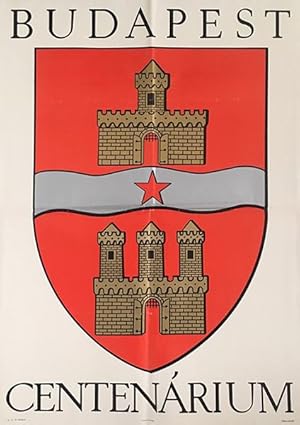
Paper, offset lithography. Condition: Fine, fold marks, light wear. Size: A1 1 Sheet (cca. 84 x 59 cm). Budapest Centenary is a 1972 1973 Hungarian vintage event poster Budapest is the capital and the most populous city of Hungary and one of the largest cities in the European Union With an estimated 2016 population of 1 752 704…distributed over a land area of about 525 square kilometres 203 square miles Budapest is also one of the most densely populated major cities in the EU Budapest is both a city and county and forms the centre of the Budapest metropolitan area which has an area of 7 626 square kilometres 2 944 square miles and a population of 3 303 786 comprising 33 percent of the population of Hungary Budapest is a leading global city with strengths in commerce finance media art fashion research technology education and entertainment Over 40 colleges and universities are located in Budapest including the E tv s Lor nd University Semmelweis University and Budapest University of Technology and Economics which have been ranked among the top 500 in the world Opened in 1896 the city s subway system the Budapest Metro serves 1 27 million while the Budapest Tram Network serves 1 08 million passengers daily Budapest ranked as the most liveable Central and Eastern European city on EIU s quality of life index The history of Budapest began with Aquincum originally a Celtic settlement that became the Roman capital of Lower Pannonia Hungarians arrived in the territory in the 9th century Their first settlement was pillaged by the Mongols in 1241 The re established town became one of the centres of Renaissance humanist culture by the 15th century Following the Battle of Moh cs and nearly 150 years of Ottoman rule the region entered a new age of prosperity and Budapest became a global city with the unification of Buda and buda on the west bank with Pest on the east bank on November 17 1873 Budapest also became the co capital of the Austro Hungarian Empire a great power that dissolved in 1918 following World War I The city was the focal point of the Hungarian Revolution of 1848 the Battle of Budapest in 1945 and the Hungarian Revolution of 1956 Budapest is cited as one of the most beautiful cities in Europe ranked as the world s second best city by Cond Nast Traveler and Europe s 7th most idyllic place to live by Forbes Among Budapest s important museums and cultural institutions the most visited art museum is the Museum of Fine Arts which is noted for one of the largest collections of all periods of European art and comprises more than 100 000 pieces Further famous cultural institutions are the Hungarian National Museum House of Terror Franz Liszt Academy of Music Hungarian State Opera House and National Sz ch nyi Library The central area of the city along the Danube River is classified as a UNESCO World Heritage Site and has many notable monuments including the Hungarian Parliament Buda Castle Fisherman s Bastion Gresham Palace Sz chenyi Chain Bridge Matthias Church and the Liberty Statue Another famous landmarks include Andr ssy Avenue St Stephen s Basilica Heroes Square the Great Market Hall the Nyugati Railway Station built by the Eiffel Company of Paris in 1877 and the second oldest metro line in the world the Millennium Underground Railway The city also has around 80 geothermal springs the largest thermal water cave system second largest synagogue and third largest Parliament building in the world Budapest attracts 4 4 million international tourists per year making it the 25th most popular city in the world and the 6th in Europe source wikipedia org.
