
Buffle Headed Duck (2 results)
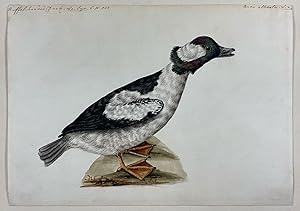
Published by [London 1790
- Softcover
- Art Print
Seller: Donald A. Heald Rare Books (ABAA), New York, NY, U.S.A.Donald A. Heald Rare Books (ABAA)
Contact seller5-star sellerCondition: Used
US$ 12,500.00
US$ 25.00 shippingShips within U.S.A.Quantity: 1 available
Watercolour on laid paper. Unsigned, attributed to Sarah Stone. Annotated, "Lyn. 6 p.533.anas albeola, Lin." along the top edge. Sarah Stone was a prolific natural history painter who was active in London from 1777 to 1806, known for her exquisite brushwork, adept use of color, and mastery across a diverse array of subjects. Her… primary patron was Sir Ashton Lever, for whom she diligently documented an extensive collection of ornithological, zoological, and ethnographical specimens. Ornithological subjects held a special place in Stone's oeuvre, constituting the majority of her known works, with her initial studies dating back to 1777 when she was just seventeen. Stone's meticulous attention to detail is evident in her preference for sized paper, an unconventional practice in British painting at the time, and her use of exceptionally fine brush strokes, sometimes employing brushes with only one or two hairs for the lightest feathers. Her association with the Leverian Museum, which changed ownership in 1786, persisted through the 1780s under James Parkinson. Stone's reputation soared, leading to her pivotal role in illustrating John White's Journal of a Voyage to NSW (1790), establishing her as one of the era's premier natural history painters. Despite limited records after her marriage in 1789, evidence suggests that Stone continued to contribute to prestigious projects, including bespoke artworks for affluent private collectors. Her work is celebrated today for its grace, precision, and significant contributions to the understanding of 18th-century natural history. The contemporary notations on Stone's ornithological drawings contain important information about each subject. The annotations, in many cases, include a citation corresponding to the volume and page number in John Latham's General Synopsis (published between 1781 and 1785) as well as a citation in Latin, corresponding to the subject's Linnaean classification at the time. The present image is annotated, "Lyn. 6 p.533.anas albeola, Lin." Though the species is still known today as the Bufflehead, it has been reassigned to a different genus, giving it a scientific name Bucephala albeola. The Bufflehead is migratory and most of them winter on the east and west coasts of North America and the southern United States. Because of their striking plumage, highly active nature, and proximity to humans on waterfront properties, buffleheads are one of the most popular birds amongst bird watchers. Jackson, Christine E. Sarah Stone. Natural Curiosities from the New Worlds. (London: Merrell Holberton and the Natural History Museum, London, 1998), pp.9-36;138.
 More images
Published by Charles Scribner and Sons, New York 1877
- Signed
- Art Print
Seller: Donald A. Heald Rare Books (ABAA), New York, NY, U.S.A.Donald A. Heald Rare Books (ABAA)
Contact seller5-star sellerOriginal watercolor on paper, signed "A. Pope Jr." in lower right corner, framed together with a chromolithograph of the same scene, in a gold-leaf wooden frame with a French washline mat. Image size: (13 x 19 inches). Framed size: (22 1/2 x 28 inches). A handsome watercolor of two buffle-headed ducks framed with a chromolithogr…aph of the same, executed by the paragon of American sporting art Alexander Pope Jr. for his 1878 print portfolio "Upland Game Birds and Water Fowl of the United States." Alexander Pope Jr. is the quintessential American sporting artist of animal and still-life paintings. Born in Dorchester, Massachusetts, in 1849, with deep roots in the Boston area that could be traced back to the Mayflower, Pope grew up working for his father's lumber business and used its spare wood for carving animal figures. He later found acclaim for these wooden carvings: Czar Alexander III of Russia owned two of them. Pope briefly studied sculpture under William Copley and Walter Rimmer, but he taught himself to paint. He was an avid outdoorsman, a member of fly-fishing and shooting clubs, who, according to Alfred Frankenstein, was of the "back-slapping, club-going variety who spent his entire life in and around Boston." In 1878 he published an important portfolio of chromolithographs after his watercolors: Upland Game Birds and Water Fowl of the United States, from which this watercolor and print of two ducks comes. In 1882, his second portfolio, Celebrated Dogs of America, Imported and Native, would follow. Pope was a member of the Copley Society of Art in Boston and his artwork is represented in major American art institutions such as the Metropolitan Museum of Art and the National Museum of Wildlife Art. The plate here was accompanied by an Ernest Ignersoll text in Pope's Upland Game Birds and Water Fowl of the United States, in which is the following description of the Buffle-Headed Duck: "As wary as most of its kind, this little duck is one of the most difficult to kill [.] since it is a rapid and accomplished swimmer, a very expert diver, and in flight is noted for its great velocity. They do not set their wings back and stop their headway before alighting, as do most wild-fowl, but plump down, splashing the water on all sides, and when the water is smooth, often slide along on its surface a considerable distance. To get a shot at one of them requires experience and the utmost caution, unless the circumstances be of the most favorable description." Pope, Upland Game Birds and Water Fowl of the United States, 1878, plate XIV.

