

Order Total (1 Item Items):
Shipping Destination:

Calculated Risks, First Edition (14 results)
Skip to main search results
Search filters
Product Type
- All Product Types
- Books (14)
- Magazines & Periodicals (No further results match this refinement)
- Comics (No further results match this refinement)
- Sheet Music (No further results match this refinement)
- Art, Prints & Posters (No further results match this refinement)
- Photographs (No further results match this refinement)
- Maps (No further results match this refinement)
- Manuscripts & Paper Collectibles (No further results match this refinement)
Condition Learn more
- New (4)
- As New, Fine or Near Fine (6)
- Very Good or Good (3)
- Fair or Poor (No further results match this refinement)
- As Described (1)
Binding
Collectible Attributes
- First Edition (14)
- Signed (No further results match this refinement)
- Dust Jacket (5)
- Seller-Supplied Images (5)
- Not Print on Demand (12)
Language (2)
Free Shipping
Seller Location
Seller Rating
-
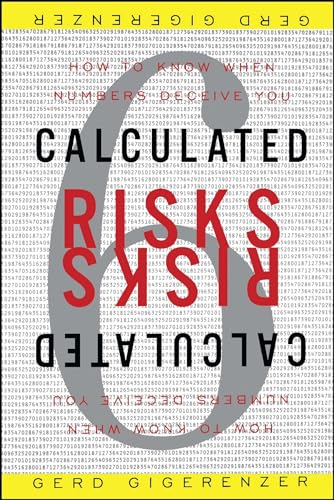
Calculated Risks: How to Know When Numbers Deceive You
First Edition
paperback. Condition: Good. 1st Edition. Ships in a BOX from Central Missouri! May not include working access code. Will not include dust jacket. Has used sticker(s) and some writing and/or highlighting. UPS shipping for most packages, (Priority Mail for AK/HI/APO/PO Boxes).
-

Mass Market Paperback. Condition: Fine. First Edition; First Printing. Full number line.; 448 pages.
-
Calculated Risks: How to Know When Numbers Deceive You
First Edition
paperback. Condition: Good. 1st Edition. Ships in a BOX from Central Missouri! May not include working access code. Will not include dust jacket. Has used sticker(s) and some writing or highlighting. Ships same or next business day. UPS shipping for most packages, (Priority Mail for AK/HI/APO/PO Boxes).
-
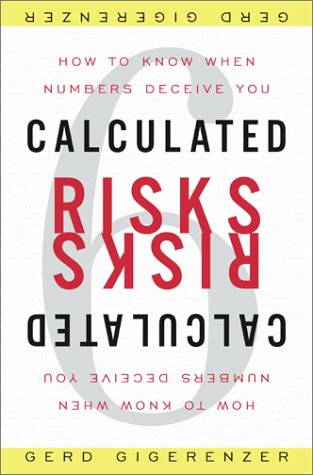
Calculated Risks: How to Know When Numbers Deceive You
Language: English
Published by Simon & Schuster, New York, 2002
ISBN 10: 0743205561 ISBN 13: 9780743205566
First Edition
Hardcover. Condition: Near Fine. Dust Jacket Condition: Very Good. First Edition. Clean and tight and square. Appears unread. Publisher's book review included. The dust jacket has a little shelfwear and is in new mylar. Size: 8vo - over 7¾" - 9¾" tall. Statistics and Probability.
-
Calculated Risks : How to Know When Numbers Deceive You
Language: English
Published by Simon & Schuster, New York, NY, U.S.A., 2002
ISBN 10: 0743205561 ISBN 13: 9780743205566
First Edition
Hardcover. Condition: New. Dust Jacket Condition: New. First. This is a new hardcover review copy in a mylar protected DJ, review slip laid in.
-
Calculated Risks: How to Know When Numbers Deceive You
First Edition
Hardcover. Condition: Like New. First Edition. First Edition, First Printing. Not price-clipped. Published by Simon and Schuster, 2002. Octavo. Hardcover. Book is like new. Dust jacket is like new.100% positive feedback. 30 day money back guarantee. NEXT DAY SHIPPING! Excellent customer service. Please email with any questions. All books packed carefully and ship with free delivery confirmation/tracking. All books come with free bookmarks. Ships from Sag Harbor, New York.
-
Calculated Risks: Understanding the Toxicity of Chemicals in Our Environment
Language: English
Published by Cambridge University Press, 1994
ISBN 10: 0521423317 ISBN 13: 9780521423311
First Edition
Trade Paperback. Condition: Like New. First Edition. First Edition, First Printing. Published by Cambridge, 1995. Octavo. Paperback. Book is like new. 100% positive feedback. 30 day money back guarantee. NEXT DAY SHIPPING! Excellent customer service. Please email with any questions or if you would like a photo. All books packed carefully and ship with free delivery confirmation/tracking. All books come with free bookmarks. Ships from Sag Harbor, New York.
-
CALCULATED RISKS: HOW to KNOW when NUMBERS DECEIVE YOU *
Language: English
Published by SIMON & SCHUSTER, * * * * *, 2002
ISBN 10: 0743205561 ISBN 13: 9780743205566
First Edition
Hardcover. Condition: Fine. Dust Jacket Condition: Fine. Lisa Chovnick, Designed by. B00K: Fine/, 2002 (illustrator). 1st Edition. B00K: Fine/, $35.16 0743205561 CALCULATED RISKS: HOW to KNOW when NUMBERS DECEIVE YOU * GIGERENZER, Gerd Lisa Chovnick, Designed by. SIMON & SCHUSTER 2002 1sT Edition, 1sT Printing D/j + H/c. Red Top And Bottom Rectangles With Silver And 0ff~White Spine And Title In 0ff~White, Black And Silver Letters, Dust Jacket: Fine/, Slight Shelf, Edge And Corner Wear. Front Interior Flap, $25.00. Hard Cover B00K: Fine/, Slight Shelf, Edge And Corner Wear. 310 Numbered Pages, Printed On 0ff~White Paper, Appear To Be Lightly Viewed, In Fine/As New/ Condition That Are Clean And Tight To The Spine. D/j: None. = No Odors, No Writing, No Names, No Rippling, Not Stuck Together, No Book Plate, Not X~Library, No Remainder Or Other Marks. Description Applies To This B00K, Only. = This B00K, Is Hard To Find, Will Be Packaged And Shipped = Carefully, To Avoid Shipping Damage And Will Make It, An Excellent Addition To Your Own Personal Library Collection, Or As A Gift, For The Discriminating Reader / Collector. = WORLD WIDE SHIPPING, AVAILABLE. =.
-
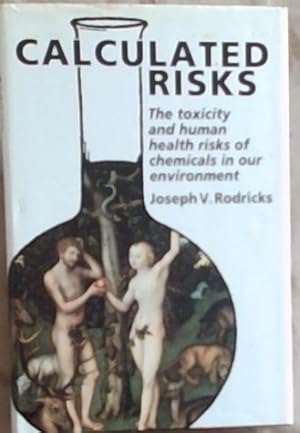
Calculated Risks: Understanding the Toxicity and human health risks of Chemicals in our Environment
Language: English
Published by Cambridge University Press, 1992
ISBN 10: 0521411912 ISBN 13: 9780521411912
First Edition
Hardcover. Condition: Very Good. Dust Jacket Condition: Very Good. First Edition. light shelf wear on the jacket. ownership stamp and inscriptions. all pages are intact and presentable. very good copy. [SK]. Our orders are shipped using tracked courier delivery services.
-

Calculated Risks. The toxicity and human health risks of chemicals in our environment.
Published by Cambridge; Uniersity Press, 1992
Seller: Richard Roberts Bookseller., KILMARNOCK, United Kingdom
Seller rating 5 out of 5 stars

First Edition
US$ 30.60
US$ 21.12 shipping
Ships from United Kingdom to U.S.A.Quantity: 1 available
Add to basket1st. Edn. pp. xxvi, 256. A fine hardback copy in a fine unclipped colour pictorial wrapper.
-

Calculated Risks (Paperback)
First Edition Print on Demand
Paperback. Condition: new. Paperback. At the beginning of the twentieth century, H. G. Wells predicted that statistical thinking would be as necessary for citizenship in a technological world as the ability to read and write. But in the twenty-first century, we are often overwhelmed by a baffling array of percentages and probabilities as we try to navigate in a world dominated by statistics. Cognitive scientist Gerd Gigerenzer says that because we haven't learned statistical thinking, we don't understand risk and uncertainty. In order to assess risk -- everything from the risk of an automobile accident to the certainty or uncertainty of some common medical screening tests -- we need a basic understanding of statistics. Astonishingly, doctors and lawyers don't understand risk any better than anyone else. Gigerenzer reports a study in which doctors were told the results of breast cancer screenings and then were asked to explain the risks of contracting breast cancer to a woman who received a positive result from a screening. The actual risk was small because the test gives many false positives. But nearly every physician in the study overstated the risk. Yet many people will have to make important health decisions based on such information and the interpretation of that information by their doctors. Gigerenzer explains that a major obstacle to our understanding of numbers is that we live with an illusion of certainty. Many of us believe that HIV tests, DNA fingerprinting, and the growing number of genetic tests are absolutely certain. But even DNA evidence can produce spurious matches. We cling to our illusion of certainty because the medical industry, insurance companies, investment advisers, and election campaigns have become purveyors of certainty, marketing it like a commodity. To avoid confusion, says Gigerenzer, we should rely on more understandable representations of risk, such as absolute risks. For example, it is said that a mammography screening reduces the risk of breast cancer by 25 percent. But in absolute risks, that means that out of every 1,000 women who do not participate in screening, 4 will die; while out of 1,000 women who do, 3 will die. A 25 percent risk reduction sounds much more significant than a benefit that 1 out of 1,000 women will reap. This eye-opening book explains how we can overcome our ignorance of numbers and better understand the risks we may be taking with our money, our health, and our lives. This item is printed on demand. Shipping may be from multiple locations in the US or from the UK, depending on stock availability.
-

Calculated Risks: Highly Radioactive Waste and Homeland Security
Seller: Kennys Bookshop and Art Galleries Ltd., Galway, GY, Ireland
Seller rating 5 out of 5 stars
First Edition
US$ 288.79
US$ 12.03 shipping
Ships from Ireland to U.S.A.Quantity: Over 20 available
Add to basketCondition: New. Examines one of the increasingly pressing problems for US homeland security: the storage and management of radioactive waste. This book explores nuclear waste problems through the broader lens of federal, state and local government and the resultant constraints on policy that emerge within the American system. Series Editor(s): Lansford, Professor Tom; Payne, Professor Tom. Series: Homeland Security. Num Pages: 218 pages, Illustrations. BIC Classification: 1KBB; GTJ; JPS; TQSR3. Category: (UP) Postgraduate, Research & Scholarly; (UU) Undergraduate. Dimension: 234 x 156 x 14. Weight in Grams: 462. . 2007. 1st Edition. hardcover. . . . .
-

Calculated Risks
Published by The 23rd Twig of the United Hospital, Port Chester, New York, 1965
Seller: Between the Covers-Rare Books, Inc. ABAA, Gloucester City, NJ, U.S.A.
Association Member: ABAA ESA ILAB IOBA
Seller rating 5 out of 5 stars
First Edition
Softcover. Condition: Near Fine. First edition. Oblong spiral bound wrappers. 144pp. Black and white illustrations. Toning and slight edgewear else near fine.
-
Calculated Risks (Paperback)
First Edition Print on Demand
US$ 35.34
US$ 48.85 shipping
Ships from United Kingdom to U.S.A.Quantity: 1 available
Add to basketPaperback. Condition: new. Paperback. At the beginning of the twentieth century, H. G. Wells predicted that statistical thinking would be as necessary for citizenship in a technological world as the ability to read and write. But in the twenty-first century, we are often overwhelmed by a baffling array of percentages and probabilities as we try to navigate in a world dominated by statistics. Cognitive scientist Gerd Gigerenzer says that because we haven't learned statistical thinking, we don't understand risk and uncertainty. In order to assess risk -- everything from the risk of an automobile accident to the certainty or uncertainty of some common medical screening tests -- we need a basic understanding of statistics. Astonishingly, doctors and lawyers don't understand risk any better than anyone else. Gigerenzer reports a study in which doctors were told the results of breast cancer screenings and then were asked to explain the risks of contracting breast cancer to a woman who received a positive result from a screening. The actual risk was small because the test gives many false positives. But nearly every physician in the study overstated the risk. Yet many people will have to make important health decisions based on such information and the interpretation of that information by their doctors. Gigerenzer explains that a major obstacle to our understanding of numbers is that we live with an illusion of certainty. Many of us believe that HIV tests, DNA fingerprinting, and the growing number of genetic tests are absolutely certain. But even DNA evidence can produce spurious matches. We cling to our illusion of certainty because the medical industry, insurance companies, investment advisers, and election campaigns have become purveyors of certainty, marketing it like a commodity. To avoid confusion, says Gigerenzer, we should rely on more understandable representations of risk, such as absolute risks. For example, it is said that a mammography screening reduces the risk of breast cancer by 25 percent. But in absolute risks, that means that out of every 1,000 women who do not participate in screening, 4 will die; while out of 1,000 women who do, 3 will die. A 25 percent risk reduction sounds much more significant than a benefit that 1 out of 1,000 women will reap. This eye-opening book explains how we can overcome our ignorance of numbers and better understand the risks we may be taking with our money, our health, and our lives. This item is printed on demand. Shipping may be from our UK warehouse or from our Australian or US warehouses, depending on stock availability.


