
Carotide: First Edition (6 results)
 More images
Language: French
Published by Pierre André Benoit, Alès
- Softcover
- First Edition
Seller: Librairie-Galerie Emmanuel Hutin, Paris, FranceLibrairie-Galerie Emmanuel Hutin
Contact seller5-star sellerCondition: Used - Fine
US$ 1,007.40
US$ 13.23 shippingShips from France to U.S.A.Quantity: 1 available
Brochés. Condition: Très bon exemplaire. Edtition originale. COLLECTION COMPLETE imprimée sur papier de différentes couleurs, du numéro I, novembre 1956 au numéro VII, septembre 1957. Textes de Francis Picabia, Pierre André Benoit, Saint-Jean de la Croix, René Char, André Frénaud, Federico Garcia Lorca, Alain Borne, Louis Émié,…Jean Lebrau, Camille Bryen, Gaston Puel, Tristan Tzara et Raymond Queneau. Chaque numéro est successivement illustré d'un dessin de Francis Picabia, Georges Braque, Jean Hugo, Camille Bryen, Joan Miro, Pablo Picasso et Léopold Survage. Tirage unique à 100 exemplaires. (Ref. Livres Réalisés par P. A. Benoit 304). > Les numéros sont rassemblés dans une emboîtage toilé peint avec pi-ce de titre sur le premier plat et au dos.
 More images
Language: French
Published by Paris 1937
- First Edition
Seller: Jean-Pierre AUBERT, Quiberon, , FranceJean-Pierre AUBERT
Contact seller5-star sellerCondition: Used - Very good
US$ 64.00
US$ 41.42 shippingShips from France to U.S.A.Quantity: 1 available
Pas de couverture. Condition: Assez bon. Edition originale. 1 fascicule in-folio (34 x 25 cm) replié en 2 (25 x 17 cm), paginé 971-986, correspondant au cahier central de ce numéro de La Presse Médicale sans le supplément "détachable" (comportant la manchette de la revue, le sommaire, la revue des journaux), extrait d'un volume…ayant été dérelié ; dos renforcé ; assez bon état. Édition originale rare. Cet article novateur de Moniz et al. occupe les pages pp. 977-980 de ce fascicule ; il est illustré de 4 figures. Il n'a pas fait l'objet d'un tirage à part. Antonio Egas Moniz (1874-1955), titulaire de la chaire de neurologie à la Faculté de médecine de Lisbonne, avait imaginé et développé la technique d'angiographie cérébrale en 1927. Lima était neurochirurgien. Les auteurs posent ici les fondements anatomiques et pathologiques de l'angiographie carotidienne. REFERENCES : Lowis GW & Minagar A: The neglected research of Egas Moniz of internal carotid artery (ICA) occlusion, J Hist Neurosci, 2003, 12(3), 286-291: "Egas Moniz is generally remembered for having discovered cerebral angiography in 1927, and having introduced lobotomy as a form of treatment for mental illness in 1935. Less well known is his pioneering research on occlusive cerebrovascular disease, namely internal carotid artery (ICA) occlusion, as documented by cerebral angiography. It is our contention that the medical community has, until recently, largely overlooked this research." ; Taveras JM & Wood EH: Diagnostic neuroradiology, p. 543: "Egas Moniz was not only the originator of carotid angiography, but with his colleagues, Almeida Lima and others, he laid down the anatomic and pathologic foundations of the method."; Moore WS: Vascular and Endovascular Surgery, p. 328: "The next major step in the evolution of the management of extracranial cerebrovascular disease [after the publication of Hunt, in 1914] came with the development of carotid angiography by Moniz in 1927. By 1937, Moniz and colleagues had described four cases of internal carotid occlusion diagnosed by angiography. Despite these early observations, the medical world was still slow to appreciate the relationship between extracranial cerebrovascular disease and cerebral symptoms."; Ferro JM: Egas Moniz and internal carotid occlusion, Arch Neurol. 1988, 45(5), 563-564: "In 1937 he [Moniz] originally described internal carotid occlusion as documented by angiography. His observations and comments on the clinical, pathogenic, and therapeutic aspects of internal carotid thrombosis are reviewed."; Liapis CD et al.: Vascular Surgery, p. 137 : "With the introduction of angiography, Egas Moniz provided the first demonstration in vivo of occlusion of the internal carotid and stroke and also described the correlation between transient strokes and carotid bifurcation stenosis (1937). His observations were confirmed in subsequent studies using angiography, although the established arteriographic technique routinely practiced often failed to visualize the extracranial vessels." ; Alexander JJ et al.: Outcome Analysis of Carotid Artery Occlusion, Vasc Endovascular Surg., 2007, 41(5), 409-416 ; Hughes JT & Brownell B: Traumatic thrombosis of the internal carotid artery in the neck, J. Neurol. Neurosurg. Psychiat., 1968, 31, 307-314; Fein JM & Flamm ES : Cerebrovascular Surgery, Volume 1, p. 5; Friedman SG: A History of Vascular Surgery, pp. 93-96 ; Berguer R & Kieffer E : Surgery of the Arteries to the Head, p. 2; Heros RC & Morcos JJ: Cerebrovascular surgery: past, present, and future, Neurosurgery, 2000, 47(5), 1007-1033.

Published by Alès, (PAB), juin 1957. 1957
- First Edition
Seller: Daniel Thierstein, Bern, SwitzerlandDaniel Thierstein
Contact seller4-star sellerCondition: Used
US$ 173.92
US$ 40.27 shippingShips from Switzerland to U.S.A.Quantity: 1 available
12°. 12 p. Broché. Tirage: 100 Exemplaires. textes de Gederico Garcia Lorca, René Char, P.A.Benoit et un dessin de Pablo Picasso. Sprache: französisch.

Published by Alès, (PAB), mars 1957. 1957
- First Edition
Seller: Daniel Thierstein, Bern, SwitzerlandDaniel Thierstein
Contact seller4-star sellerCondition: Used
US$ 173.92
US$ 40.27 shippingShips from Switzerland to U.S.A.Quantity: 1 available
12°. 12 p. Broché. Tirage: 100 Exemplaires. 2 Poèmes (en prose) de René Char, un dessins de Joan Miro. Sprache: n.
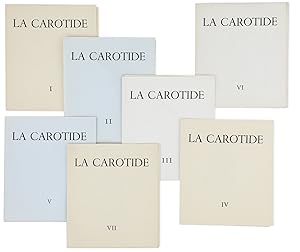
Published by PAB, Alès 1956
- First Edition
Seller: Librairie le pas sage, PARIS, , FranceLibrairie le pas sage
Contact seller5-star sellerCondition: Used - Near fine
US$ 1,066.66
US$ 46.03 shippingShips from France to U.S.A.Quantity: 1 available
Pas de couverture. Condition: Bon. Edition originale. Alès, PAB, Sans date [1956]. Pas de couverture, non paginé [4 feuillets par numéro]. Plaquettes sur vélin blanc, bleu ou crème ÉDITION ORIGINALE et collection complète des sept fascicules publiés à Alès par Pierre-André Benoit. Tirage limité à 100 exemplaires pour les numéros… IV à VII, non précisé pour les numéros I à III. Textes de Francis Picabia, PAB, Saint-Jean de la Croix, René Char, André Frénaud, Frederico Garcia Lorca, Alain Borne, Louis Emié, Jean Lebrau, Camille Bryen, Gaston Puel, Tristan Tzara, Raymond Queneau. Chaque plaquette comporte une illustration, reproduite en noir en frontispice, de Francis Picabia, Georges Braque, Jean Hugo, Camille Bryen, Joan Miró, Pablo Picasso, Léopold Survage. Bel ensemble. Bryen_Camille / Miro, Joan / Picasso, Pablo (illustrator).

- First Edition
Seller: Antiq. F.-D. Söhn - Medicusbooks.Com, Marburg, , GermanyAntiq. F.-D. Söhn - Medicusbooks.Com
Contact seller5-star sellerCondition: Used
US$ 183.70
US$ 41.94 shippingShips from Germany to U.S.A.Quantity: 1 available
Bull. Scienze Mediche (3), 5+6. - Bologna, Tipografia della Volpe, 1844, 8°, 437, (3) pp., 1 gefalt. lith. Taf.; 427, (1) pp., 1 lith. Taf., Halbledereinband d.Zt.; minimal fleckig; feines Expl. First Edition! Francesco Rizzoli (11 July 1809 - 24 May 1880) was an Italian politician, surgeon and physician, considered one of the f…athers of modern orthopedics. Following an intense and productive postgraduate training he obtained a position of assistant to Paolo Baroni, Rizzoli's brother in law, who was a professor at the University and director of the hospital of the Abbandonati. When Baroni became chief physician of Pope Gregory XVI in Rome, in 1842 Rizzoli was appointed chief surgeon of the hospital. From 1838 to 1849 he was substitute professor of obstetrics, when he was awarded the chair of clinical surgery that he held until 1865. In the following years he visited the surgical institute of Joseph-François Malgaigne in Paris. On his return he repeatedly demanded improved sanitation and teaching conditions at the hospital, so differences arose between him and the ministry, and the professor was dismissed. "Rizzoli was Professor of Surgery at Bologna and an outstanding operative surgeon. He introduced a compressor for aneurysms, a tracheotome, cystotome, lithotrite, enterotome, osteoclast, and performed acupressure as early as 1854." Garrison & Morton.


