Order Total (1 Item Items):
Shipping Destination:

Cathode Rays by Thomson, First Edition (7 results)
Skip to main search results
Search filters
Product Type
- All Product Types
- Books (7)
- Magazines & Periodicals (No further results match this refinement)
- Comics (No further results match this refinement)
- Sheet Music (No further results match this refinement)
- Art, Prints & Posters (No further results match this refinement)
- Photographs (No further results match this refinement)
- Maps (No further results match this refinement)
- Manuscripts & Paper Collectibles (No further results match this refinement)
Condition Learn more
- New (No further results match this refinement)
- As New, Fine or Near Fine (No further results match this refinement)
- Very Good or Good (1)
- Fair or Poor (No further results match this refinement)
- As Described (6)
Binding
Collectible Attributes
- First Edition (7)
- Signed (No further results match this refinement)
- Dust Jacket (No further results match this refinement)
- Seller-Supplied Images (6)
- Not Print on Demand (7)
Language (2)
Price
- Any Price
- Under US$ 25 (No further results match this refinement)
- US$ 25 to US$ 50 (No further results match this refinement)
- Over US$ 50
Free Shipping
- Free Shipping to U.S.A. (No further results match this refinement)
Seller Location
Seller Rating
-
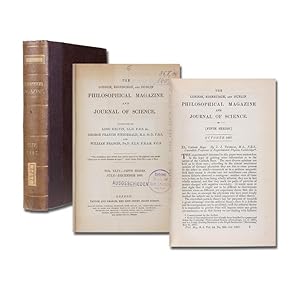
Cathode rays. SS. 293-316 mit 6 Abbildungen. In: The London, Edinburgh, and Dublin Philosophical Magazine and Journal of Science. 5th series. Vol. 44.
Language: English
Published by London Taylor & Francis, 1897
Seller: Antiquariat Gerhard Gruber, Heilbronn, Germany
Seller rating 4 out of 5 stars

First Edition
(22 x 14 cm). VII, 520 S. Mit zahlreichen Abbildungen und 5 (4 gefalteten) Tafeln. Halbleinwandband der Zeit. Erste Ausgabe. - Thomson gelingt 1897 die Aufklärung des Rätsels um die Natur der Kathodenstrahlen. Er kann nachweisen, dass die Kathodenstrahlen aus negativ geladenen Teilchen bestehen, deren Masse 1800mal kleiner ist als die des Wasserstoffatoms. Er wird damit zum Entdecker des Elektrons, das er aber bis 1907 als "Korpuskel" bezeichnet. "Damit hatte er die Physik revolutioniert. Es gab kein 'unzerstörbares' Atom mehr und es fing an, wahrscheinlich zu werden, daß der allgemeine Baustoff aller Materie eine Form von Energie war. Thomsons Entdeckung stellte fast jedem Zweig der Physik neue Aufgaben und öffnete neue Forschungsgebiete" (PMM). Den Nobelpreis für Physik erhält er 1906 allerdings für seine Untersuchungen zur elektrischen Leitung durch Gase. - Titel etwas gebräunt und gestempelt. Rücken leicht ausgebleicht, sonst sauber und wohlerhalten. - DSB 13, 371, 26; PMM 386 (a); Dibner 165.
-

On the theory of the conduction of electricity through gases by charged ions. WITH: SUTHERLAND, William (1859-1911). Cathode, Lenard, and Rontgen rays. WITH: THOMSON, J. J. Note on Mr. Sutherland's paper on the cathode rays. In: The London, Edinburgh, and Dublin Philosophical Magazine and Journal of Science, Fifth Series, Volume XLVII, January - June, 1899.
Published by Taylor and Francis, 1899., London:, 1899
Seller: Jeff Weber Rare Books, Neuchatel, NEUCH, Switzerland
Seller rating 5 out of 5 stars

First Edition
8vo. Pages (253)-268; 269-284; 415-416. [Entire volume: vii, [1], 580 pp.] 4 figs. in the first paper. Contemporary quarter morocco, morocco corners, marbled boards, raised bands, gilt spine; lightly rubbed. Ex library bookplate of The University of Chicago Library and perforated stamp on title. Very good. FIRST EDITION of Thomson's "pioneering theory of the conduction of electricity in gases." DSB. This paper reports on the experimental work that formed the basis of Thomson's famous Conduction of electricity through gases (Cambridge, 1903) which is cited in Dibner, PMM, Haskell Norman Library and others. "Thomson was President of the Royal Society from 1915 to 1920 and Noble Prize Winner in Physics in 1906. He made the Cavendish Laboratory at Cambridge the greatest experimental school in physics ever known and was succeeded there by his pupil Rutherford." PMM. DSB, XIII, p. 364. See: Dibner, Heralds of science, rev. ed., 165; Haskell Norman Library 2076; Printing and the mind of man 386.
-
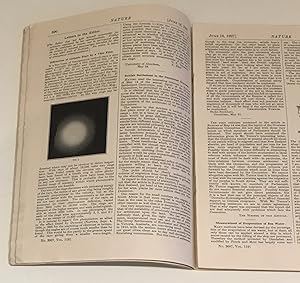
Diffraction of Cathode Rays by a Thin Film, in Nature, Vol. 119, No. 3007, June 18, 1927. WAVE-PARTICLE DUALITY: NOBEL PRIZE 1937
Published by London: Macmillan, 1927
Seller: Landmarks of Science Books, Richmond, United Kingdom
Seller rating 4 out of 5 stars
First Edition
US$ 681.41
US$ 39.69 shipping
Ships from United Kingdom to U.S.A.Quantity: 1 available
Add to basketSoft cover. Condition: Very Good. 1st Edition. First edition, complete journal issue in original printed wrappers, of Thomson and Reid's experimental confirmation of de Broglie's wave-particle duality, carried out independently of similar experiments by Davisson and Germer at Bell labs in New York. Davisson and Thomson shared the Nobel Prize for Physics in 1937, for the "experimental discovery of the diffraction of electrons by crystals." Born in 1892, the son of the physicist Sir J. J. Thomson, G. P. Thomson studied at Trinity College, Cambridge. Following a post at Cambridge, G. P. became Professor of Natural Philosophy at the University of Aberdeen in 1922 and remained there until 1930. It was at Aberdeen that G. P. began to carry out experiments revealing the phenomena of electron diffraction, assisted by one of his students, Alexander Reid. In this paper, Reid and Thomson describe the rings formed when a beam of cathode rays was sent at normal incidence through a thin film of celluloid and struck a photograph plate placed some distance behind the film. These were attributed to a diffraction of the cathode rays by the film, the cathode rays behaving as waves of wave-length h/mv according to de Broglie's theory of wave mechanics, and regularities in the structure of the film, or in the size of the molecules, making it behave as a kind of diffraction grating (Abstract). "Thomson arrived at his discovery in Aberdeen at about the same time as Davisson in New York. They announced their discoveries simultaneously in the same volume 119 of the journal Nature. However, the experimental approach and the manner in which the diffraction was observed were completely different in the two camps. Davisson's discovery was accidental, whereas Thomson, inspired by the theory of de Broglie, set out from the start to prove the wave nature of the electron . . . Quite opposite to the approach used by Davisson and Germer, who measured a beam of low energy electrons (54 eV) as these deflected off the atomic plane of the crystal surface, Thomson and Reid used a beam of relatively high-energy electrons (20,000 to 60,000 eV), which would pass directly through the crystalline lattice of thin metal foils . . . Thomson thus demonstrated the de Broglie matter wave. The materials tested by Thomson were polycrystalline meaning that the substance is built up of many crystals having different orientations, such as a powdered sample of single crystal grains. The effect of X-ray or electron diffraction of polycrystalline materials is the production of a diffraction pattern consisting of several concentric rings of various diameters about the central spot produced by the electron beam" (L'Annunziata, Radioactivity: Introduction and History, From the Quantum to Quarks, pp. 431-2). 8vo, pp. cxciii-cxcvi, 881-912, cxcvii-cc. Complete journal issue in original printed wrappers (a little soiled, corners a little worn, library ink stamp in upper margin of front wrapper).
-
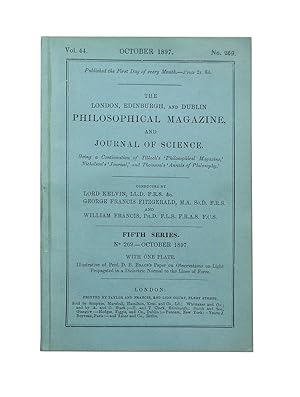
Cathode Rays: in The London, Edinburgh, and Dublin Philosophical Magazine and Journal of Science. Fifth Series. No 269- October 1897
Published by Taylor and Francis, London, 1897
Seller: Heritage Book Shop, ABAA, Beverly Hills, CA, U.S.A.
Seller rating 5 out of 5 stars
First Edition
First Edition. Full Description: THOMSON, Sir Joseph John. Cathode Rays. [In]: The London, Edinburgh, and Dublin Philosophical Magazine and Journal of Science. Being a Continuation of Tilloch's 'Philosophical Magazine,' Nicholson's 'Journal,' and Thomson's 'Annals of Philosophy.' Conducted by Lord Kelvin, LL.D. F.R.S. &c. George Francis Fitzgerald, M.A. Sc.D. F.R.S. and William Francis, Ph.D. F.L.S. F.R.A.S. F.C.S. 'Fifth Series.No 269- October 1897. With one plate. Illustrative of Prof. D.B. Brace's paper on Oberservations on Light Propagated in a Dielectric Normal to the lines of Force. London: Taylor and Francis, October, 1897. First edition. Octavo (8 7/16 x 5 9/16 inches; 215 x 142 mm). 293-368 pp. Thomson's article on Cathode rays comprised pages 293-316 with six black and white line-drawings, some numerical charts and equations. Along this article are eight other articles and one engraved plate. Publisher's original blue printed wrappers, neatly rebacked to style. Edges speckled red. We could find no other copy in the original wrappers at auction. An about fine copy. This was the first of Thomson's papers on the discovery of sub-atomic particles. "It was reserved for J.J. Thomson (knighted in 1908) to discover the true nature of the cathode rays. In April 1897 he gave a public demonstration at one of the Friday evening discourses at the Royal Institute in which he declared that cathode rays are composed of particles of sub-atomic proportions. At this stage, he had been unable to calculate the weight of the particles, but he had measured their rate of charge to mass. The ratio was large, so they must either have a big charge or a small mass. Thomson gave reasons for preferring the latter-from experiments performed by Kenard in particular. If the charge could be calculated, then the mass could be found, since the ratio between the two was known, Thomson eventually succeeded in calculating the charge, by an ingenious adaptation of the 'dust counter' devised by C.T.R. Wilson. Thomson substituted for the dust particles counted by Wilson the cathode-ray particles. By observing variations in their fall in various electric fields he was able to calculate the electric charge of the particles. These experiments, later perfected by Millikan, led to the calculation of the mass of the electron as one eighteen-hundredth of a hydrogen atom, hitherto the lightest known object. Moreover the mass of these 'corpuscles', as Thomson called them, was constant, whatever their origin. That is to say that all forms of matter, no matter how varied their chemical composition, produced cathode rays of uniform make-up. Although he still preferred as late as 1907 'corpuscle' to 'electron' to describe this ultimate particle, Thomson has provided experimental proof of the theoretical speculation of Lorentz. In doing so he had revolutionized the science of physics. The 'indestructible' atom was no more and it began to seem likely that the common constituent of all matter was a form of energy. Thomson's discovery opened up new fields of investigation in almost every branch of physics." (PMM 386). Printing and the Mind of Man 386. HBS 68815. $4,500.
-
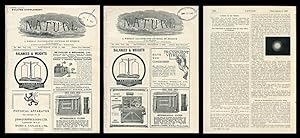
1st Edition. FIRST EDITION IN ORIGINAL WRAPS OF THOMSON & REID'S NOBEL PRIZE WINNING PAPERS "for the experimental discovery of the diffraction of electrons by crystals" (Nobel Prize Portal). The experiments conducted here "beautifully confirmed the [de Broglie's] wave theory" (Lindau Nobel Laureate Portal). Sir George Paget Thomson was born in 1892, the son of the physicist Sir J. J. Thomson. Paget Thomson studied at Cambridge's Trinity College, later working for a year studying atomic structure with his father; this was followed by work at Cavendish Laboratory until WWI. Following a post at Cambridge, Paget Thomson became Professor of Natural Philosophy at the University of Aberdeen. It is at Aberdeen that Paget Thomson began to carry out experiments revealing the phenomena of electron diffraction with thin metal foils and high-voltage electrons. In 1924, the de Broglie hypothesis argued that a wave must be associated with the motion of any material corpuscle. "Reasoning that the effect would be easier to analyze with a solid than with a gaseous target, Thomson asked one of his students, Alexander Reid, to modify an existing apparatus and investigate the scattering of a beam of electrons with energy in the keV range through this celluloid films at normal incidence" (Lindau). In the first paper offered here (June 1927), Reid and Paget Thomson describe "the rings formed when a beam of cathode rays was sent at normal incidence through a thin film of celluloid and struck a photograph plate placed some distance behind the film. These were attributed to a diffraction of the cathode rays by the film, the cathode rays behaving as waves of wave-length h/mv according to de Broglie's theory of wave mechanics, and regularities in the structure of the film, or in the size of the molecules, making it behave as a kind of diffraction grating" (Abstract). In the paper of 1927 December, Paget Thomson (working alone) confirmed and extended his experimentation "to films of gold, aluminium, and of an unknown (probably organic) substance. In particular, the relation that the size of the rings is in all cases inversely as the momentum of the cathode rays is fully confirmed, and the number and size of the rings correspond remarkably with what is to be expected from the known crystalline structure of gold and aluminium, using de Broglie's expression for the wave- length of the cathode rays" (Abstract). "Whereas his father had seen the electron as a particle (and won his Nobel Prize in the process), Paget Thomson demonstrated that it could be diffracted like a wave, a discovery proving the principle of wave-particle duality which had first been posited by de Broglie in the 1920s as what is often dubbed the de Broglie hypothesis" (Strickland, Creators of Quantum Physics, 180). CONDITION & DETAILS: Two issues in original wraps. London: Macmillan. 4to. (10.5 x 7.5 inches; 262 x 188mm). Ex-libris with stamps on front wraps; professionally rebacked at the spine (see scan). Slight wear; bright and clean throughout. Both very good condition.
-
![Seller image for The Scattering of Electrons by a Single Crystal of Nickel [Davisson & Germer, pp. 558-560] WITH Diffraction of Cathode Rays by a Thin Film [Thomson & Reid, p. 890] WITH The Continuous Spectrum of -Rays [Ellis & Wooster, pp. 563-564] WITH Physical Aspects of Quantum Mechanics [Born, pp. 354-357] WITH Supplement to Nature: The Bicentenary of Newton's Death [Bound in pp. 1-100] in Nature 119, 1927 for sale by Atticus Rare Books](https://pictures.abebooks.com/inventory/md/md22444606462.jpg)
The Scattering of Electrons by a Single Crystal of Nickel [Davisson & Germer, pp. 558-560] WITH Diffraction of Cathode Rays by a Thin Film [Thomson & Reid, p. 890] WITH The Continuous Spectrum of -Rays [Ellis & Wooster, pp. 563-564] WITH Physical Aspects of Quantum Mechanics [Born, pp. 354-357] WITH Supplement to Nature: The Bicentenary of Newton's Death [Bound in pp. 1-100] in Nature 119, 1927
Published by Macmillan, London, 1927
First Edition
1st Edition. FIRST EDITIONS OF FOUR VERY IMPORTANT PHYSICS PAPERS, TWO OF WHICH CONFIRMED DE BROGLIE'S HYPOTHESIS ON THE WAVE NATURE OF MATTER. Davisson and Thomson shared the 1937 Nobel Prize in Physics "for the experimental discovery of the diffraction of electrons by crystals" (Nobel Prize Portal). (1) DAVISSON & GERMER'S 1927 confirmation of de Broglie's hypothesis --the first observation of the wave nature of electrons. de Broglie's wave-particle duality hypothesis and this 1927 confirmation were major steps forward in the experimental confirmation of quantum mechanics. Though Davisson's discovery was somewhat "accidental", it is considered the "definitive confirmation of de Broglie's hypothesis" (L'Annunziata, Radioactivity, 428; Brush, Making 20th Century Science, 224). (2) THOMSON & REID's purposefully set out to prove de Broglie's hypothesis, the wave nature of the electron. Together they designed an instrument to observe diffraction effects, specifically using transmission geometry with high-energy electrons (Davisson and Germer had used reflection diffraction geometry with low-energy electrons. (3) ELLIS & WOOSTER here demonstrate that beta decay does not conserve energy (they did not know of the existence of the neutrino at the time). "By measuring the average energy of disintegration of electrons in the beta decay of radium E", Ellis and Wooster "firmly established that the energy spectrum of electrons emitted in beta decay was continuous" (Hon, Going Amiss in Experimental Research, 227). (4) MAX BORN'S first description in English of his revolutionary new probabilistic interpretation of quantum mechanics. In 1926, Born published, in German, a series of papers entitled "Zur Quantenmechanik der Stoßvorgänge". The papers presented, explained, and developed Born's probability interpretation (also known as the statistical interpretation) for the first time. In this paper, Born explains that work in English for the first time with the additional goal of making "an attempt to understand the physical significance of the quantum theoretical formulae" as a whole (Born, Nature 119, 1927). ALSO INCLUDED: a hundred page "Supplement to Nature: The Bicentenary of Newton's Death" bound in. NOTE THAT WE SEPARATELY OFFER THE 1927 THOMSON & REID PAPER AND THE 1928 THOMSON PAPER ON THE SAME SUBJECT IN ORIGINAL WRAPS. WE ALSO OFFER DE BROGLIE'S SEMINAL PAPER IN BOTH ORIGINAL WRAPS AND BOUND. CONDITION & DETAILS: London: Macmillan. Complete volume. 4to. 10.5 x 8 inches (262 x 200mm). [lix], 948, [100], 4. Ex-libris bearing only minimal markings on the title page and none on the spine. Full, complete volume. Handsomely and professionally rebound in half leather. 5 raised bands at the spine, gilt-ruled. One red morocco label; one black morocco label; both gilt-lettered. Tightly and very solidly bound. Clean and bright throughout. Near fine condition.
-
1st Edition. FIRST EDITION IN ORIGINAL WRAPS OF THOMSON & REID'S NOBEL PRIZE WINNING PAPERS "for the experimental discovery of the diffraction of electrons by crystals" (Nobel Prize Portal). The experiments conducted here "beautifully confirmed the [de Broglie's] wave theory" (Lindau Nobel Laureate Portal). Sir George Paget Thomson was born in 1892, the son of the physicist Sir J. J. Thomson. Paget Thomson studied at Cambridge's Trinity College, later working for a year studying atomic structure with his father; this was followed by work at Cavendish Laboratory until WWI. Following a post at Cambridge, Paget Thomson became Professor of Natural Philosophy at the University of Aberdeen. It is at Aberdeen that Paget Thomson began to carry out experiments revealing the phenomena of electron diffraction with thin metal foils and high-voltage electrons. In 1924, the de Broglie hypothesis argued that a wave must be associated with the motion of any material corpuscle. "Reasoning that the effect would be easier to analyze with a solid than with a gaseous target, Thomson asked one of his students, Alexander Reid, to modify an existing apparatus and investigate the scattering of a beam of electrons with energy in the keV range through this celluloid films at normal incidence" (Lindau). In the first paper offered here (June 1927), Reid and Paget Thomson describe "the rings formed when a beam of cathode rays was sent at normal incidence through a thin film of celluloid and struck a photograph plate placed some distance behind the film. These were attributed to a diffraction of the cathode rays by the film, the cathode rays behaving as waves of wave-length h/mv according to de Broglie's theory of wave mechanics, and regularities in the structure of the film, or in the size of the molecules, making it behave as a kind of diffraction grating" (Abstract). In the paper of 1927 December, Paget Thomson (working alone) confirmed and extended his experimentation "to films of gold, aluminium, and of an unknown (probably organic) substance. In particular, the relation that the size of the rings is in all cases inversely as the momentum of the cathode rays is fully confirmed, and the number and size of the rings correspond remarkably with what is to be expected from the known crystalline structure of gold and aluminium, using de Broglie's expression for the wave- length of the cathode rays" (Abstract). "Whereas his father had seen the electron as a particle (and won his Nobel Prize in the process), Paget Thomson demonstrated that it could be diffracted like a wave, a discovery proving the principle of wave-particle duality which had first been posited by de Broglie in the 1920s as what is often dubbed the de Broglie hypothesis" (Strickland, Creators of Quantum Physics, 180). CONDITION & DETAILS: Two issues in original wraps. London: Macmillan. 4to. (10.5 x 7.5 inches; 262 x 188mm). Ex-libris with stamps on front wraps; professionally rebacked at the spine (see scan). Slight wear; bright and clean throughout. Both very good condition.