

Order Total (1 Item Items):
Shipping Destination:

Celluloid Collars Cuffs (5 results)
Skip to main search results
Search filters
Product Type
- All Product Types
- Books (4)
- Magazines & Periodicals (No further results match this refinement)
- Comics (No further results match this refinement)
- Sheet Music (No further results match this refinement)
- Art, Prints & Posters (No further results match this refinement)
- Photographs (No further results match this refinement)
- Maps (No further results match this refinement)
- Manuscripts & Paper Collectibles (1)
Condition Learn more
- New (No further results match this refinement)
- As New, Fine or Near Fine (No further results match this refinement)
- Very Good or Good (1)
- Fair or Poor (No further results match this refinement)
- As Described (4)
Binding
- All Bindings
- Hardcover (No further results match this refinement)
- Softcover (No further results match this refinement)
Collectible Attributes
- First Edition (No further results match this refinement)
- Signed (No further results match this refinement)
- Dust Jacket (No further results match this refinement)
- Seller-Supplied Images (5)
- Not Print on Demand (5)
Language (1)
Free Shipping
- Free Shipping to U.S.A. (No further results match this refinement)
Seller Location
Seller Rating
-

VICTORIAN TRADE CARD FOR CELLULOID WATERPROOF COLLARS, CUFFS AND SHIRT BOSOMS WITH SAILOR BOY
Published by N.D.
Manuscript / Paper Collectible
Ephemera. Very Good; Victorian Trade Card for Celluloid Waterproof Collars, Cuffs and Shirt Bosoms. On the Front of the card is a Sailor Boy Sailing along the waves. Back of card has information and advice about the Celluloid, Waterproof Linen. Card is 3" across and 4 1/2" high. Card is in very good condition, slight wear at edges.
-

Celluloid waterproof collars, cuffs & shirt bosoms
Seller: Antipodean Books, Maps & Prints, ABAA, Garrison, NY, U.S.A.
Association Member: ABAA ANZAAB ESA ILAB
Seller rating 3 out of 5 stars

Celluloid collar advertising card with illustration of a small Chinese boy in Chinese attire, but also wearing the advertised celluloid collar and cuffs, and wearing a fanciful hat made of collar and cuffs, and smoking a pipe. Without advertising text at verso, not dated. 3 x 4 1/4 in, slt marked at edges of verso, o/w very good. HKD350.
-
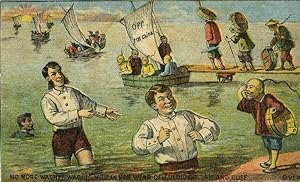
Celluloid waterproof collars, cuffs & shirt bosoms "No More Washee Washee Melican Man Wear Celluloid Collar and Cuff"
Seller: Antipodean Books, Maps & Prints, ABAA, Garrison, NY, U.S.A.
Association Member: ABAA ANZAAB ESA ILAB
Seller rating 4 out of 5 stars

Celluloid collar advertising card with illustration of men emerging from the water wearing the waterproof collars and cuffs as a Chinese laundry worker tearfully watches, and in the background, pig tail wearing Chinese laundry men depart on boats, "Off for China". With advertising text at verso, "For Sale at Auer's, North Pearl St, Albany. Not dated. 5 1/4 x 3 1/4", slt marked at verso, o/w very good.
-

"Celluloid" Collars and Cuffs
Published by Donaldson Brothers, 1895
Seller: Carpe Diem Fine Books, ABAA, Monterey, CA, U.S.A.
Association Member: ABAA ILAB TXBA
Seller rating 5 out of 5 stars

Large color lithograph (image 16" X 11"; framed 23" x 18") advertising the use of celluoid collars and cuffs worn by three "brownies" after the artwork of Palmer Cox (1840-1924). Cox was a Canadian illustrator and author, best known for The Brownies, his series of humorous verse books and comic strips about the mischievous but kindhearted fairy-like sprites. This charming and delightful lithograph is professionally double-matted and famed and is in fine condition.
-
Seventeen Mostly Colorful Stereotype or Anti-Chinese Trade cards. Many relate to Chinese laundries -- some promoting celluloid Cuffs, Collars and Bosoms
Seller: McBlain Books, ABAA, Hamden, CT, U.S.A.
Association Member: ABAA ILAB SNEAB
Seller rating 5 out of 5 stars
Condition: Very Good. Size varies. Most are imprinted with a specific merchant's information on front or back or both. Seldom dated but generally late 19th or early 20th century. Generally individual except for a set of four advertising George Heppe's Excelsior Candy Kitchen in Philadelphia whose humor involves children trying, partially successfully, to pull off a Chinese male's braided hair (queue).


