
Classical Mechanics: Signed (3 results)
Language: English
Published by Cambridge University Press 1987
Series: London Mathematical Society Lecture Notes, Book 100 of 387. Book 100 of 387 - London Mathematical Society Lecture Notes
- Softcover
- First Edition
- Signed
Seller: Powell's Bookstores Chicago, ABAA, Chicago, IL, U.S.A.Powell's Bookstores Chicago, ABAA
Contact seller4-star sellerCondition: Used
US$ 23.00
US$ 6.65 shippingShips within U.S.A.Quantity: 1 available
paperback. Condition: Used-Very Good. 1st Edition. Some shelf-wear.

Published by Prentice Hall 1966 1966
- Hardcover
- First Edition
- Signed
Seller: Wonderland Books, Berkeley, CA, U.S.A.Wonderland Books
Contact seller4-star sellersigned letter from the publisher laid in first printing ed. hardback Very good condition in a near very good dust jacket with some rubbing to the spine.
- Softcover
- Signed
Seller: The Raab Collection, Ardmore, PA, U.S.A.The Raab Collection
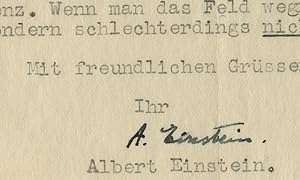
Contact seller4-star sellerThe fullest summation we have seen by Einstein comparing relativity to Newtonian concepts of space and timeImmanuel Kant took both Euclidean geometry and the Newtonian laws of motion to be synthetic a priori principles, which, from Kant?s point of view, function as necessary presuppositions for applying our fundamental concepts…of space, time, matter, and motion to our sensible experience of the natural world, meaning they are fixed necessary conditions. This idea rested on the absolute nature of space and time, the work of Newton, and the relationship between geometry and physics.In 1905, while a young patent clerk and physicist in Bern, Switzerland, Albert Einstein obtained his doctorate and published a paper that explained his newly developed Special Theory of Relativity. This unlocked many mysteries of the universe, and introduced the world to "e=mc2," equating mass and the speed of light with energy. It established that time and space are not fixed, and in fact change to maintain a constant speed of light regardless of the relative motions of sources and observers. Just 10 years later, in 1915, Einstein published his General Theory of Relativity, which described the universe as a four-dimensional continuum (with time added as the fourth dimension), where gravitational effects are explained by the warping of space-time. In this theory, Einstein incorporated gravity as a geometric property of space-time.The impact of Einstein's work between 1905 and 1915 challenged many principles of physics that had been accepted for centuries. In 1921, he won the Nobel Prize for his work. Time Magazine named him the Person of the Century for the 20th century for his discoveries in relativity and space-time. Einstein is the most important scientist since Isaac Newton, and probably the most famous in history.Space and time were considered relativistic, more subjective, and not the fixed a priori notions that had long permeated the mathematical and scientific worlds.Max Fischler was a California scientist who was interested in the implications of this distinction: were space and time now to be studied together in this context only or were the nature of space and the nature of time different?In special relativity, what appears simultaneous to one person, might not to another - they are relative. You cannot separate space and time; they occur subjectively and semi-dependently, but are not tied to the content of that space.With General Relativity, space-time remains but matter warps it. It's a field, like the sheet of a trampoline but reacts to matter. One needs all four dimensions of space-time and without them, the others don't exist. You need matter for space.On September 5, 1954, he wrote to Einstein: ".Can anything in your theory of Relativity be said to throw new light on the nature of space and time themselves? Or must we rest satisfied with the purely new logical treatment of these conceptions? In other words, does the new view of space and time as space-time carry any new meaning ontologically beyond the purely mathematical and logical relationship between the two. Or to put it differently: When Minkowski, in his famous words said, 'Space by itself and time by itself must not sink into the mere shadows, and only a kind of union of the two can preserve an independent existence,' did he not attach some new, real meaning to the 'spacetime' which the old independent notions of space and time could not convey? If so in what does this new meaning consist."Four days later, Einstein replied in this letter:Typed letter signed, in German, on his personal blind embossed letterhead, Princeton, September 9, 1954, to Max Fishler. "The expression cited in the second paragraph only signifies the wish for logical clarity in the formal expressions. De facto the justification for concepts lies in their ability to comprehend the empirically given."In classical mechanics, space and time were completed existences, which had to be presupposed as real [a pri.

