Order Total (1 Item Items):
Shipping Destination:

Dictionary Musicians, Signed (4 results)
Skip to main search results
Search filters
Product Type
- All Product Types
- Books (4)
- Magazines & Periodicals (No further results match this refinement)
- Comics (No further results match this refinement)
- Sheet Music (No further results match this refinement)
- Art, Prints & Posters (No further results match this refinement)
- Photographs (No further results match this refinement)
- Maps (No further results match this refinement)
- Manuscripts & Paper Collectibles (No further results match this refinement)
Condition Learn more
- New (No further results match this refinement)
- As New, Fine or Near Fine (No further results match this refinement)
- Very Good or Good (4)
- Fair or Poor (No further results match this refinement)
- As Described (No further results match this refinement)
Binding
Collectible Attributes
Language (3)
Price
- Any Price
- Under US$ 25 (No further results match this refinement)
- US$ 25 to US$ 50 (No further results match this refinement)
- Over US$ 50
Free Shipping
- Free Shipping to U.S.A. (No further results match this refinement)
Seller Location
Seller Rating
-
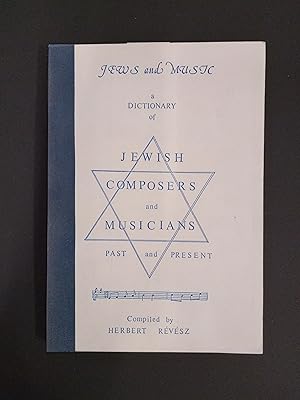
Jews and Music; a Dictionary of Jewish Composers and Musicians Past and Present
Published by Self Published, London, 1985
First Edition Signed
Soft cover. Condition: Very Good. No Jacket. 1st Edition. Paper covers with a blue cloth spine. Limited and numbered edition, this being no. 18 of 30. Signed by author. Includes a note requesting "suggestions, corrections and/or additions". In Very Good condition throughout. Signed by Author(s).
-
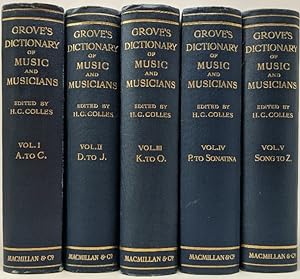
Grove's Dictionary of Music and Musicians.
Language: English
Published by Macmillan & Co. Ltd, London, 1927
Seller: Henry Pordes Books Ltd, London, United Kingdom
Association Member: PBFA
Seller rating 5 out of 5 stars

Signed
US$ 186.68
US$ 20.14 shipping
Ships from United Kingdom to U.S.A.Quantity: 1 available
Add to basketHardcover. Condition: Very Good. George Grove's signature tipped in on front pastedown of volume 1. In 5 volumes, no dust jackets but all very good condition with only minor wear and no signs of fading. 1927 edition. Signed by Author(s).
-

Grove's Dictionary of Music and Musicians
Published by Mac Millan and Co, London, 1900
First Edition Signed
Gilt Cloth. Condition: Very Good Minus. Dust Jacket Condition: No Dj as Issued. Sir George Grove (illustrator). 3rd Edition. a rare early edition of the famous Dictionary of Music. original publisher in 4 thick 8vo volumes, revised after the 1877 1st and the 1889 2nd editions with additions. early Groves are rare. Original green cloth. almost OIive colored cloth, joints a tad frayed as usual. Note each volume is about 900 pages long. a masterpiece of musical scholarship with a bargain price. shipping is extra for North America and over seas, these are heavy volumes. Size: Royal 8vo. By the Owners. Hard Cover.
-
Grove's Dictionary of Music and Musicians in Five Volumes 1929 Third Edition Edited By H. C. Colles, M. A. (Oxon.)
Language: German
Published by London, Macmillan and Co. Limited, 1929
Signed
Condition: Befriedigend. Grove's Dictionary of Music and Musicians in Five Volumes 1929. Third Edition Edited By H. C. Colles, M. A. (Oxon.) THE third edition of Grove's Dictionary of Music and Musicians makes an attempt to face a problem which has been accumulating for nearly fifty years. The original work was far more than a compendium of knowledge on a large number of sub jects; it gained its peculiar position of authority from the fact that each one of its larger articles embodied the considered opinion of its author and was stamped with his individuality both in its critical estimate and its literary expression. Initials at the end of each article placed responsibility on the contributor. Twenty five years later increased knowledge and the passage of time disproving prophecy made correction of innumerable details necessary in articles by authors no longer able to revise their own work. The Editor of the second edition devised the method of additions in square brackets in the text, thus on the whole preserving the integrity of the original while giving the reader the benefit of later research. To continue that method into a third edition, however, was hardly possible or desirable. Large numbers of such additions must confuse the issue, they do in fact destroy the integrity of the original and are bewildering to the reader who uses the Dictionary for purposes of reference. A more drastic method, therefore, seemed called for and has been adopted. Every article in the Dictionary has been reconsidered and its contents viewed as material to be accepted or rejected as the case may be, but in any case to be remodelled at discretion in accordance with a definite plan of arrangement. This, it must be admitted, has meant doing. a certain amount of violence to the prerogative of the individual contributor, but every practicable means of securing justice to his work has been adopted. The use of the word 'revised' (rev.) after the author's initials means that the article has been reshaped and generally shortened but not materially altered as regards the facts related and views expressed therein. The words with additions (with addns.) mean that facts of some importance in themselves but not making un tenable the original writer's general thesis have been incorporated. Wherever these facts assume any large place in the revised article the initials of the new contributor have been added to indicate their source. Occasionally the word 'abridged' is placed after the author's initials as an indication that a fuller treatment of the subject by the same writer was contained in earlier editions. These pro visions apply to the great mass of articles of moderate length, both biographical and technical. The articles of the larger kind have been dealt with by other methods. A great many, even some by the most eminent among Sir George Grove's contributors, have been replaced by new articles written by specialists of to-day. Others have been retained, but with substantial additions, in some cases amounting to supple mentary articles or sections signed by their authors' initials. Others, again, notably Sir George Grove's own monumental articles on Beethoven, Mendelssohn and Schubert, have been revised principally by means of footnote annotations. Cross-headings and side-headings have been inserted to guide the eye of the reader in his search for a particular point, and the process of revision has included many other devices, serving to correlate the several parts of the Dictionary, and to avoid duplication of its matter. By these means space has been secured for the inclusion of a very large number of new names and subjects without greatly increasing the size of the work. The responsibility for the many decisions which the revision has involved must rest with the Editor, but in arriving at them he has had the benefit of an immense fund of helpful advice from many sources. The new contributors include many names everywhere recognised as among the first authorities of the day on the subjects of which they here treat. Many of them have given invaluable help over and above that which can be recognised from their initials in the following pages. This has been particularly the case in regard to certain national groups, the several interests of which have engaged the special thought and care of the following: The Rev. E. H. Fellowes (Early English Schools), Mile. M. L. Pereyra (France), Mr. J. B. Trend (Spain), Mrs. Rosa Newmarch (Southern Slavs), Mr. R. Mengelberg (Holland), Mr. R. Aldrich (U.S.A.). Mr. F. Bonavia (Italy), Mr. A. H. Fox Strangways (Indian and other Asiatics). The illustrations for this edition, by means of 96 plates in colour and in black and white, have been chosen by the Rev. Canon F. W. Galpin and the late Mr. W. Barclay Squire, who have brought to bear on the problem profound know ledge and artistic discernment, the one in regard to instruments and manuscripts, the other in regard to portraits. It was decided to include only the portraits of deceased musicians. Mr. Barclay Squire's work in this direction was completed some months before his death, which occurred while this edition was passing through the press. It owes so much to his careful scholarship and to the personal advice on innumerable details which was always at the service of the Editor that his loss before the completion of the work is a matter of profound regret. It has not been possible to alter all the many references to manuscripts, portraits, etc., in Mr. Barclay Squire's collection. During the four years of the revision the Dictionary has lost. several other valuable contributors whose work for this edition is included therein. One of Mr. H. E. Krehbiel's last acts was to engage in conference with Mr. Richard Aldrich about the revision of the American articles, but he did not live to participate in the work. Mr. Loonard Borwick wrote his article on pianoforte arrangement shortly before his death; Mr. S. H. Pardon and Mr. Frank Kidson revised their former.