
Discovery Elements: First Edition (10 results)

- Hardcover
- First Edition
Seller: Better World Books, Mishawaka, IN, U.S.A.Better World Books
Contact seller5-star sellerCondition: Used - Very good
US$ 6.69
Free ShippingShips within U.S.A.Quantity: 1 available
Condition: Very Good. 1st Edition. Former library copy. Pages intact with possible writing/highlighting. Binding strong with minor wear. Dust jackets/supplements may not be included. Includes library markings. Stock photo provided. Product includes identifying sticker. Better World Books: Buy Books. Do Good.
- Hardcover
- First Edition
Seller: Better World Books, Mishawaka, IN, U.S.A.Better World Books
Contact seller5-star sellerCondition: Used - Good
US$ 6.69
Free ShippingShips within U.S.A.Quantity: 1 available
Condition: Good. 1st Edition. Former library copy. Pages intact with minimal writing/highlighting. The binding may be loose and creased. Dust jackets/supplements are not included. Includes library markings. Stock photo provided. Product includes identifying sticker. Better World Books: Buy Books. Do Good.
 More images
- Hardcover
- First Edition
Seller: Shasta Library Foundation, Redding, CA, U.S.A.Shasta Library Foundation
Contact seller4-star sellerCondition: Used - As new
US$ 20.00
US$ 5.50 shippingShips within U.S.A.Quantity: 1 available
Hardcover. Condition: As New. No Jacket. 1st Edition. Pictorial boards with gilt spine and lettering. Binding is tight. Spine is straight. Corners are sharp. Content is clean. No markings. No shelf wear. 224 p. This copy has not been open/read.

Published by Delacorte Press, New York 1968
- Hardcover
- First Edition
Seller: Lectern Books, Brooklyn, NY, U.S.A.Lectern Books
Contact seller5-star sellerCondition: Used - Near fine
US$ 40.00
US$ 6.00 shippingShips within U.S.A.Quantity: 1 available
Hardcover. Condition: Near Fine. Dust Jacket Condition: Very Good. First Edition. 8vo. 215 pp. Near Fine in Very Good dust jacket. Black cloth with gilt titles and decorations. Slight edgewear to boards. Jacket worn and rubbed, with small chips and tears. Light sunning to spine.

Published by London : Printed for Thomas Tegg 1809
- Hardcover
- First Edition
Seller: MW Books, New York, NY, U.S.A.MW Books
Contact seller5-star sellerFirst Edition. Poor copy in contemporary half leather over marble boards, now very heavily worn overall with substantial surface loss to both marbled papers and leather. Front board shows a heavy abrasion. Internally much better: tight and clean, save for the faint dust-dulling expected of age. Plates collated, and all present.…Remains a very serviceable copy overall. Series: The new encyclopædia ; 9. Elements of natural and experimental philosophy ; 1. Physical description: 271 pages : illustrations ; 15 cm. Notes: Volume 9 of 10. Frontispiece engraved by J. Dadley from an original painting by J. Thurston. Subjects: Physics - Early works to 1800. Science - Philosophy - Early works to 1800. Natural history - Pre-Linnean works. Encyclopedias and dictionaries - 18th century - Specimens. 3 Kg.
 More images
Language: English
Published by Printed for The Author, London 1799
- Hardcover
- First Edition
Seller: Neil Summersgill Ltd ABA,PBFA,ILAB., Blackburn, , United KingdomNeil Summersgill Ltd ABA,PBFA,ILAB.
Contact seller5-star sellerCondition: Used
US$ 656.29
US$ 33.54 shippingShips from United Kingdom to U.S.A.Quantity: 1 available
Half-Leather. Condition: G-vg. 1st Edition. Thick quarto; xviii,571p, 47 engraved plates, complete. Contemporary half calf, gilt bands and motifs to spine, red lettering piece. Sl wear extremities, sl cracking to the joints but both boards are well attached.Plates marginally browned, occasional spots. Overall a G-VG copy. Owners…hip signature to title page of one Thomas Broadwood.

Published by London : Printed for Thomas Tegg 1809
- Hardcover
- First Edition
Seller: MW Books Ltd., Galway, , IrelandMW Books Ltd.
Contact seller5-star sellerCondition: Used
US$ 77.50
US$ 16.15 shippingShips from Ireland to U.S.A.Quantity: 1 available
First Edition. Poor copy in contemporary half leather over marble boards, now very heavily worn overall with substantial surface loss to both marbled papers and leather. Front board shows a heavy abrasion. Internally much better: tight and clean, save for the faint dust-dulling expected of age. Plates collated, and all present.…Remains a very serviceable copy overall. Series: The new encyclopædia ; 9. Elements of natural and experimental philosophy ; 1. Physical description: 271 pages : illustrations ; 15 cm. Notes: Volume 9 of 10. Frontispiece engraved by J. Dadley from an original painting by J. Thurston. Subjects: Physics - Early works to 1800. Science - Philosophy - Early works to 1800. Natural history - Pre-Linnean works. Encyclopedias and dictionaries - 18th century - Specimens. 1 Kg.

- Softcover
- First Edition
Seller: Herman H. J. Lynge & Søn ILAB-ABF, Copenhagen, , DenmarkHerman H. J. Lynge & Søn ILAB-ABF
Contact seller4-star sellerCondition: Used
US$ 358.91
US$ 48.62 shippingShips from Denmark to U.S.A.Quantity: 1 available
Lancaster, American Institute of Physics, 1949. Lex8vo. Volume 76, October 15, No. 8, 1949 of "The Physical Review", Second Series. Entire volume offered. In the original printed blue wrappers. Previous owner's name to vaguely stamped to top right corner of front wrapper. Minor traces of wear to extremities and a few small tears… to spine. Overall a very nice and clean copy. Pp. 1226-1231. [Entire issue: Pp. 1005-1274]. First printing of Mayer's seminal paper which led to the finding of "magic number" and the Goeppert-Mayer "shell model". Marie Goeppert-Mayer and Marie Curie are the only two women to have received the Nobel Prize in Physics.The nuclear shell model is partly analogous to the atomic shell model which describes the arrangement of electrons in an atom. The nuclear shell model describes the structure of the nucleus in terms of energy based on the Pauli exclusion principle."With Edward Teller in 1947, Marie Goeppert-Mayer began work on the origin of elements, which led to the finding that stable elements contained what would become known as "magic numbers", or patterns in the number of particles their nuclei contain. This ultimately led Goeppert-Mayer to the "shell model" of the nucleus - the theory that atomic nuclei owe their stability to the existence of relatively fixed "shells" or orbits upon which proton and neutrons travel. While other physicists also had envisioned a shell model, there was no convincing evidence until Marie Goeppert-Mayer, acting on a suggestion made by Enrico Fermi, and German scientist H. H. D. Jensen, working simultaneously but seperatly, discovered that spin-orbit coupling occurred within nuclei." (Cullen-DuPont, Kathryn. Encyclopedia of women's history in America, 2000, p. 102) "When Teller and I worked on a paper on the origin of elements, I stumbled over the magic numbers. We found that there were a few nuclei which had a greater isotopic as well as cosmic abundance than our theory or any other reasonable continuum theory could possible explain. Then I found that those nuclei had something in common: they either had 82 neutrons, whatever the associated proton number, or 50 neutrons. Eighty-two and fifty are " magic " numbers. That nuclei of this type are unusually abundant indicates that the excess stability must have played a part in the process of the creation of elements." (Marie Goeppert-Mayer's Nobel Lecture, December 12, 1963).
 More images
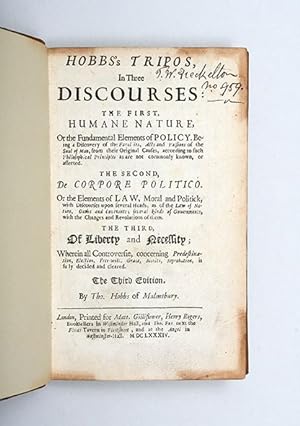
Published by London: for Matt. Gilliflower, Henry Rogers, and Tho. Fox, 1684 1684
- First Edition
Seller: Peter Harrington. ABA/ ILAB., London, United KingdomPeter Harrington. ABA/ ILAB.
Contact seller5-star sellerCondition: Used
US$ 2,072.50
US$ 29.51 shippingShips from United Kingdom to U.S.A.Quantity: 1 available
First collected edition, somewhat confusingly called "The Third Edition" on the title, comprising the two texts which form The Elements of Law, together with a third text. The Elements of Law was originally published in 1650 in two parts, Humane Nature, and De Corpore Politico, both with subsequent separate editions. It had circ…ulated in manuscript in 1640. "Starting with an account of human psychology and a powerful analysis of the origins (and the necessity) of the state, it mounted a strong defence of royal authority in such matters as the imposition of taxation" (ODNB). In so doing Hobbes foreshadowed many of the ideas which he would put forward in Leviathan in 1651, namely, the indivisibility of sovereignty. The third part, "Of Libertie and Necessitie", dates from after Hobbes's return to England in 1651, when he "became embroiled in a heated debate with John Bramhall, bishop of Derry, Ulster, on the subject of free will. In 1645, in Paris, Hobbes had discussed the problem of free will with the bishop, and they both wrote their views on the matter soon afterward. A young disciple of Hobbes published his contribution in 1654, without Hobbes's consent" (The Encyclopedia of Philosophy, IV, p. 32). Though included with the Elements of Law here, it has no broader connection to the other two parts. ESTC R12077; Macdonald & Hargreaves 103; Wing H2266. Octavo (178 x 113 mm). Bound without initial blank. Twentieth-century calf, marbled sides. 19th-century inscription to title page of reverend Thomas Wesley Freckelton (1827-1903), author of The Church and the Drama (1865), and Religion and Modern Thought (1893). A few pin-sized holes to spine, early inscription to title page, some light browning and peripheral staining, small chip to bottom corner of T2 not near text. A good copy.
 More images
- Softcover
- First Edition
Seller: Herman H. J. Lynge & Søn ILAB-ABF, Copenhagen, , DenmarkHerman H. J. Lynge & Søn ILAB-ABF
Contact seller4-star sellerCondition: Used
US$ 3,190.27
Free ShippingShips from Denmark to U.S.A.Quantity: 1 available
Lancaster, American Physical Society, 1923. Royal8vo. In the original printed wrappers. In: Physical Review, Second Series, Vol. 25, No. 5, May 1923. With black cloth back-strip. Front wrapper missing top right corner and front wrapper washed/polished. Internally fine and clean. [Compton's paper:] pp. 483-502. [Entire issue:] Pp…: 483-584. First printing of this milestone paper in quantum physics in which Compton verifies Planck's quantum postulate and found that some of the X-rays had, in scattering, lenghtened their wavelenght. This phenomena was called the "Compton Effect" in his honour. For this discovery Compton received the Nobel prize in physics in 1927."Compton was able to account for this (lenghtening of wavelenght) by presuming that a photon of light struch an electron, which recoiled, subtracting some energy from the photon and therefore increasing its wavelenght. This made it seem that a photon acted as a particle: thus after more than a century, the particulate natuer of light, as evolved by Newton, was revived. What itamounted to was that Compton brought to fruition the view that electromagnetic radiation had both a wave aspect and a particle aspect, and that the aspect which was most evident depended on how the radiation was tested. De Broglie was, at the same time, showing that this held true also for ordinary particles, such as electrons." (Asimov)Parkinson "Breakthroughs", 1923 P. - Sigmund Brandt "The Harvest of as Century", Episode 31.


