
Document Signed by Monroe James (5 results)

Published by Richmond, VA 1800
- Signed
Seller: James Cummins Bookseller, ABAA, New York, NY, U.S.A.James Cummins Bookseller, ABAA
Contact seller5-star seller1p. Paper-covered wax seal at lower left. 10 x 7-1/4 inches. The Election of 1800, sometimes referred to as the Revolution of 1800, was a significant moment in American political history, being the first election in which the power of the Federal government transferred from one party (John Adams's Federalists) to the other (Thom…as Jefferson's Democratic Republicans). But the election was not without major controversy. In the years prior to the passage of the 12th Amendment, no distinction was made between electoral votes for the president and vice president, with the second place winner serving in the latter position regardless of the party affiliation of the former. For the first time, in the election of 1800 the parties put up slates of candidates, with Adams running with Charles C. Pinkney and Jefferson with Aaron Burr. However, because electors could not distinguish between president and vice president when voting, Jefferson and Burr each received 73 electoral votes. Thus with the electoral vote tied, per the Constitution the presidential election was decided by the House of Representatives. From February 11 to 17, 1801, the House cast a total of 35 ballots to decide the presidency, each ending in a tie, with most Federalists backing Burr. On the 36th ballot, after Alexander Hamilton had actively campaigned against Burr, Delaware representative James Bayard changed his vote to abstain, thereby giving the dramatic victory to Jefferson. The present document, signed by James Monroe as the Governor of Virginia (whose 21 electoral votes were cast for Jefferson and Burr respectively) is a rare document from that famed election, appointing election commissioners from Augusta County, the county neighboring Monticello's Albermale County. Old folds, minor stain, remnants of prior mounting on the verso 1p. Paper-covered wax seal at lower left. 10 x 7-1/4 inches. Signed.
 More images
Published by Washington 1823
- Signed
Seller: James Cummins Bookseller, ABAA, New York, NY, U.S.A.James Cummins Bookseller, ABAA
Contact seller5-star seller1p., plus integral blank. Paper covered seal of the U.S. Folio (15 x 10 inches). Following the ratification of the Adams-Onis Treaty, President James Monroe was authorized on March 3, 1821, to take possession of Florida for the United States and provide for its initial governance. After appointing William Pope Duval as the first… civilian governor in 1822 he began filling other appointments including the attorneys general for East and West Florida. See The Territorial Papers of the United States (Vol. XXII) for the present appointment, as well as several official communications to Adams and others from Steele concerning timber and other matters, and numerous subsequent communications from Steele and others concerning charges brought against Steele on a variety of charges (including failing to enforce the law against bringing slaves into the territory). Steele would ultimately be removed in 1825 for misconduct and abandoning his office. He died at Mobile, Alabama the following year. Minor toning, separated from the conjugate blank, separations at folds of the blank 1p., plus integral blank. Paper covered seal of the U.S. Folio (15 x 10 inches). Signed.
 More images
Published by Washington 1824
- Signed
Seller: Argosy Book Store, ABAA, ILAB, New York, NY, U.S.A.Argosy Book Store, ABAA, ILAB
Contact seller5-star sellerCondition: Used - Very good
US$ 2,500.00
US$ 6.00 shippingShips within U.S.A.Quantity: 1 available
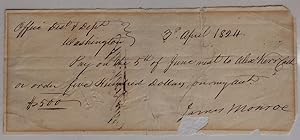
unbound. Condition: very good(+). A.D.S. "James Monroe", 6.5" x 3.25", Presidential Check, Office Distribution and Deposit, Washington, April 3, 1824, iin full: "Pay on the 5th of June next to Alexander Kerr Cash or order five Hundred dollars on my account $500." Alexander Kerr and the "Late Distressing Affair": On February 16,…1808, Amexander Kerr's son of the same name was killed by Thomas Jefferson's four-horned ram. Kerr had met Jefferson through their mutual friend James Madison. The President made an overture of sympathy and sent the family a check for $25 - but less that two months later the boy's father wrote back seeking a federal job: "The compensation I receive from my present situation is too small for the support of my family. which is a strong reason for my taking this liberty in applying to you for an Office. with the great desire to remove myself from this place. due to the late distressing affair. that has taken place in it." In other words: your sheep killed my son, so you owe me. Official records show that Kerr indeed sought positions from his friend President Madison but remained in the private sector. He moved from the Branch Bank to the National Bank in Washington when it opened in 1814 and remained there until his death in 1832. In that capacity he served another Secretary of State and future President John Quincy Adams. *James Monroe and Thomas Jefferson were like brothers and it was Monroe who assisted Jefferson in paying delinquent bills and obligations towards the end of his life; even when his own affairs were not in order. Through writing each other frequently records show Monroe promised to visit Monticello in October 1824, six months after this check was drafted, but cancelled. It would take nine more months before the two would meet, accompanied by General Lafayette, where they would find each other. And so the question goes: is it possible that President Monroe made this payment to Alexander Kerr on behalf of Thomas Jefferson? After all, Monroe did at times oversee Jefferson's delinquent affairs including the upkeep of Monticello. As a footnote one should visit the website Boston 1775 of which some of the above material originated. It ends with the caption - Tomorrow: More victims of killer sheep. Condition: Archivally repaired creases, tears and folds. There is a small piece missing just under the President's signature affecting the "J" in James. Despite its flaws the check remains eye-appealing. American Statesmand and Founding Father who served as fifth President of the United States (1817-1825).

Published by Washington, D.C. 1824
Seller: James Cummins Bookseller, ABAA, New York, NY, U.S.A.James Cummins Bookseller, ABAA
Contact seller5-star seller1 page, engraved and completed in manuscript; red wafer seal (chipped), docketed on verso. Oblong folio. The grant is for "Section Nineteen, in Township Twenty of Range Fifteen east of the second principal Meridian in the Distict of Cincinnati and State of Indiana, containing Six Hundred and forty Acres." Jeremiah Cox (1763-1836…) was among the earliest settlers of Wayne County, Indiana. On vellum. Light staining, folding creaes 1 page, engraved and completed in manuscript; red wafer seal (chipped), docketed on verso. Oblong folio.

- Signed
Seller: Bauman Rare Books, Philadelphia, PA, U.S.A.Bauman Rare Books
Contact seller4-star sellerMONROE, James. Document signed. Washington, D.C., March 31, 1824. Original document, measuring 9-1/2 by 15-1/2 inches, printed and finished by hand on recto, docketed on the verso. $2000.Printed and manuscript land registry document, signed by President James Monroe and countersigned by George Graham, Commissioner of the General… Land Office. With original paper seal.This document, printed and completed by hand, is a Certificate of the Register of the Land Office for the sale of land to Alexander Johnston for 63.95 acres in Ohio "in conformity with the several acts of Congress." Expected fold lines; mild soiling near top of document. Suitable for framing. Signed.


