Order Total (1 Item Items):
Shipping Destination:

Document by Trotter James, Signed (1 results)
Skip to main search results
Search filters
Product Type
- All Product Types
- Books (1)
- Magazines & Periodicals (No further results match this refinement)
- Comics (No further results match this refinement)
- Sheet Music (No further results match this refinement)
- Art, Prints & Posters (No further results match this refinement)
- Photographs (No further results match this refinement)
- Maps (No further results match this refinement)
- Manuscripts & Paper Collectibles (No further results match this refinement)
Condition Learn more
- New (No further results match this refinement)
- As New, Fine or Near Fine (1)
- Very Good or Good (No further results match this refinement)
- Fair or Poor (No further results match this refinement)
- As Described (No further results match this refinement)
Binding
- All Bindings
- Hardcover (No further results match this refinement)
- Softcover (No further results match this refinement)
Collectible Attributes
- First Edition (No further results match this refinement)
- Signed (1)
- Dust Jacket (No further results match this refinement)
- Seller-Supplied Images (1)
- Not Print on Demand (1)
Language (1)
Price
- Any Price
- Under US$ 25 (No further results match this refinement)
- US$ 25 to US$ 50 (No further results match this refinement)
- Over US$ 50
Free Shipping
- Free Shipping to U.S.A. (No further results match this refinement)
Seller Location
Seller Rating
-
Document
Published by Washington, D.C., 1887
Seller: North Star Rare Books & Manuscripts, Sheffield, MA, U.S.A.
Seller rating 5 out of 5 stars

Signed
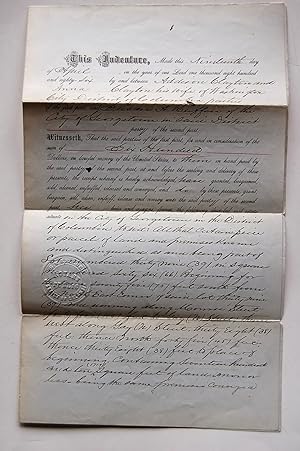
No Binding. Condition: Fine. Printed document signed James M. Trotter. Single folio leaf folded to form four pages; notary blind-stamp; docketed, with several notations in Trotter's hand and filled out by former Union General George W. Balloch, a notary public, who served as a trustee and treasurer of Howard University ---- Born an enslaved man in grand Gulf, Mississippi, James Monroe Trotter (1842-1892) and his family were sent to Cincinnati, where he attended school and developed a passion for music. During the Civil War, Trotter enlisted as a private in the all-Black 55th Massachusetts Regiment, sister regiment to Colonel Robert Gould Shaw's 54th Massachusetts. Although initially the officers were white, Trotter rose rapidly through the ranks; by 1864 he was a second lieutenant. The War Department, however, was slow to recognize his field commission, and Trotter openly protested this discrimination. He also participated in the struggle for equal pay, in which African Americans insisted on the same recognition that their white counterparts received. Trotter and comrades held the principle of racial justice was important than immediate gratification: the two Black Massachusetts regiments went without pay for a year before Congress approved equal compensation ---- After the war, Trotter moved to Boston and was appointed a clerk in the U. S. Post office. In 1878, he published "Music and Some Highly Musical People," the first historical survey of Black music by an African American, through which he aimed to correct erroneous estimates of the art-capabilities of the colored race. By the time Trotter was confirmed recorder of deeds nine years later, "Music and Some Highly Musical People" had sold 8,000 copies to become the most vendible history of black music in the United States. In 1887, President Grover Cleveland appointed Trotter recorder of deeds for the District of Columbia, the capacity by which he completed this land deed. (Frederick Douglass held the recorder position prior to Trotter, and another former enslaved person, Senator Blanche K. Bruce, succeeded Trotter.) As a result of his lucrative recordership, Trotter was able to leave substantial property to his family. His son William Monroe absorbed James Trotter's legacy of militancy and his commitment to integration and racial equality ----- Exceedingly rare signature of an African American Civil War officer and the second Black recorder of deeds. Signed by Author(s).