
Einstein Peace: Signed (2 results)

Language: English
Published by LA Pointe, Wisconsin, U.S.A.: Mad Island Communications Llc 2007
- Softcover
- Signed
Seller: Blue Eagle Metaphysical Emporium, Albuquerque, NM, U.S.A.Blue Eagle Metaphysical Emporium
Contact seller5-star sellerCondition: Used - Very good
US$ 19.50
US$ 3.95 shippingShips within U.S.A.Quantity: 1 available
Soft cover. Condition: Very Good. Very good condition, author dedication on front page, tiny dappling on top page edges. Inscribed by Author(s).
- Hardcover
- Signed
Seller: The Raab Collection, Ardmore, PA, U.S.A.The Raab Collection
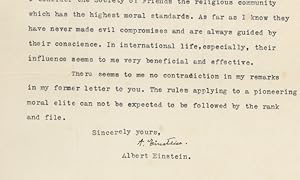
Contact seller4-star sellerAn increasingly uncommon letter of Einstein on the role of religions, philosophy, peace, and the dangers of the atomic age (that he helped usher in)Albert Einstein believed that wars stood in the way of human progress, and he was a lifelong pacifist (though he did not believe in pacifism at any price or in all situations). He wa…s also an active promoter of world peace, from the days of World War I right up to his death in 1955. In fact, one of his last acts before his death was to add his signature to a statement of nine scientists warning that the world risked universal annihilation unless the institution of war was abolished.?Knowing his stance, people from all over the world appealed to him to assist various causes consistent with these beliefs, and to give statements supporting individuals and groups that did so.Einstein was also not a member or follower of any organized religion. He considered himself a Jew, but was not a practicing Jew. And as for the Christian churches, he felt that it ?since Constantine has always favored the authoritarian State, as long as the State allows the Church to baptize and instruct the masses". Their conduct in the years up to World War II was worse than disappointing, he thought, as they made the devil?s bargain - the evil compromise - with the Hitler regime. Einstein addressed this saying, ?Since when can one make a pact with Christ and Satan at the same time?" He added, "The Church has always sold itself to those in power, and agreed to any bargain in return for immunity?If I were allowed to give advice to the Churches, I would tell them to begin with a conversion among themselves, and to stop playing power politics.? This idea of an evil compromise or devil's pact is central to his feelings about organized religion.There was one exception to his criticism of religions - the Quakers. Their community aims at purifying the Christian world and generating social reform by creating direct experience with God, without intervention of clergy or other expressions of church. The Quakers greatly influenced science and industry, and their community is noted for the pursuit of peace and non-violence. Thus Einstein?s views fit into their belief system. ?If I were not a Jew I would be a Quaker,? he once wrote. Speaking to a Quaker gathering in 1938, he said, "With admiration and respect I have seen, in the course of many years, how successfully and selflessly the Society of Friends has worked in the entire world to lessen human suffering and to make the teachings of Christ apply to real life. Everyone who is concerned about a better lot and a more dignified stature for humanity owes deep gratitude to the Society of Friends. This Society is an admirable testimony against the assertion that every organization by its very nature kills the spirit which has called it into life.?In 1949 the Australian pathologist Alton R. Chapple, who was a Quaker, wrote to Einstein, in the then-current climate of concern regarding the perils of the atomic age, for "a few words of leadership and hope". Einstein responded, stressing the necessity for moral courage by the individual. He said that power is often in the hands of power-loving persons who know very little restrictions when it comes to the realization of their ambitious goals; and answering negatively the question whether self-restraint on what ?productive thinkers and explorers? research might not prevent further development of means of mass destruction. He gave three main reasons: 1) The already existing means of destruction are effective enough to bring about total destruction; 2) People really devoted to the progress of knowledge concerning the physical world like Faraday or Rutherford have never worked for practical goals, let alone military goals. And nobody could know in advance what kind of application might be developed on the basis of their discoveries; and 3) People of technical skill are so numerous and so dependent economically that they cannot be expec.

