
Emakimono: Signed (1 results)
 More images
- First Edition
- Signed
- Art Print
Seller: Librairie Le Feu Follet, Paris, , FranceLibrairie Le Feu Follet
Contact seller5-star sellerCondition: Used
US$ 3,394.21
US$ 34.39 shippingShips from France to U.S.A.Quantity: 1 available
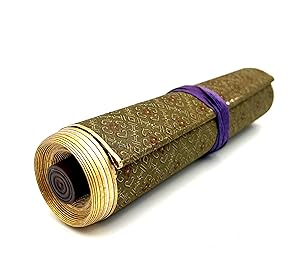
autre. 1920 | 24.50 x 380 cm | autre | 12 peintures originales sur soie dans un rouleau, lui même revêtu de soie. L'Emakimono est un rouleau peint à la narration horizontale. Rouleau composé d'une tige en bois sur lequel viennent s'enrouler les peintures. Les marges externes sont faites de soie verte imprimée tandis que le fond…sur lequel les peintures sont contrecollées est fait d'un autre tissu de soie verte plus claire ; l'ensemble est contrecollé sur un papier. Parfois piqûres ou légères petites taches sur la soie. Chaque peinture : 18x23,5cm. Très bel état. Les 12 peintures racontent l'histoire d'une deesse venue du ciel vêtue d'une robe à plume et qui visite le monde des humains. Cette célèbre légende est un mythe dans plusieurs pays du sud est asiatique, notamment la Chine et le Japon.Elle devient piégée dans le royaume humain lorsque sa robe est cachée et tombe finalement amoureuse d'un homme mortel. Dans les peintures il s'agit d'un pauvre pêcheur. La présence de ce pêcheur évoque l'un des plus anciens et classiques contes japonais : le pêcheur et la tortue. On notera la présence du Mont Fuji qui inaugure et clot le conte. Il est extrèmement rare que les shunga racontent une histoire, ce sont toujours des scènes isolées pouvant avoir un fond commun, mais jamais une narration par l'image. En 12 volets, les peintures racontent la rencontre et le départ de la déesse pour son monde lorsqu'elle retrouve sa robe de plume. Outre ce phénomène particulier, les peintures appartiennent à la fin des créations shunga, et c'est la seule période de cet art qui vit naître une nouvelle manière, non seulement dans la représentation mais aussi dans la distribution des rôles dans la sexualité. Les peintures ne se contentent plus de reproduire un style déjà établi mais en crée un nouveau pour les besoins de l'histoire. On remarquera dans chaque scène sexuelle la présence de mouchoirs, destinés à la toilette intime, avant ou après l'acte. | [ENGLISH DESCRIPTION FOLLOWS] 12 original paintings on silk in a scroll, itself covered with silk. The Emakimono is a painted scroll with horizontal narrative. Scroll composed of a wooden rod around which the paintings are rolled. The external margins are made of printed green silk while the background on which the paintings are mounted is made of another lighter green silk fabric; the whole is mounted on paper. Occasional worming or light small stains on the silk. Each painting: 18x23.5cm. Very fine condition. The 12 paintings tell the story of a goddess who came from heaven wearing a feathered robe and who visits the world of humans. This famous legend is a myth in several Southeast Asian countries, notably China and Japan. She becomes trapped in the human realm when her robe is hidden and eventually falls in love with a mortal man. In the paintings it is a poor fisherman. The presence of this fisherman evokes one of the oldest and most classic Japanese tales: the fisherman and the turtle. One notes the presence of Mount Fuji which opens and closes the tale. It is extremely rare for shunga to tell a story; they are always isolated scenes that may have a common background, but never a narrative through images. In 12 panels, the paintings tell of the meeting and departure of the goddess to her world when she finds her feathered robe again. Beyond this particular phenomenon, the paintings belong to the end of shunga creations, and it is the only period of this art that saw the birth of a new manner, not only in representation but also in the distribution of roles in sexuality. The paintings no longer merely reproduce an already established style but create a new one for the needs of the story. One will notice in each sexual scene the presence of handkerchiefs, intended for intimate cleansing, before or after the act. *.
