Order Total (1 Item Items):
Shipping Destination:

Extra Dimensions Space Time by Bars Itzhak (20 results)
Skip to main search results
Search filters
Product Type
- All Product Types
- Books (20)
- Magazines & Periodicals (No further results match this refinement)
- Comics (No further results match this refinement)
- Sheet Music (No further results match this refinement)
- Art, Prints & Posters (No further results match this refinement)
- Photographs (No further results match this refinement)
- Maps (No further results match this refinement)
- Manuscripts & Paper Collectibles (No further results match this refinement)
Condition Learn more
- New (18)
- As New, Fine or Near Fine (1)
- Very Good or Good (1)
- Fair or Poor (No further results match this refinement)
- As Described (No further results match this refinement)
Binding
Collectible Attributes
- First Edition (No further results match this refinement)
- Signed (No further results match this refinement)
- Dust Jacket (No further results match this refinement)
- Seller-Supplied Images (10)
- Not Print on Demand (11)
Language (1)
Price
- Any Price
- Under US$ 25 (No further results match this refinement)
- US$ 25 to US$ 50 (No further results match this refinement)
- Over US$ 50
Free Shipping
Seller Location
Seller Rating
-

hardcover. Condition: Good. Connecting readers with great books since 1972! Used textbooks may not include companion materials such as access codes, etc. May have some wear or writing/highlighting. We ship orders daily and Customer Service is our top priority!
-

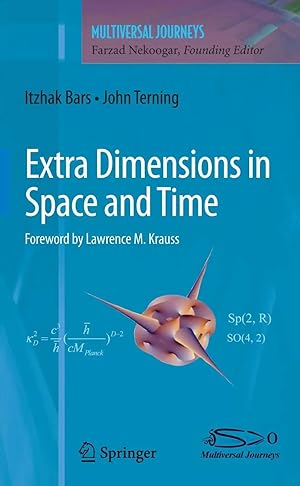
Extra Dimensions in Space and Time (Multiversal Journeys)
Seller: Ria Christie Collections, Uxbridge, United Kingdom
Seller rating 5 out of 5 stars

US$ 189.72
US$ 16.39 shipping
Ships from United Kingdom to U.S.A.Quantity: Over 20 available
Add to basketCondition: New. In.
-
Condition: New.
-
Condition: New.
-
Extra Dimensions in Space and Time (Multiversal Journeys)
Seller: Ria Christie Collections, Uxbridge, United Kingdom
Seller rating 5 out of 5 stars
US$ 203.37
US$ 16.39 shipping
Ships from United Kingdom to U.S.A.Quantity: Over 20 available
Add to basketCondition: New. In.
-
Condition: New.
-

Extra Dimensions in Space and Time
Language: English
Published by Springer New York, Springer US, 2012
ISBN 10: 1461425328 ISBN 13: 9781461425328
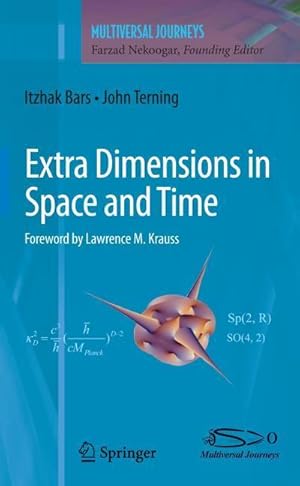
Taschenbuch. Condition: Neu. Druck auf Anfrage Neuware - Printed after ordering - In physics, the idea of extra spatial dimensions originates from Nordstöm's 5-dimensional vector theory in 1914, followed by Kaluza-Klein theory in 1921, in an effort to unify general relativity and electromagnetism in a 5 dimensional space-time (4 dimensions for space and 1 for time). Kaluza-Klein theory didn't generate enough interest with physicist for the next five decades, due to its problems with inconsistencies. With the advent of supergravity theory (the theory that unifies general relativity and supersymmetry theories) in late 1970's and eventually, string theories (1980s) and M-theory (1990s), the dimensions of space-time increased to 11 (10-space and 1-time dimension).There are two main features in this book that differentiates it from other books written about extra dimensions: The first feature is the coverage of extra dimensions in time (Two Time physics), which has not been covered in earlier books about extra dimensions. All other books mainly cover extra spatial dimensions. The second feature deals with level of presentation. The material is presented in a non-technical language followed by additional sections (in the form of appendices or footnotes) that explain the basic equations and formulas in the theories. This feature is very attractive to readers who want to find out more about the theories involved beyond the basic description for a layperson. The text is designed for scientifically literate non-specialists who want to know the latest discoveries in theoretical physics in a non-technical language. Readers with basic undergraduate background in modern physics and quantum mechanics can easily understand the technical sections.Part I starts with an overview of the Standard Model of particles and forces, notions of Einstein's special and general relativity, and the overall view of the universe from the Big Bang to the present epoch, and covers Two-Time physics. 2T-physics has worked correctly at all scales ofphysics, both macroscopic and microscopic, for which there is experimental data so far. In addition to revealing hidden information even in familiar 'everyday' physics, it also makes testable predictions in lesser known physics regimes that could be analyzed at the energy scales of the Large Hadron Collider at CERN or in cosmological observations.'Part II of the book is focused on extra dimensions of space. It covers the following topics: The Popular View of Extra Dimensions, Einstein and the Fourth Dimension, Traditional Extra Dimensions, Einstein's Gravity, The Theory Formerly Known as String, Warped Extra Dimensions, and How Do We Look For Extra Dimensions.
-
Extra Dimensions in Space and Time
Language: English
Published by Springer New York, Copernicus, 2009
ISBN 10: 0387776370 ISBN 13: 9780387776378
Buch. Condition: Neu. Druck auf Anfrage Neuware - Printed after ordering - In physics, the idea of extra spatial dimensions originates from Nordstöm's 5-dimensional vector theory in 1914, followed by Kaluza-Klein theory in 1921, in an effort to unify general relativity and electromagnetism in a 5 dimensional space-time (4 dimensions for space and 1 for time). Kaluza-Klein theory didn't generate enough interest with physicist for the next five decades, due to its problems with inconsistencies. With the advent of supergravity theory (the theory that unifies general relativity and supersymmetry theories) in late 1970's and eventually, string theories (1980s) and M-theory (1990s), the dimensions of space-time increased to 11 (10-space and 1-time dimension).There are two main features in this book that differentiates it from other books written about extra dimensions: The first feature is the coverage of extra dimensions in time (Two Time physics), which has not been covered in earlier books about extra dimensions. All other books mainly cover extra spatial dimensions. The second feature deals with level of presentation. The material is presented in a non-technical language followed by additional sections (in the form of appendices or footnotes) that explain the basic equations and formulas in the theories. This feature is very attractive to readers who want to find out more about the theories involved beyond the basic description for a layperson. The text is designed for scientifically literate non-specialists who want to know the latest discoveries in theoretical physics in a non-technical language. Readers with basic undergraduate background in modern physics and quantum mechanics can easily understand the technical sections.Part I starts with an overview of the Standard Model of particles and forces, notions of Einstein's special and general relativity, and the overall view of the universe from the Big Bang to the present epoch, and covers Two-Time physics. 2T-physics has worked correctly at all scales ofphysics, both macroscopic and microscopic, for which there is experimental data so far. In addition to revealing hidden information even in familiar 'everyday' physics, it also makes testable predictions in lesser known physics regimes that could be analyzed at the energy scales of the Large Hadron Collider at CERN or in cosmological observations.'Part II of the book is focused on extra dimensions of space. It covers the following topics: The Popular View of Extra Dimensions, Einstein and the Fourth Dimension, Traditional Extra Dimensions, Einstein's Gravity, The Theory Formerly Known as String, Warped Extra Dimensions, and How Do We Look For Extra Dimensions.
-
US$ 315.93
US$ 13.68 shipping
Ships from United Kingdom to U.S.A.Quantity: 2 available
Add to basketPaperback. Condition: Brand New. 232 pages. 9.20x6.10x0.53 inches. In Stock.
-
US$ 318.06
US$ 17.10 shipping
Ships from United Kingdom to U.S.A.Quantity: 2 available
Add to basketHardcover. Condition: Brand New. 1st edition. 208 pages. 9.00x6.00x0.25 inches. In Stock.
-
US$ 301.59
US$ 34.21 shipping
Ships from United Kingdom to U.S.A.Quantity: 1 available
Add to basketHardcover. Condition: Like New. LIKE NEW. SHIPS FROM MULTIPLE LOCATIONS. book.
-
Extra Dimensions in Space and Time
Language: English
Published by Springer New York Dez 2009, 2009
ISBN 10: 0387776370 ISBN 13: 9780387776378
Seller: BuchWeltWeit Ludwig Meier e.K., Bergisch Gladbach, Germany
Seller rating 5 out of 5 stars
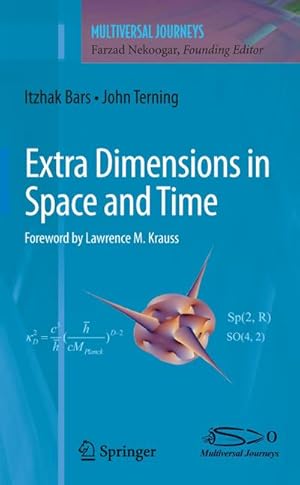
Buch. Condition: Neu. This item is printed on demand - it takes 3-4 days longer - Neuware -In physics, the idea of extra spatial dimensions originates from Nordstöm's 5-dimensional vector theory in 1914, followed by Kaluza-Klein theory in 1921, in an effort to unify general relativity and electromagnetism in a 5 dimensional space-time (4 dimensions for space and 1 for time). Kaluza-Klein theory didn't generate enough interest with physicist for the next five decades, due to its problems with inconsistencies. With the advent of supergravity theory (the theory that unifies general relativity and supersymmetry theories) in late 1970's and eventually, string theories (1980s) and M-theory (1990s), the dimensions of space-time increased to 11 (10-space and 1-time dimension).There are two main features in this book that differentiates it from other books written about extra dimensions: The first feature is the coverage of extra dimensions in time (Two Time physics), which has not been covered in earlier books about extra dimensions. All other books mainly cover extra spatial dimensions. The second feature deals with level of presentation. The material is presented in a non-technical language followed by additional sections (in the form of appendices or footnotes) that explain the basic equations and formulas in the theories. This feature is very attractive to readers who want to find out more about the theories involved beyond the basic description for a layperson. The text is designed for scientifically literate non-specialists who want to know the latest discoveries in theoretical physics in a non-technical language. Readers with basic undergraduate background in modern physics and quantum mechanics can easily understand the technical sections.Part I starts with an overview of the Standard Model of particles and forces, notions of Einstein's special and general relativity, and the overall view of the universe from the Big Bang to the present epoch, and covers Two-Time physics. 2T-physics has worked correctly at all scales of physics, both macroscopic and microscopic, for which there is experimental data so far. In addition to revealing hidden information even in familiar 'everyday' physics, it also makes testable predictions in lesser known physics regimes that could be analyzed at the energy scales of the Large Hadron Collider at CERN or in cosmological observations.'Part II of the book is focused on extra dimensions of space. It covers the following topics: The Popular View of Extra Dimensions, Einstein and the Fourth Dimension, Traditional Extra Dimensions, Einstein's Gravity, The Theory Formerly Known as String, Warped Extra Dimensions, and How Do We Look For Extra Dimensions 232 pp. Englisch.
-

US$ 188.48
US$ 58.32 shipping
Ships from Germany to U.S.A.Quantity: Over 20 available
Add to basketCondition: New. Dieser Artikel ist ein Print on Demand Artikel und wird nach Ihrer Bestellung fuer Sie gedruckt. The aim is to continue to raise public awareness in the exciting field of theoretical physicsCovers the latest theories in theoretical physics and cosmology, at a level not weighed down by highly mathematical equationsEach chapter is writte.
-

US$ 188.48
US$ 58.32 shipping
Ships from Germany to U.S.A.Quantity: Over 20 available
Add to basketCondition: New. Dieser Artikel ist ein Print on Demand Artikel und wird nach Ihrer Bestellung fuer Sie gedruckt. The aim is to continue to raise public awareness in the exciting field of theoretical physicsCovers the latest theories in theoretical physics and cosmology, at a level not weighed down by highly mathematical equationsEach chapter is writte.
-

Extra Dimensions in Space and Time
Language: English
Published by Springer New York, Springer US Feb 2012, 2012
ISBN 10: 1461425328 ISBN 13: 9781461425328
Seller: BuchWeltWeit Ludwig Meier e.K., Bergisch Gladbach, Germany
Seller rating 5 out of 5 stars
Taschenbuch. Condition: Neu. This item is printed on demand - it takes 3-4 days longer - Neuware -In physics, the idea of extra spatial dimensions originates from Nordstöm's 5-dimensional vector theory in 1914, followed by Kaluza-Klein theory in 1921, in an effort to unify general relativity and electromagnetism in a 5 dimensional space-time (4 dimensions for space and 1 for time). Kaluza-Klein theory didn't generate enough interest with physicist for the next five decades, due to its problems with inconsistencies. With the advent of supergravity theory (the theory that unifies general relativity and supersymmetry theories) in late 1970's and eventually, string theories (1980s) and M-theory (1990s), the dimensions of space-time increased to 11 (10-space and 1-time dimension).There are two main features in this book that differentiates it from other books written about extra dimensions: The first feature is the coverage of extra dimensions in time (Two Time physics), which has not been covered in earlier books about extra dimensions. All other books mainly cover extra spatial dimensions. The second feature deals with level of presentation. The material is presented in a non-technical language followed by additional sections (in the form of appendices or footnotes) that explain the basic equations and formulas in the theories. This feature is very attractive to readers who want to find out more about the theories involved beyond the basic description for a layperson. The text is designed for scientifically literate non-specialists who want to know the latest discoveries in theoretical physics in a non-technical language. Readers with basic undergraduate background in modern physics and quantum mechanics can easily understand the technical sections.Part I starts with an overview of the Standard Model of particles and forces, notions of Einstein's special and general relativity, and the overall view of the universe from the Big Bang to the present epoch, and covers Two-Time physics. 2T-physics has worked correctly at all scales ofphysics, both macroscopic and microscopic, for which there is experimental data so far. In addition to revealing hidden information even in familiar 'everyday' physics, it also makes testable predictions in lesser known physics regimes that could be analyzed at the energy scales of the Large Hadron Collider at CERN or in cosmological observations.'Part II of the book is focused on extra dimensions of space. It covers the following topics: The Popular View of Extra Dimensions, Einstein and the Fourth Dimension, Traditional Extra Dimensions, Einstein's Gravity, The Theory Formerly Known as String, Warped Extra Dimensions, and How Do We Look For Extra Dimensions 232 pp. Englisch.
-
Buch. Condition: Neu. Extra Dimensions in Space and Time | Itzhak Bars (u. a.) | Buch | xiv | Englisch | 2009 | Springer New York | EAN 9780387776378 | Verantwortliche Person für die EU: Springer Verlag GmbH, Tiergartenstr. 17, 69121 Heidelberg, juergen[dot]hartmann[at]springer[dot]com | Anbieter: preigu Print on Demand.
-
Taschenbuch. Condition: Neu. Extra Dimensions in Space and Time | Itzhak Bars (u. a.) | Taschenbuch | xiv | Englisch | 2012 | Springer | EAN 9781461425328 | Verantwortliche Person für die EU: Springer Verlag GmbH, Tiergartenstr. 17, 69121 Heidelberg, juergen[dot]hartmann[at]springer[dot]com | Anbieter: preigu Print on Demand.
-

Extra Dimensions in Space and Time
Language: English
Published by Springer New York, Springer New York Dez 2009, 2009
ISBN 10: 0387776370 ISBN 13: 9780387776378
Seller: buchversandmimpf2000, Emtmannsberg, BAYE, Germany
Seller rating 5 out of 5 stars
Buch. Condition: Neu. This item is printed on demand - Print on Demand Titel. Neuware -In physics, the idea of extra spatial dimensions originates from Nordstöm¿s 5-dimensional vector theory in 1914, followed by Kaluza-Klein theory in 1921, in an effort to unify general relativity and electromagnetism in a 5 dimensional space-time (4 dimensions for space and 1 for time). KaluzäKlein theory didn¿t generate enough interest with physicist for the next five decades, due to its problems with inconsistencies. With the advent of supergravity theory (the theory that unifies general relativity and supersymmetry theories) in late 1970¿s and eventually, string theories (1980s) and M-theory (1990s), the dimensions of space-time increased to 11 (10-space and 1-time dimension).There are two main features in this book that differentiates it from other books written about extra dimensions: The first feature is the coverage of extra dimensions in time (Two Time physics), which has not been covered in earlier books about extra dimensions. All other books mainly cover extra spatial dimensions. The second feature deals with level of presentation. The material is presented in a non-technical language followed by additional sections (in the form of appendices or footnotes) that explain the basic equations and formulas in the theories. This feature is very attractive to readers who want to find out more about the theories involved beyond the basic description for a layperson. The text is designed for scientifically literate non-specialists who want to know the latest discoveries in theoretical physics in a non-technical language. Readers with basic undergraduate background in modern physics and quantum mechanics can easily understand the technical sections.Part I starts with an overview of the Standard Model of particles and forces, notions of Einstein¿s special and general relativity, and the overall view of the universe from the Big Bang to the present epoch, and covers Two-Time physics. 2T-physics has worked correctly at all scales of physics, both macroscopic and microscopic, for which there is experimental data so far. In addition to revealing hidden information even in familiar 'everyday' physics, it also makes testable predictions in lesser known physics regimes that could be analyzed at the energy scales of the Large Hadron Collider at CERN or in cosmological observations.'Part II of the book is focused on extra dimensions of space. It covers the following topics: The Popular View of Extra Dimensions, Einstein and the Fourth Dimension, Traditional Extra Dimensions, Einstein's Gravity, The Theory Formerly Known as String, Warped Extra Dimensions, and How Do We Look For Extra Dimensions Springer Verlag GmbH, Tiergartenstr. 17, 69121 Heidelberg 232 pp. Englisch.
-

Extra Dimensions in Space and Time
Language: English
Published by Springer New York, Springer US Feb 2012, 2012
ISBN 10: 1461425328 ISBN 13: 9781461425328
Seller: buchversandmimpf2000, Emtmannsberg, BAYE, Germany
Seller rating 5 out of 5 stars
Taschenbuch. Condition: Neu. This item is printed on demand - Print on Demand Titel. Neuware -In physics, the idea of extra spatial dimensions originates from Nordstöm¿s 5-dimensional vector theory in 1914, followed by Kaluza-Klein theory in 1921, in an effort to unify general relativity and electromagnetism in a 5 dimensional space-time (4 dimensions for space and 1 for time). KaluzäKlein theory didn¿t generate enough interest with physicist for the next five decades, due to its problems with inconsistencies. With the advent of supergravity theory (the theory that unifies general relativity and supersymmetry theories) in late 1970¿s and eventually, string theories (1980s) and M-theory (1990s), the dimensions of space-time increased to 11 (10-space and 1-time dimension).There are two main features in this book that differentiates it from other books written about extra dimensions: The first feature is the coverage of extra dimensions in time (Two Time physics), which has not been covered in earlier books about extra dimensions. All other books mainly cover extra spatial dimensions. The second feature deals with level of presentation. The material is presented in a non-technical language followed by additional sections (in the form of appendices or footnotes) that explain the basic equations and formulas in the theories. This feature is very attractive to readers who want to find out more about the theories involved beyond the basic description for a layperson. The text is designed for scientifically literate non-specialists who want to know the latest discoveries in theoretical physics in a non-technical language. Readers with basic undergraduate background in modern physics and quantum mechanics can easily understand the technical sections.Part I starts with an overview of the Standard Model of particles and forces, notions of Einstein¿s special and general relativity, and the overall view of the universe from the Big Bang to the present epoch, and covers Two-Time physics. 2T-physics has worked correctly at all scales ofphysics, both macroscopic and microscopic, for which there is experimental data so far. In addition to revealing hidden information even in familiar 'everyday' physics, it also makes testable predictions in lesser known physics regimes that could be analyzed at the energy scales of the Large Hadron Collider at CERN or in cosmological observations.'Part II of the book is focused on extra dimensions of space. It covers the following topics: The Popular View of Extra Dimensions, Einstein and the Fourth Dimension, Traditional Extra Dimensions, Einstein's Gravity, The Theory Formerly Known as String, Warped Extra Dimensions, and How Do We Look For Extra Dimensions Springer Verlag GmbH, Tiergartenstr. 17, 69121 Heidelberg 232 pp. Englisch.
-
Condition: New. PRINT ON DEMAND pp. xiv + 218.