Order Total (1 Item Items):
Shipping Destination:

Five Cent, Signed (13 results)
Skip to main search results
Search filters
Product Type
- All Product Types
- Books (11)
- Magazines & Periodicals (1)
- Comics (No further results match this refinement)
- Sheet Music (No further results match this refinement)
- Art, Prints & Posters (No further results match this refinement)
- Photographs (No further results match this refinement)
- Maps (No further results match this refinement)
- Manuscripts & Paper Collectibles (1)
Condition Learn more
- New (No further results match this refinement)
- As New, Fine or Near Fine (5)
- Very Good or Good (6)
- Fair or Poor (1)
- As Described (1)
Binding
Collectible Attributes
- First Edition (3)
- Signed (13)
- Dust Jacket (No further results match this refinement)
- Seller-Supplied Images (4)
- Not Print on Demand (13)
Language (2)
Free Shipping
Seller Location
Seller Rating
-

Ninety Five Per Cent Perfect The Older Residences of Nantucket
Published by Tetaukimmo Press, Nantucket, 1953
First Edition Signed
Hardcover. Condition: Near Fine. Dust Jacket Condition: None Issued. 1st Edition. This is a Near Fine copy of the first edition - containing "The Spoon Primer"; "Silversmiths of Old-Time Nantucket"; "Nantucket's Underground Moon". This copy is Signed and Dated (May 1953) by the author on the Title Page. A presentation copy to (two first names). A nice, clean, tight copy with a very slight sun fade to the top inch of the front cover. Bound in gray boards with deep blue cloth spine. Illustrated throughout.There are 2-3 small fade spots to the spine. As well as an inch of lost spine. Signed by Author(s).
-
![Seller image for Why Salt the Peanuts : Sayings of the Five Cent / 5¢ Psychiatrist [ Cover Illustrated By Shulz, Humor of psycholog and Being Human, Professional Doctor Sheds Wisdom on His Profession, and the Foibles of Being Human, Jewish wit] for sale by GREAT PACIFIC BOOKS](https://pictures.abebooks.com/inventory/md/md3193844336.jpg)
Why Salt the Peanuts : Sayings of the Five Cent / 5¢ Psychiatrist [ Cover Illustrated By Shulz, Humor of psycholog and Being Human, Professional Doctor Sheds Wisdom on His Profession, and the Foibles of Being Human, Jewish wit]
Language: English
Published by The Guild of Tutors Press 1978, Clean and Unmarked Text, 1979
ISBN 10: 0896150208 ISBN 13: 9780896150201
Signed
Soft Cover / Pictorial Binding. Condition: Very Good. Dust Jacket Condition: No Dust Jacket. Cover Illustrated (illustrator). Paperback : soft cover edition in good to better condition, a typical used book with slight wear to edges and spine. Overall good / nice copy of this scarce title. Excellent reading on the subject. A good book to enjoy and keep on hand for yourself. Or would make a GREAT GIFT for the fan / reader in your life. Reading is one of the great pleasures in life. Previous owner inscription below Weininger's. Some cover scuff, minor. Please send us a note if you have any questions. Thank you. SIGNED & INSCRIBED By Author. Book.
-
The Pittsburgh, Cincinnati, Chicago and St. Louis Railroad Company. General Mortgage Five Per Cent. Gold Bond. Series A. Due June 1, 1970.
Published by Press of Allen, Lane & Scott, Philadelphia, PA, 1921
Seller: Barry Cassidy Rare Books, Sacramento, CA, U.S.A.
Seller rating 5 out of 5 stars

Signed
No Binding. Condition: Very Good. General Mortgage Five Per Cent; Gold Bond; Series A. Number M, 15994. Dated June 1, 1920. Printed on black and white 10 1/8" x 14 1/2" paper with decorative border and illustration of a train in a rail yard at the top. Also printed at the top is an original red "Cancelled" stamp. "P.G.G. & ST.L." printed in the background behind the main text. Signed by the Assistant Secretary and President of The Pittsburgh, Cincinnati, Chicago, and St. Louis Railroad Company on the front. On the back of are two certificates. One certificate (same number as front: Number M, 15994) is signed by Vice President of the Mellon National Bank and Trust Company (Successor Corporate Trustee by Merger and Consolidation to The Union Trust Company of Pittsburgh, Trustee), and the other certificate (no. 1488) is signed by the Assistant Secretary and President of The Pennsylvania Railroad Company. A very clean copy. Signed by Author(s).
-
THE COLOURFUL FIVE PER CENT ILLUSTRATED. NUMBER 2. OCTOBER, 1985 THE YUKON AND ALASKA
Published by Touchstone Studioes Ltd/ the Colourful Five Per Cent Company Ltd., 1985
Signed
Softcover. Condition: Fine. SIGNED by the editor, Jim Robb, on the cover in 2000.; Folio 13" - 23" tal; 39 pages.
-
THE COLOURFUL FIVE PER CENT ILLUSTRATED. NUMBER 3. SEPTEMBER 1998
Published by The Colourful Five Per Cent Company Ltd., 1998
Signed
Softcover. Condition: Near Fine. SIGNED by the editor, Jim Robb, on the cover in 2000.; Folio 13" - 23" tal; 64 pages.
-
In Search of the Long Green; The tale of this adventure by Frank Pullen, aged 20 when he set forth, as recorded in his twenty-five cent diary, his subsequent narrative, and letters to his mother who grubstaked him.
Published by Self Published
Seller: Spafford Books (ABAC / ILAB), Regina, SK, Canada
Seller rating 5 out of 5 stars
Signed
1988. (Mass market paperback) Very good. vi, 82pp. 4to. Signed by both authors to the title page. White card covers, bound with black spiral coil. Covers show light markings, as may be anticipated. Internally clean and bright. Related ephemera (letter) dated 1989 laid in. Maps. Black and white photographs.
-
The Colourful Five Per Cent, Volume 1, Number 1; A Unique Guide of the Yukon's Greatest Treasure: Her Colourful Characters and Exceptionally Fine People
Published by Touchtone Studios Ltd., and the Colourful Five Per Cent Company Ltd, Whitehorse, Yukon, Canada, 1992
Seller: Ground Zero Books, Ltd., Silver Spring, MD, U.S.A.
Seller rating 5 out of 5 stars
First Edition Signed
Trade paperback. Condition: Good. 36 pages, including covers. Oversize--measures 17 inches by 11 inches. Illustrations (some with color). Some soiling to front cover. Signed and inscribed by the author on the front cover; inscription reads: To Maggie and Rick. Greetings from the Yukon--J. Robb, 2006. The purpose behind the author's desire to preserve the "colourful five per cent" in water colours is to record the interesting people, so that we can have that heritage to look back on in the future. There are no social barriers or time restraints, as long as these members of the "colourful five per cent" have something that sets them apart from 95% of the people. The book is profusely illustrated; most illustrations are in black and white, and seven are in color. Includes stories, poems, photographs, and drawings. Jim Robb has called the Yukon his home for over 50 years. He specializes in recording by camera, ink or watercolour and pastels the "Colourful Five Per Cent", a phrase he coined to describe the colourful and unusual characters and historical buildings of the North. His career as an artist in the Yukon began in the 1950s. Robb was 22 years old when left Montreal in 1955 and moved to Whitehorse. His early artwork featured pastel and charcoal drawings on raw moose hide. His first sale was three 8x4 foot murals for the bar in the Taku Hotel in Whitehorse in 1957. In 1961 he began to focus on photography, and pen, ink, and watercolour drawings. He would find interesting people and cabins to sketch across the territory - including in Carcross, Carmacks, and Dawson City. He would also follow tips from people working for the mining companies who advised him about interesting shacks they had seen out in the back country. His style took shape, and he began to focus on "the colourful five per cent." It's a term he created and that has become woven into the fabric of life in the Yukon. "I'm not interested in 95 per cent of the population," he says. "I'm interested in the interesting and unique people who set themselves apart at what they work at, and their philosophy in life." First Reprint (of original 1984 issuance).
-
TABLES, for Calculating Interest at Five Per Cent. On Any Sum from L.1 To L.20,000, from 1 Day to 365 and from 1 Year to 10 Years.: Accompanied By 2 Short and Simple Tables for Reducing to the Rates of 3 and 4 Per Cent.
Published by Bell and Bradfute, Edinburgh, 1810
Signed
US$ 48.33
US$ 28.16 shipping
Ships from United Kingdom to U.S.A.Quantity: 1 available
Add to basketHardcover. Condition: Fair. Title Continues; "With TABLES for Calculating Exchange and Commission." Preceding the Title is tated "On a New and Improved Plan". Genuine Copy with the Author's Signature on reverse of Title Page. 392 Pages. 8 1/2" Tall, 490g. Front Board is missing. Closed tear to cloth down left side of spine. Text Block firmly bound. Antique inscription "Hunt" on ffep. Dark brown stain to margin at bottom corner on most pages (probably an old ink stain). Some faint foxing on first and last few pages but only an occasional spot elsewhere. Size: 8vo - over 7¾ - 9¾" Tall. Signed by Author(s).
-
Tables of Interest, at Four Per Cent. Per Annum, Advancing Progressively By Pounds, From One to Three Hundred and Seventy Five, and by Other Useful Sums to Twenty Thousand Pounds
Published by Hurst, Robinson and Co.
Seller: Wonder Book, Frederick, MD, U.S.A.
Seller rating 5 out of 5 stars
Signed
Condition: Good. SIGNED! London: Hurst, Robinson and Co., 1826. 2nd edition. 8vo hardcover in beautiful early leather with gilt and blind border details, raised spine bands, gilt decoration to inside edge of boards, and marbled page edges and endpapers. 394pp. Signed by author on signature page. Near very good. Boards very lightly shelfworn for the age, with some minor scuffing, light dampstain to front board, and joints just starting. Hinge paper cracked and remains of small paper label to rear endpaper. Book else near fine, with binding remaining strong and tight and pages beautifully bright and clean. (stem, math, finance, economics, interest) Inquire if you need further information.
-
FIVE CENT COTTON : Images of the Depression in Alabama ( signed )
Published by Birmingham Public Library, Birmingham , AL., 1982
Signed
Soft cover. Condition: Fine. Various Contributors (illustrator). Only Edition 1982, Soft cover in illustrated wraps, un-paged . Illustrated with 31 full page black & white plates by such noted photographers as Dorothea Lange , Walker Evans , Marion Post Wolcott and Arthur Rothstein ( he signed this copy ). A scarce signed by an contributor to this work. Rothstein has signed this copy on the first title page. Condition : FINE Size: 8vo - over 7¾ - 9¾" tall. Signed by Illustrator(s). Book.
-
Jerome H. Remick Five Thousand Dollars Six Per Cent Gold Note
Published by The Reardon-Parshall Co. Bond Specialists: Detroit, MI, 1923
Seller: John K King Used & Rare Books, Detroit, MI, U.S.A.
Seller rating 4 out of 5 stars

Signed
Paperback. Condition: Very Good. Wood frame 21.5 x 14", certificate 15.5 x 10", green, three tickets 1.5 x 3" each, all dated 1924. Certificate has creasing, not examined out of frame. Jerome Hosmer Remick of Detroit founded one of the most successful and popular sheet music companies, Jerome H. Remick & Co. Some of the composers employed by him included George Gershwin, Harry Warren, Al Dubin and Gus Kahn. Remick agrees to pay the trustee five thousand dollars in gold coin on April 6, 1926. Signed "Jerome H. Remick". Attractively framed.
-
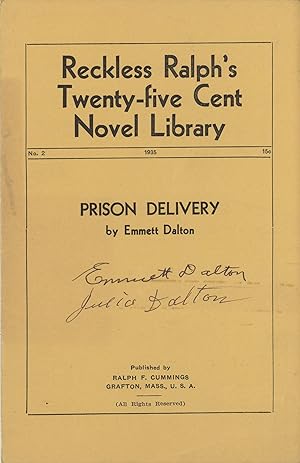
RECKLESS RALPH'S TWENTY-FIVE CENT NOVEL LIBRARY NO. 2, 1935; FEATURING "PRISON DELIVERY" BY EMMETT DALTON; SIGNED BY EMMETT AND JULIA DALTON ON THE FRONT WRAPPER
Published by Ralph F. Cummings, Grafton, Mass., 1935
Seller: Wallace & Clark, Booksellers, Katy, TX, U.S.A.
Seller rating 5 out of 5 stars
Magazine / Periodical First Edition Signed
Soft cover. Condition: Near Fine. 1st Edition. (Crime and Punishment) RECKLESS RALPH'S TWENTY-FIVE CENT NOVEL LIBRARY NO. 2, 1935; FEATURING "PRISON DELIVERY" BY EMMETT DALTON; SIGNED BY EMMETT AND JULIA DALTON ON THE FRONT WRAPPER. Grafton, Mass.: Ralph F. Cummings, 1935. FIRST EDITION. 8vo - 8-5/16" x 5-7/16". Original yellow paper wrappers with titles printed in black to front wrapper, with minor toning along spine and a few light stray marks; also on front wrapper are the full signatures in ink of Emmett Dalton and his wife Julia Dalton; back wrapper with minor toning along the lower edge and other light signs of handling for what is a nice copy of the periodical. 8 pp.; staple bound and laid in wrappers as issued. Reckless Ralph's Twenty-Five Cent Novel Library was an early dime novel fanzine self-published by Ralph F. Cummings. It was devoted to the collecting and preservation of the old-time dime and nickel novels, libraries and popular story papers and all the wonderful American literature contained within them. The feature article in the issue offered here is "Prison Delivery" by Emmett Dalton. Dalton, in addition to being an author, was an outlaw, train robber and member of the infamous Dalton gang in the American Old West. The Dalton gang was implicated in a series of train robberies that began in 1889. In 1892, the M-K-T Railroad posted a $40,000 reward for the capture of the Daltons whose notoriety had increased substantially in just three short years. On October 5, 1892, short on money and long on wanting to out do the James gang's record, the Daltons robbed two banks in Coffeyville, Kansas in one day. While successful in both robberies, the Daltons were not successful in steering clear of an angry mob of local citizens that ambushed them, killing four of the five gang members and leaving the fifth, Emmett Dalton, with 23 gunshot wounds and an eventual life sentence in the penitentiary in Lansing, Kansas. After serving 14 years of his life sentence, Dalton was pardoned by the Kansas governor. After his release from prison, Dalton moved to California where he got married to Julia Johnson, wrote two books, played himself in the Hollywood movie version of his first book, "Beyond the Law," consulted on other movie projects and sold real estate. The first article in the magazine, "Prison Delivery" by Emmett Dalton, is a critique of America's prison policies and prison systems. In it he offers suggestions based on his own personal experiences and observations he made during his 14 years behind bars, as to how to improve the lot of the over four hundred thousand "prison deliveries" (Dalton's term for the men, women and juveniles released from confinement) made every year into the neighborhoods and homes next door to the law abiding masses. Dalton believed that the implementation of his ideas and observations would improve the lives of the people coming out of prison systems every year, and by extension, the lives of all the people who would be coming into contact with them. The second article in the magazine, "Two Remarkable Heroes: The Deadwood Dicks, Senor and Junior, Are the Gentlemen" was written by the magazine's publisher, Ralph F. Cummings. In this article, Cummings argues that a trace of literature from the beginning of time to his present day would "show but few heroes that in the eyes of boyhood would be even judged worthy of comparison with the two greatest heroes known to American literature . . . Deadwood Dick and Deadwood Dick, Jr." I would personally go out on a limb and say that Ralph F. Cummings really, really liked the two Deadwood Dicks! The condition of the magazine is NEAR FINE. Only seven copies located on OCLC/WorldCat. RARE; and probably unique signed by the famous outlaw author and his wife. Note: Magazine will be accompanied by a "Letter of Authenticity" from PSA/DNA Authenticating Services, authenticating both Emmett and Julia Dalton's signatures; PSA/DNA Certification Number: AL04813. Signed by Author(s).
-
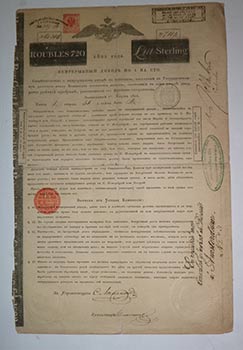
Russian Annuity Bond signed by N.M. Rothschild. Five per Cent. Roubles 720. £111 Sterling. First edition of the document.
Published by St. Petersburg: Imperial Russian Government, 1822
Seller: Wittenborn Art Books, San Francisco, CA, U.S.A.
Seller rating 5 out of 5 stars
Manuscript / Paper Collectible Signed
Condition: Good. 36 x 23.5 cm. Printed document in Russian, French and English; with various signatures, one of which is described elsewhere as that of N.M. Rothschild; With wet stamps. Hand numbered. "Russian Annuity Bond signed by N.M. Rothschild. FIVE per Cent. ANNUITY. Certificate of a perpetual Annuity in the Great Book of the Public Debt of the Imperial Commission of the Sinking Fund.The Bearer of this Certificate, on application to the Commission of the Sinking Fund, may cause it to be converted into an Inscription in the Great Book, in his own name, or that of any person or persons whom he shall designate; in which case the Dividends will he payable in St.-Petersburg only, at the periods above mentioned; and the transfer, or cession of such Inscription be made according to the existing Regulations. Twenty-four Dividend Warrants are hereunto attached; if, when the last becomes payable, the Capital has not been redeemed or inscribed in the Great Book, twenty-four similar Warrants will be issued, and so forward, and in such manner as to secure to the Holder of this Certificate the due payment of the Annuity in St.-Petersburg or London. St. Petersburg, Russia, 1822 March 1. In Russian, printed in French and English on verso. Five percent annuity certificate for a loan issued in 1918 with an expiration date of March 1930. . In part: "Certificate of a perpetual Annuity in the Great Book of the Public Debt of the Sinking Fund, representing a Capital of Seven Hundred and Twenty Silver Roubles". The bearer was entitled to an annuity of 36 silver roubles. A sinking fund is a special reserve account into which the issuer promises to deposit funds at regular intervals and use the cash that accumulates to redeem the bonds, giving bondholders extra protection against default. Also signed by the Director of the Commission on verso. At the time this bond was signed, ALEXANDER I (1777-1825) was Czar of Russia (1801-1825). During the reign of Alexander, who was known for alternately befriending and then fighting with Napoléon I, St. Petersburg became the social and artistic center of Europe. NATHAN M. ROTHSCHILD (1777-1836), who created the bulk of his family's wealth with his bank, N.M. Rothschild, and his investments, was the third son of Mayer Rothschild, who had founded a money-lending business in Frankfurt and was the agent of the British government in subsidizing European sovereigns during the Napoléonic Wars. Nathan, who left for England in 1799, where he was a textile and general merchant before moving into finance, was one of the world's richest men when he died in 1836. Nathan's son Lionel was elected to Parliament but was not allowed to take his seat because he was Jewish. Lionel's son, Sir Nathan Mayer Rothschild, 1st Baron Rothschild, was the first Jew admitted to the House of Lords. His son, 2nd Baron Rothschild, received the Balfour Declaration in 1917.NB. A Special Fund of ONE per Cent, on the Amount of this Loan is appropriated for its redemption. Extract from the Regulations of the Commission. Chap. 2:? 22. The payment of the perpetual Annuity, as well as the payment of the outstanding Debts, will be effected in time of Peace, as well as in time of War, without distinction, whether the creditor belongs to a friendly or a hostile nation.? 23. If a Foreigner, proprietor of Inscriptions, dies intestate, the inscriptions shall pass to his heirs, in the order of succession established by the Laws of the Country of which he was a subject.? 24. The Capital placed in the Perpetual Debt being considered as an inviolable Property, sliall be exempt from sequestration, both for claims of the Crown and those of individuals, unless these Capitals, in whole or in part have been given in security for Contracts of provisions, or by any other Articles of Agreement, whether with the Crown or with private individuals, or for the purpose of bailing any claim; in which case they are subject to the general Laws, concerning mortgages and bails. These Capitals are likewise exempted in all cases from every Tax.? 25- No Person can be constrained to take back the whole or a part of the Capital placed in tlie Perpetual Debt. But to facilitate to the Proprietors of Inscriptions the means of converting them, when they desire it into ready money, the Commission will employ annually, for the purpose of repurchasing them, at the current price, a Capital of the Sinking Fund which shall be assigned beyond the Fund necessary for the Payment of the perpetual Interest.This Russian bond from 1822 is widely recognized as the first Eurobond. Issued by the House of Rothschild in London, Frankfurt, Paris and Vienna, the bond promised payment in European currencies, as well as in Russian rubles. Perhaps more importantly, dividends could be claimed in any of the above cities -- effectively protecting the bondholder from the effects of a continental war -- if you are forced to flee the country, you can take your bonds with you to any one of four safe havens and expect payment! This is certified by none other than Nathan Rothschild -- one of the most famous investment bankers of all time. His signature appears on the upper right hand side of the bond. Missing from the bond are the original coupons -- they were all clipped and exchanged for payment. Although titled an annuity, the 1822 issue was a perpetuity -- a promise by Russia to pay a dividend to the bondholder forever -- or at least until the Revolution of 1917.Nathan Mayer Rothschild (1777-1836) founded the British branch of the Rothschild banking house in London in 1805 and became the first Jew admitted to the House of Lords. He took a leading part in managing and financing the subsidies that the British government transferred to its allies during the Napoleonic Wars. Nathan Mayer's eldest son, Lionel Nathan Rothschild (1808-79), who succeeded him as manager of the London branch, financed the British government's purchase of a controlling interest in the Suez Canal in 1875. Lionel Natha.