
Force Example: First Edition (3 results)

Published by Soviet Booklets, London 1963
- Softcover
- First Edition
Seller: Left On The Shelf (PBFA), Kendal, United KingdomLeft On The Shelf (PBFA)
Contact seller5-star sellerAssociation member: PBFA
Condition: Used - Good
US$ 9.52
US$ 39.60 shippingShips from United Kingdom to U.S.A.Quantity: 1 available
Pamphlet. Condition: Good+. 1st Edition. 15pp. Soviet Booklet No.119.
Published by M.J. Godwin and Co., London 1822
- Softcover
- First Edition
Seller: Muir Books [Robert Muir Old & Rare Books], PERTH, WA, AustraliaMuir Books [Robert Muir Old & Rare Books]
Contact seller5-star sellerCondition: Used
US$ 356.13
US$ 28.00 shippingShips from Australia to U.S.A.Quantity: 1 available
Stiff Wraps. 1st edition. 1st ed., sm. octavo, pp.(ii), (3)-19, 9 hand-coloured engravings, incl t.p. vignette, publisher's advert rep, most cnrs missing now repaired, scattered foxing, pages soiled, tanned with staining and creasing, child's scribble to recto p.19, sections of orig wraps missing, woodcut on front darkened and d…amaged, professionally restored and remains of front wrap laid onto new bd and rebacked in dark brown cloth, contemporary pres inscr to fep. (Robert Twyford Mills from his affectionate Mother, 1st January 1825), though a poor copy the plates are in good condn. Scarce. Complete with nine hand-coloured engravings which feature a boy with a bee, a dog, a bird and a horse. The author was a writer in the late 18th to early 19th centuries.
 More images
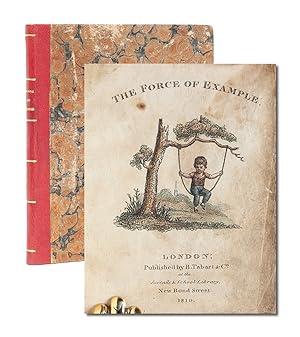
Published by Published by B. Tabart & Co. at the Juvenile & School Library, London 1810
- First Edition
Seller: Whitmore Rare Books, Inc. -- ABAA, ILAB, Pasadena, CA, U.S.A.Whitmore Rare Books, Inc. -- ABAA, ILAB
Contact seller5-star sellerFirst edition. Contemporary quarter morocco over marbled boards, rebacked with gilt to spine. Measuring 125 x 105mm and collating complete in 8 pages with hand-colored frontis and 8 hand-colored plates. A Near Fine copy in and out, with minimal rubbing to boards. Occasional marginal soiling, and archival reinforcement to fore-ed…ge of title page and to a small hole in pages 3-4 not affecting text. OCLC notes no institutional copies of this small text, though Moon documents incomplete copies at UCLA and the Lilly. There are no other examples on the market. An influential teacher, essayist, and women's activist, Barbauld was one of the later generation members of the Bluestocking Circle which had included Maria Edgeworth and Hannah More. The daughter of Presbyterian dissenters, she was trained early on in classical and modern languages, history, and literature; this access to knowledge shaped her work as she pushed for the expansion of women's education. Though much of her work was addressed to young women, her series of four age-adapted reading primers titled Lessons for Children (1778-1779) initiated a revolution in children's literature in the English-speaking world. "The work is still regarded as a landmark in the approach to the reading of the very young child. The secret of Barbauld's success was that, for the first time, she wrote for a child that was maturing as they progressed through the books. The prose became successively more complex, using longer words, less facile subjects, and more complicated narrative structures. The book was printed in a large, clear typeface, with large gaps between the words, designed to facilitate an adult pointing to each successive word" (Hockliffe Collection). In content and form, the series was revolutionary. The present children's book takes one of Barbauld's lessons and versifies it for even younger readers. Replicating the typography of the original series, it also includes charming illustrations of the narrative to guide small readers and keep their attention. Within the text, a Mother sends her small son to school and admonishes him to work hard. When he meanders through the woods instead, seeking to make friends with various creatures, the natural world chides him for idleness as an ant, a sheep dog, a goldfinch, a horse, and a honey bee each inform him of the important work they do. It is his part to do his, and so he resolves to attend to his lessons. The effectiveness of this versification led to later editions, in 1819 and 1822 respectively. Moon 44.1.
