
Foundations Economic Analysis by Samuelson Paul: Signed (6 results)

Published by Harvard University Press, Cambridge 1948
- Hardcover
- First Edition
- Signed
Seller: Raptis Rare Books, Palm Beach, FL, U.S.A.Raptis Rare Books
Contact seller5-star sellerThird printing of the Nobel Prize-winning economistâs magnum opus and one of the most influential economic texts of the twentieth century. Octavo, original burgundy cloth with titles in gilt. Boldly signed by the author on the title page, "Paul A. Samuelson MIT" on the title page. Near fine in a near fine dust jacket. An excepti…onal example, uncommon signed. Paul Samuelson is one of the developers of both neo-Keynesian and neoclassical economics, the latter of which still dominates mainstream economics. He was awarded the Nobel Memorial Prize in Economic Sciences in 1970 for having written considerable parts of economic theory. The title of this work "was meant to be exactly as ambitious as it sounds, and the book's impact on the profession has largely justified it For the first time in a book in English on economic principles, the mathematics, instead of being relegated to an appendix, provided the skeleton of the argument Fifty years after it was written, the Foundations (together with Hicks' Value and Capital) is still one of the most inspiring classics of general equilibrium economics (Niehans, History of Economic Theory, 423).
 More images
Published by Harvard University Press, Cambridge 1947
- Hardcover
- First Edition
- Signed
Seller: Raptis Rare Books, Palm Beach, FL, U.S.A.Raptis Rare Books
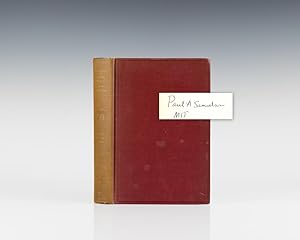
Contact seller5-star sellerFirst edition of the Nobel Prize-winning economistâs magnum opus and one of the most influential economic texts of the twentieth century. Octavo, original burgundy cloth with titles in gilt. Boldly signed by the author on the title page, "Paul A. Samuelson MIT." In near fine condition with light rubbing. Housed in a custom half…morocco clamshell box. A very nice example, uncommon signed. Paul Samuelson is one of the developers of both neo-Keynesian and neoclassical economics, the latter of which still dominates mainstream economics. He was awarded the Nobel Memorial Prize in Economic Sciences in 1970 for having written considerable parts of economic theory. The title of this work "was meant to be exactly as ambitious as it sounds, and the book's impact on the profession has largely justified it For the first time in a book in English on economic principles, the mathematics, instead of being relegated to an appendix, provided the skeleton of the argument Fifty years after it was written, the Foundations (together with Hicks' Value and Capital) is still one of the most inspiring classics of general equilibrium economics (Niehans, History of Economic Theory, 423).
 More images
Published by Harvard University Press, Cambridge 1947
- Hardcover
- First Edition
- Signed
Seller: Raptis Rare Books, Palm Beach, FL, U.S.A.Raptis Rare Books
Contact seller5-star sellerFirst edition of the Nobel Prize-winning economistâs magnum opus and one of the most influential economic texts of the twentieth century. Octavo, original burgundy cloth with titles in gilt. Signed "Paul A. Samuelson MIT" on the title page. An excellent example with light wear to the cloth, some toning to the spine, near fine. H…oused in a custom half morocco clamshell box. Paul Samuelson is one of the developers of both neo-Keynesian and neoclassical economics, the latter of which still dominates mainstream economics. He was awarded the Nobel Memorial Prize in Economic Sciences in 1970 for having written considerable parts of economic theory. The title of this work "was meant to be exactly as ambitious as it sounds, and the book's impact on the profession has largely justified it For the first time in a book in English on economic principles, the mathematics, instead of being relegated to an appendix, provided the skeleton of the argument Fifty years after it was written, the Foundations (together with Hicks' Value and Capital) is still one of the most inspiring classics of general equilibrium economics (Niehans, History of Economic Theory, 423).
 More images
Published by Cambridge, Massachusetts: Harvard University Press, 1947 1947
- First Edition
- Signed
Seller: Peter Harrington. ABA/ ILAB., London, United KingdomPeter Harrington. ABA/ ILAB.
Contact seller5-star sellerCondition: Used
US$ 10,321.92
US$ 29.40 shippingShips from United Kingdom to U.S.A.Quantity: 1 available
First edition, inscribed by the author on the front free endpaper, "This book was written for economists like Roman Weil, Paul A. Samuelson, AB Chicago '35. MIT, June 2001". Weil (1940-2023) was a faculty member of the Booth School of Business at the University of Chicago from 1965 to 2008, where he was especially known for his…work on bond duration. He has inserted a pencilled slip, noting, "His textbook & my freshman Yale teacher, G. G. Gaul, turned me on to economics. I didn't look at this till I was a graduate student in the mid 1960s. Didn't mean much to me then or now. Still 1st book by 1st USA Econ. Nobelist, RLW 07/01". Samuelson's inscription refers to his graduation from Chicago in 1935. Foundations is the Nobel prize-winning economist's first book, based on his Harvard doctoral dissertation, which established mathematics as the foundation of economics. "More than anyone else he [Samuelson] bears responsibility for the mathematical bent of economics in the late 20th century" (Pressman, pp. 162-3). Samuelson shows that the common mathematical structure underlying multiple branches of economics is based on a set of basic principles: the optimizing behaviour of agents and the stability of equilibrium for economic systems. Fundaburk 2039; Mattioli 3186. Steven Pressman, Fifty Major Economists, 1999. Octavo. Tables, graphs, and formulas in the text. Original red cloth, spine lettered and with publisher's device in gilt, covers panelled in blind. Housed in custom brown quarter cloth solander box. Spine very slightly sunned, extremities very slightly rubbed, contents clean and unmarked. A very good copy.
 More images
Published by Cambridge, Massachusetts: Harvard University Press, 1947 1947
- First Edition
- Signed
Seller: Peter Harrington. ABA/ ILAB., London, United KingdomPeter Harrington. ABA/ ILAB.
Contact seller5-star sellerCondition: Used
US$ 5,160.96
US$ 29.40 shippingShips from United Kingdom to U.S.A.Quantity: 1 available
First edition, first printing, with a loosely inserted slip signed by Samuelson at MIT in 1979, and formerly belonging to Ragnar Nurkse (1907-2007), a key founder of development economics, with his ink signature on the front free endpaper. In 1947, Nurkse had just joined Columbia University as an associate professor of economics…. Interestingly, Samuelson does not appear to have been sympathetic to development economics, warning in 2004 that continued economic integration of global markets would damage high-wage jobs in more highly developed countries. Foundations is the Nobel Prize-winning economist's first book, which established mathematics as the foundation of economics, rather than an addendum. It is based on Samuelson's doctoral dissertation at Harvard. "Regarded by most economists as providing the mathematical foundations for contemporary economics. more than anyone else he bears responsibility for the mathematical bent of economics in the late 20th century" (Pressman, pp. 162-3). Samuelson demonstrates that the common mathematical structure underlying multiple branches of economics is based on a set of basic principles: the optimizing behaviour of agents and the stability of equilibrium for economic systems. Fundaburk 2039; Mattioli 3186. Steven Pressman, Fifty Major Economists, 1999. Octavo. Tables, graphs, and formulas in the text. Original red cloth, spine lettered and with publisher's device in gilt, covers panelled in blind. Short pencil annotation on p. x. Cloth bright, minimal bumping and rubbing, faint toning to spine, minor browning and foxing to outer leaves: a very good copy indeed.
 More images
Published by Harvard University Press, Cambridge, MA 1961
- Signed
Seller: Burnside Rare Books, ABAA, Portland, OR, U.S.A.Burnside Rare Books, ABAA
Contact seller5-star sellerCondition: Used - Very good
US$ 2,500.00
Free ShippingShips within U.S.A.Quantity: 1 available
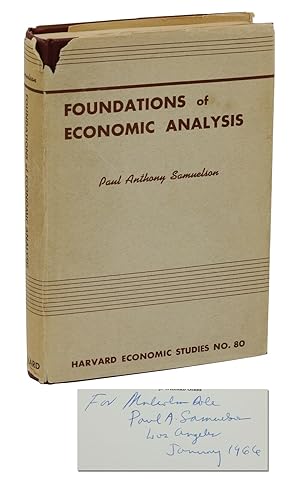
Condition: Very Good+. Dust Jacket Condition: Good+. Signed by Paul Samuelson, inscribed "For Malcolm Dole / [signed] Paul A. Samuelson / Los Angeles / January 1966" on title page. xii, 447 pp. Original crimson cloth, spine lettered in gilt. Sixth printing of the first edition. Very Good+ with bookplate to paste down, some under…lines in light pencil to early pages, UCLA Student bookstore stamp on rear blank, another former owner's name written on rear endpaper. In Good+ unclipped jacket, chipped at extremities (largest being at head), tidemark to foot, spine panel toned. An uncommon signed copy of Samuelson's classic economics text.


