
Order Total (1 Item Items):
Shipping Destination:

Fundamentals Astrodynamics Second Edition by Bate Roger (18 results)
Skip to main search results
Search filters
Product Type
- All Product Types
- Books (18)
- Magazines & Periodicals (No further results match this refinement)
- Comics (No further results match this refinement)
- Sheet Music (No further results match this refinement)
- Art, Prints & Posters (No further results match this refinement)
- Photographs (No further results match this refinement)
- Maps (No further results match this refinement)
- Manuscripts & Paper Collectibles (No further results match this refinement)
Condition Learn more
- New (17)
- As New, Fine or Near Fine (No further results match this refinement)
- Very Good or Good (1)
- Fair or Poor (No further results match this refinement)
- As Described (No further results match this refinement)
Binding
- All Bindings
- Hardcover (No further results match this refinement)
- Softcover (18)
Collectible Attributes
- First Edition (No further results match this refinement)
- Signed (No further results match this refinement)
- Dust Jacket (No further results match this refinement)
- Seller-Supplied Images (8)
- Not Print on Demand (18)
Language (1)
Price
- Any Price
- Under US$ 25
- US$ 25 to US$ 50
- Over US$ 50 (No further results match this refinement)
Free Shipping
Seller Location
Seller Rating
-
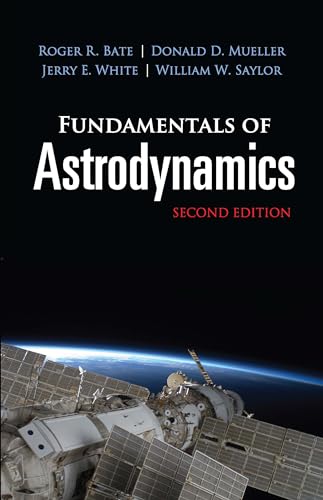
Fundamentals of Astrodynamics: Second Edition (Dover Books on Physics)
Seller: World of Books (was SecondSale), Montgomery, IL, U.S.A.
Seller rating 5 out of 5 stars

Condition: Very Good. Item in very good condition! Textbooks may not include supplemental items i.e. CDs, access codes etc.
-

Fundamentals of Astrodynamics: Second Edition
Published by Dover Publications Inc., US, 2020
ISBN 10: 0486497046 ISBN 13: 9780486497044
Language: English
Paperback. Condition: New. When the United States Air Force Academy began teaching astrodynamics to undergraduates majoring in astronautics or aerospace engineering, it found that the traditional approach to the subject was well over 100 years old. An entirely new text had to be evolved, geared to the use of high speed digital computers and actual current practice in the industry. Over the years the new approach was proven in the classrooms of the Academy; its students entering graduate engineering schools were found to possess a better understanding of astrodynamics than others. So pressing is the need for superior training in the aerospace sciences that the professor-authors of this text decided to publish it for other institutions' use. This Dover edition is the result.The text is structured for teaching. Central emphasis is on use of the universal variable formulation, although classical methods are discussed. Several original unpublished derivations are included. A foundation for all that follows is the development of the basic two-body and n-body equations of motion; orbit determination is then treated, and the classical orbital elements, coordinate transformations, and differential correction. Orbital transfer maneuvers are developed, followed by time-of-flight with emphasis on the universal variable solution. The Kepler and Gauss problems are treated in detail. Two-body mechanics are applied to the ballistic missile problem, including launch error analysis and targeting on a rotating earth. Some further specialized applications are made to lunar and interplanetary flight, followed by an introduction to perturbation, special perturbations, integration schemes and errors, and analytic formulation of several common perturbations.Example problems are used frequently, while exercises at the end of each chapter include derivations and quantitative and qualitative problems. The authors suggest how to use the text for a first course in astrodynamics or for a two-course sequence.This major instructional tool effectively communicates the subject to engineering students in a manner found in no other textbook. Its efficiency has been thoroughly demonstrated. Dover feels privileged in joining with the authors to make its concepts and text matter available to other faculties.
-
-

Fundamentals of Astrodynamics: Second Edition (Paperback)
Published by Dover Publications Inc., New York, 2020
ISBN 10: 0486497046 ISBN 13: 9780486497044
Language: English
Paperback. Condition: new. Paperback. When the United States Air Force Academy began teaching astrodynamics to undergraduates majoring in astronautics or aerospace engineering, it found that the traditional approach to the subject was well over 100 years old. An entirely new text had to be evolved, geared to the use of high speed digital computers and actual current practice in the industry. Over the years the new approach was proven in the classrooms of the Academy; its students entering graduate engineering schools were found to possess a better understanding of astrodynamics than others. So pressing is the need for superior training in the aerospace sciences that the professor-authors of this text decided to publish it for other institutions' use. This Dover edition is the result. The text is structured for teaching. Central emphasis is on use of the universal variable formulation, although classical methods are discussed. Several original unpublished derivations are included. A foundation for all that follows is the development of the basic two-body and n-body equations of motion; orbit determination is then treated, and the classical orbital elements, coordinate transformations, and differential correction. Orbital transfer maneuvers are developed, followed by time-of-flight with emphasis on the universal variable solution. The Kepler and Gauss problems are treated in detail. Two-body mechanics are applied to the ballistic missile problem, including launch error analysis and targeting on a rotating earth. Some further specialized applications are made to lunar and interplanetary flight, followed by an introduction to perturbation, special perturbations, integration schemes and errors, and analytic formulation of several common perturbations. Example problems are used frequently, while exercises at the end of each chapter include derivations and quantitative and qualitative problems. The authors suggest how to use the text for a first course in astrodynamics or for a two-course sequence. This major instructional tool effectively communicates the subject to engineering students in a manner found in no other textbook. Its efficiency has been thoroughly demonstrated. Dover feels privileged in joining with the authors to make its concepts and text matter available to other faculties. AUTHORS: All of the authors are present or former members of the faculty of the Department of Astronautics at the U.S. Air Force Academy. Jerry E. White is still active, and William W. Saylor is the new team member. Widely known and used throughout the astrodynamics and aerospace engineering communities, this teaching text was developed at the U.S. Air Force Academy. Completely revised and updated 2013 edition. Shipping may be from multiple locations in the US or from the UK, depending on stock availability.
-
Fundamentals of Astrodynamics: Second Edition
Published by Dover Publications Inc., 2020
ISBN 10: 0486497046 ISBN 13: 9780486497044
Language: English
PAP. Condition: New. New Book. Shipped from UK. Established seller since 2000.
-
Fundamentals of Astrodynamics: Second Edition
Published by Dover Publications Inc., 2020
ISBN 10: 0486497046 ISBN 13: 9780486497044
Language: English
Seller: PBShop.store UK, Fairford, GLOS, United Kingdom
Seller rating 5 out of 5 stars
PAP. Condition: New. New Book. Shipped from UK. Established seller since 2000.
-
Fundamentals of Astrodynamics: Second Edition (Paperback or Softback)
Published by Dover Publications 1/15/2020, 2020
ISBN 10: 0486497046 ISBN 13: 9780486497044
Language: English
Paperback or Softback. Condition: New. Fundamentals of Astrodynamics: Second Edition. Book.
-

Fundamentals of Astrodynamics: Second Edition
Published by Dover Publications Inc., US, 2020
ISBN 10: 0486497046 ISBN 13: 9780486497044
Language: English
Seller: Rarewaves.com USA, London, LONDO, United Kingdom
Seller rating 5 out of 5 stars
Paperback. Condition: New. When the United States Air Force Academy began teaching astrodynamics to undergraduates majoring in astronautics or aerospace engineering, it found that the traditional approach to the subject was well over 100 years old. An entirely new text had to be evolved, geared to the use of high speed digital computers and actual current practice in the industry. Over the years the new approach was proven in the classrooms of the Academy; its students entering graduate engineering schools were found to possess a better understanding of astrodynamics than others. So pressing is the need for superior training in the aerospace sciences that the professor-authors of this text decided to publish it for other institutions' use. This Dover edition is the result.The text is structured for teaching. Central emphasis is on use of the universal variable formulation, although classical methods are discussed. Several original unpublished derivations are included. A foundation for all that follows is the development of the basic two-body and n-body equations of motion; orbit determination is then treated, and the classical orbital elements, coordinate transformations, and differential correction. Orbital transfer maneuvers are developed, followed by time-of-flight with emphasis on the universal variable solution. The Kepler and Gauss problems are treated in detail. Two-body mechanics are applied to the ballistic missile problem, including launch error analysis and targeting on a rotating earth. Some further specialized applications are made to lunar and interplanetary flight, followed by an introduction to perturbation, special perturbations, integration schemes and errors, and analytic formulation of several common perturbations.Example problems are used frequently, while exercises at the end of each chapter include derivations and quantitative and qualitative problems. The authors suggest how to use the text for a first course in astrodynamics or for a two-course sequence.This major instructional tool effectively communicates the subject to engineering students in a manner found in no other textbook. Its efficiency has been thoroughly demonstrated. Dover feels privileged in joining with the authors to make its concepts and text matter available to other faculties.
-
Paperback. Condition: new. Excellent Condition.Excels in customer satisfaction, prompt replies, and quality checks.
-
Fundamentals of Astrodynamics: Second Edition: Second Edition
Published by Dover Publications Inc., 2020
ISBN 10: 0486497046 ISBN 13: 9780486497044
Language: English
Seller: Kennys Bookshop and Art Galleries Ltd., Galway, GY, Ireland
Seller rating 5 out of 5 stars
Condition: New. 2019. 2nd edition. Paperback. . . . . .
-
Fundamentals of Astrodynamics: Second Edition (Dover Books on Physics)
Seller: Ria Christie Collections, Uxbridge, United Kingdom
Seller rating 5 out of 5 stars
US$ 25.55
US$ 15.86 shipping from United Kingdom to U.S.A.Quantity: Over 20 available
Add to basketCondition: New. In.
-
Fundamentals of Astrodynamics: Second Edition: Second Edition
Published by Dover Publications Inc., 2020
ISBN 10: 0486497046 ISBN 13: 9780486497044
Language: English
Condition: New. 2019. 2nd edition. Paperback. . . . . . Books ship from the US and Ireland.
-
Fundamentals of Astrodynamics: Seco: Second Edition
Published by Dover Publications Inc., 2020
ISBN 10: 0486497046 ISBN 13: 9780486497044
Language: English
Seller: THE SAINT BOOKSTORE, Southport, United Kingdom
Seller rating 5 out of 5 stars
US$ 23.54
US$ 21.65 shipping from United Kingdom to U.S.A.Quantity: Over 20 available
Add to basketPaperback / softback. Condition: New. New copy - Usually dispatched within 4 working days. 560.
-
paperback. Condition: New. Second. Special order direct from the distributor.
-

Fundamentals of Astrodynamics: Second Edition (Paperback)
Published by Dover Publications Inc., New York, 2020
ISBN 10: 0486497046 ISBN 13: 9780486497044
Language: English
Paperback. Condition: new. Paperback. When the United States Air Force Academy began teaching astrodynamics to undergraduates majoring in astronautics or aerospace engineering, it found that the traditional approach to the subject was well over 100 years old. An entirely new text had to be evolved, geared to the use of high speed digital computers and actual current practice in the industry. Over the years the new approach was proven in the classrooms of the Academy; its students entering graduate engineering schools were found to possess a better understanding of astrodynamics than others. So pressing is the need for superior training in the aerospace sciences that the professor-authors of this text decided to publish it for other institutions' use. This Dover edition is the result. The text is structured for teaching. Central emphasis is on use of the universal variable formulation, although classical methods are discussed. Several original unpublished derivations are included. A foundation for all that follows is the development of the basic two-body and n-body equations of motion; orbit determination is then treated, and the classical orbital elements, coordinate transformations, and differential correction. Orbital transfer maneuvers are developed, followed by time-of-flight with emphasis on the universal variable solution. The Kepler and Gauss problems are treated in detail. Two-body mechanics are applied to the ballistic missile problem, including launch error analysis and targeting on a rotating earth. Some further specialized applications are made to lunar and interplanetary flight, followed by an introduction to perturbation, special perturbations, integration schemes and errors, and analytic formulation of several common perturbations. Example problems are used frequently, while exercises at the end of each chapter include derivations and quantitative and qualitative problems. The authors suggest how to use the text for a first course in astrodynamics or for a two-course sequence. This major instructional tool effectively communicates the subject to engineering students in a manner found in no other textbook. Its efficiency has been thoroughly demonstrated. Dover feels privileged in joining with the authors to make its concepts and text matter available to other faculties. AUTHORS: All of the authors are present or former members of the faculty of the Department of Astronautics at the U.S. Air Force Academy. Jerry E. White is still active, and William W. Saylor is the new team member. Widely known and used throughout the astrodynamics and aerospace engineering communities, this teaching text was developed at the U.S. Air Force Academy. Completely revised and updated 2013 edition. Shipping may be from our UK warehouse or from our Australian or US warehouses, depending on stock availability.
-

Fundamentals of Astrodynamics: Second Edition
Published by Dover Publications Inc., US, 2020
ISBN 10: 0486497046 ISBN 13: 9780486497044
Language: English
Paperback. Condition: New. When the United States Air Force Academy began teaching astrodynamics to undergraduates majoring in astronautics or aerospace engineering, it found that the traditional approach to the subject was well over 100 years old. An entirely new text had to be evolved, geared to the use of high speed digital computers and actual current practice in the industry. Over the years the new approach was proven in the classrooms of the Academy; its students entering graduate engineering schools were found to possess a better understanding of astrodynamics than others. So pressing is the need for superior training in the aerospace sciences that the professor-authors of this text decided to publish it for other institutions' use. This Dover edition is the result.The text is structured for teaching. Central emphasis is on use of the universal variable formulation, although classical methods are discussed. Several original unpublished derivations are included. A foundation for all that follows is the development of the basic two-body and n-body equations of motion; orbit determination is then treated, and the classical orbital elements, coordinate transformations, and differential correction. Orbital transfer maneuvers are developed, followed by time-of-flight with emphasis on the universal variable solution. The Kepler and Gauss problems are treated in detail. Two-body mechanics are applied to the ballistic missile problem, including launch error analysis and targeting on a rotating earth. Some further specialized applications are made to lunar and interplanetary flight, followed by an introduction to perturbation, special perturbations, integration schemes and errors, and analytic formulation of several common perturbations.Example problems are used frequently, while exercises at the end of each chapter include derivations and quantitative and qualitative problems. The authors suggest how to use the text for a first course in astrodynamics or for a two-course sequence.This major instructional tool effectively communicates the subject to engineering students in a manner found in no other textbook. Its efficiency has been thoroughly demonstrated. Dover feels privileged in joining with the authors to make its concepts and text matter available to other faculties.
-

Fundamentals of Astrodynamics: Second Edition (Paperback)
Published by Dover Publications Inc., New York, 2020
ISBN 10: 0486497046 ISBN 13: 9780486497044
Language: English
Paperback. Condition: new. Paperback. When the United States Air Force Academy began teaching astrodynamics to undergraduates majoring in astronautics or aerospace engineering, it found that the traditional approach to the subject was well over 100 years old. An entirely new text had to be evolved, geared to the use of high speed digital computers and actual current practice in the industry. Over the years the new approach was proven in the classrooms of the Academy; its students entering graduate engineering schools were found to possess a better understanding of astrodynamics than others. So pressing is the need for superior training in the aerospace sciences that the professor-authors of this text decided to publish it for other institutions' use. This Dover edition is the result. The text is structured for teaching. Central emphasis is on use of the universal variable formulation, although classical methods are discussed. Several original unpublished derivations are included. A foundation for all that follows is the development of the basic two-body and n-body equations of motion; orbit determination is then treated, and the classical orbital elements, coordinate transformations, and differential correction. Orbital transfer maneuvers are developed, followed by time-of-flight with emphasis on the universal variable solution. The Kepler and Gauss problems are treated in detail. Two-body mechanics are applied to the ballistic missile problem, including launch error analysis and targeting on a rotating earth. Some further specialized applications are made to lunar and interplanetary flight, followed by an introduction to perturbation, special perturbations, integration schemes and errors, and analytic formulation of several common perturbations. Example problems are used frequently, while exercises at the end of each chapter include derivations and quantitative and qualitative problems. The authors suggest how to use the text for a first course in astrodynamics or for a two-course sequence. This major instructional tool effectively communicates the subject to engineering students in a manner found in no other textbook. Its efficiency has been thoroughly demonstrated. Dover feels privileged in joining with the authors to make its concepts and text matter available to other faculties. AUTHORS: All of the authors are present or former members of the faculty of the Department of Astronautics at the U.S. Air Force Academy. Jerry E. White is still active, and William W. Saylor is the new team member. Widely known and used throughout the astrodynamics and aerospace engineering communities, this teaching text was developed at the U.S. Air Force Academy. Completely revised and updated 2013 edition. Shipping may be from our Sydney, NSW warehouse or from our UK or US warehouse, depending on stock availability.
-

Fundamentals of Astrodynamics: Second Edition
Published by Dover Publications Inc., US, 2020
ISBN 10: 0486497046 ISBN 13: 9780486497044
Language: English
Paperback. Condition: New. When the United States Air Force Academy began teaching astrodynamics to undergraduates majoring in astronautics or aerospace engineering, it found that the traditional approach to the subject was well over 100 years old. An entirely new text had to be evolved, geared to the use of high speed digital computers and actual current practice in the industry. Over the years the new approach was proven in the classrooms of the Academy; its students entering graduate engineering schools were found to possess a better understanding of astrodynamics than others. So pressing is the need for superior training in the aerospace sciences that the professor-authors of this text decided to publish it for other institutions' use. This Dover edition is the result.The text is structured for teaching. Central emphasis is on use of the universal variable formulation, although classical methods are discussed. Several original unpublished derivations are included. A foundation for all that follows is the development of the basic two-body and n-body equations of motion; orbit determination is then treated, and the classical orbital elements, coordinate transformations, and differential correction. Orbital transfer maneuvers are developed, followed by time-of-flight with emphasis on the universal variable solution. The Kepler and Gauss problems are treated in detail. Two-body mechanics are applied to the ballistic missile problem, including launch error analysis and targeting on a rotating earth. Some further specialized applications are made to lunar and interplanetary flight, followed by an introduction to perturbation, special perturbations, integration schemes and errors, and analytic formulation of several common perturbations.Example problems are used frequently, while exercises at the end of each chapter include derivations and quantitative and qualitative problems. The authors suggest how to use the text for a first course in astrodynamics or for a two-course sequence.This major instructional tool effectively communicates the subject to engineering students in a manner found in no other textbook. Its efficiency has been thoroughly demonstrated. Dover feels privileged in joining with the authors to make its concepts and text matter available to other faculties.

