
Fusione: First Edition (10 results)
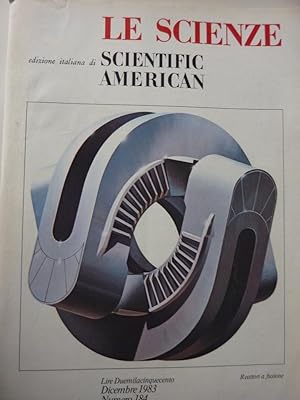
"LE SCIENZE - Edizione Italiana di AMERICAN SCIENTIFIC - Dicembre 1983 N.° 184 - REATTORI A FUSIONE"
Published by Messaggerie Italiane S.p.A. Milano 1983
- Softcover
- First Edition
Seller: Historia, Regnum et Nobilia, BATTIPAGLIA, SA, ItalyHistoria, Regnum et Nobilia
Contact seller4-star sellerCondition: Used - Fine
US$ 9.54
US$ 23.15 shippingShips from Italy to U.S.A.Quantity: 1 available
Brossura. Condition: ottimo. senza sovraccoperta. prima edizione. Formato in 8°; 159 pagine. Brossura editoriale figurata. Bella rivista riccamente illustrata.

Published by Masson Italia Editori 1983
- Hardcover
- First Edition
Seller: Historia, Regnum et Nobilia, BATTIPAGLIA, SA, ItalyHistoria, Regnum et Nobilia
Contact seller4-star sellerCondition: Used - Near fine
US$ 23.84
US$ 23.15 shippingShips from Italy to U.S.A.Quantity: 1 available
Rilegato. Condition: quasi ottimo. senza sovraccoperta. prima edizione. Formato in 8°; 84 pagine. Brossura editoriale figurata: macchia alla pare interna della copertina posteriore. Con figure in nero intercalate nel testo.

Published by L. G. Pirola Editore, Milano 1976
- Softcover
- First Edition
Seller: Historia, Regnum et Nobilia, BATTIPAGLIA, SA, ItalyHistoria, Regnum et Nobilia
Contact seller4-star sellerCondition: Used - Very good
US$ 23.84
US$ 23.15 shippingShips from Italy to U.S.A.Quantity: 1 available
brossura. Condition: in eccellenti condizioni. senza sovraccoperta. prima edizione. Formato in 8°; 491 pagine. Brossura editoriale: piccolo strappo alla copertina anteriore. Interno fresco e ben conservato.
 More images
Published by Milan: Dell Imp. Regia Stamperia 1825
- First Edition
Seller: Emerald Booksellers, New York, NY, U.S.A.Emerald Booksellers
Contact seller5-star sellerCondition: Used - Very good
US$ 40.00
US$ 10.00 shippingShips within U.S.A.Quantity: 1 available
No Binding. Condition: Very Good. No Jacket. 1st Edition. First Edition 8vo pamphlet, disbound, sewn spine: 64 pp including title page, huge folding plate at the end. Pages are stiff but bright and sharp. VG. Vismara was Professor of Physics, Mathematics and Natural History at Cremona (also Padua). This work describes Vismara's…work in exploring the use of gaseous hydrocarbons to carburize steel (see F. Giolitti, The Cementation of Iron and Steel, translated from the Italian by J.W. Richards and C.A. Rouiller), McGraw-Hill, NY, 1914, p xxvii.

Published by UTET, Torino 1973
- First Edition
Seller: studio bibliografico pera s.a.s., LUCCA, LU, Italystudio bibliografico pera s.a.s.
Contact seller4-star sellerCondition: Used - Fair
US$ 10.73
US$ 46.29 shippingShips from Italy to U.S.A.Quantity: 1 available
Brossura. Condition: Discreto. Prima edizione. Prima edizione. 8°,pg.12,448. Legatura in tutta tela con titoli al dorso e al piatto. Collana "Giurisprudenza sistematica civile e commerciale". 1200 gr.

Published by EDIZIONI ITALIANE 1943
- Softcover
- First Edition
Seller: Il Mondo Nuovo, TORINO, TO, ItalyIl Mondo Nuovo
Contact seller5-star sellerCondition: Used - Good
US$ 47.68
US$ 40.51 shippingShips from Italy to U.S.A.Quantity: 1 available
Brossura. Condition: buono. prima edizione. Timbro in prima pagina. Scritta a penna in quinta pagina.
Language: Italian
Published by EDIZIONI ITALIANE, ROMA 1943
- Softcover
- First Edition
Seller: RONCHI, SIENA, SI, ItalyRONCHI
Contact seller2-star sellerCondition: Used - Near fine
US$ 53.64
US$ 23.15 shippingShips from Italy to U.S.A.Quantity: 1 available
brossura. Condition: condizioni quasi ottime. prima edizione. COLLANA STUDI DI SCIENZE POLITICHE PUBBLICATI DALLA FACOLTA' DI SCIENZE POLITICHE- REALE UNIVERSITA' DI ROMA. PREFAZIONE DI SERGIO PANNUNZIO. BROSSURA EDITORIALE IN CARTONCINO SEMI RIGIDO CON TITOLI AL PIATTO E AL DORSO. TAGLI LEGGERMENTE BRUNITI. PER IL RESTO BUON ES…EMPLARE.

Published by Tipografia "Il Risveglio", Bologna 1890
- Softcover
- First Edition
Seller: Gilibert Libreria Antiquaria (ILAB), Torino, TO, ItalyGilibert Libreria Antiquaria (ILAB)
Contact seller5-star sellerCondition: Used
US$ 143.05
US$ 52.08 shippingShips from Italy to U.S.A.Quantity: 1 available
In-4°, pp. 14, brossura editoriale. 2 tavv. f.t. in cromolitografia a tinta argento, incise da A. Baraldini e stampate da Wenk e figli di Bologna da disegni dello stesso Bombicci; le cromolitografie raffigurano il disco d'argento con rilievi crateriformi e dettagli di alcuni crateri e rilievi d'eruzione. Una tabella a p. pag. In… seconda, terza e quarta di copertina, elenco delle pubblicazioni del Bombicci dal 1858 al 1890. Ottimo stato. Edizione originale. Memoria presentata all'Accademia delle Scienze dell'Istituto di Bologna e letta nell'adunanza del 9 febbraio 1890. Estratto dalla serie IV, tomo X delle Memorie della Reale Accademia delle Scienze dell'Istituto di Bologna. Il disco d'argento di fusione studiato nella presente memoria figurava all'Esposizione Universale di Parigi del 1889, dividendo la sezione del Belgio da quella dell'Austria-Ungheria. Pesante oltre due tonnellate, la focaccia metallica valeva oltre 310 mila lire italiane del tempo. Il Bombicci (Siena, 1833Bologna, 1903) fu uno dei massimi mineralogisti italiani del XIX secolo.
MERGER LAW / LOI SUR LA FUSION / FUSIONSGESETZ / LEGGE SULLA FUSIONE;
BAUEN, MARC / JEGHER, GION / WENGER, BORIS / ZEN-RUFFINEN, MARIE-NOELLE;
- Softcover
- First Edition
Seller: Antiquariat A. Thomi, Basel, , SwitzerlandAntiquariat A. Thomi
Contact seller3-star sellerCondition: Used
US$ 90.60
US$ 25.46 shippingShips from Switzerland to U.S.A.Quantity: 1 available
555 S., Schulthess, Zürich 2005, 8°, Orig.Karton ** Erstausgabe --- Texte E / F / D / I. Schöner Zustand >> Versand ab Deutschland möglich << ??? PREIS ZU HOCH ODER ZU TIEF ??? ANGEBOT ERWÜNSCHT !!! 650 Gramm.
 More images
Published by Giovanni Padovano for Curzio Troiano Navò, Venice 1550
- First Edition
Seller: SOPHIA RARE BOOKS, Koebenhavn V, , DenmarkSOPHIA RARE BOOKS
Contact seller4-star sellerCondition: Used
US$ 17,500.00
Free ShippingShips from Denmark to U.S.A.Quantity: 1 available
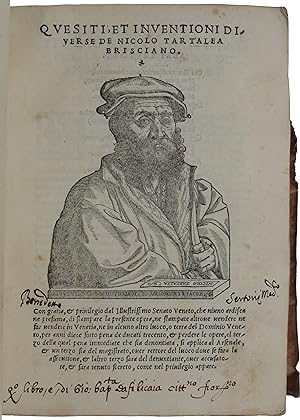
First edition. A MAJOR CATALYST FOR THE RESEARCHES OF GALILEO. First edition of Tartaglia's Quesiti, second edition of the other two works. The Quesiti continues the discussion of ballistics in Tartaglia's Nova scientia (first published in 1537), pointing out for the first time that the trajectory of a projectile is curved throu…ghout (in the Nova Scientia he argued that the path of a projectile consisted of rectilinear parts at the beginning and end of the trajectory, with a curved part between). The Quesiti is also famous for containing Tartaglia's solution of cubic equations, which until a few years earlier had been considered impossible; he had kept it secret since discovering it in 1535 (Cardano had published Tartaglia's solution in his Artis magnae (1545), without his permission.) Tartaglia (1499-1557) "reshaped the character of military discourse by identifying a 'new science' of artillery and casting it as a mathematical discipline. As a mathematician he was first directed to military questions in 1531 or 1532 in Verona when he was consulted on the maximum range of cannon . Few European mathematicians of the 16th century had been as directly affected by war as Niccolò Tartaglia. In 1512, when still a boy, he received a facial wound during the sack of Brescia by the French. Left with a speech defect he adopted the nickname of Tartaglia ('stammerer') to replace his original surname Fontana. If Tartaglia's very identity was marked by war, he in turn reshaped the character of military discourse by identifying a 'new science' of artillery and casting it as a mathematical discipline . A measure of Tartaglia's importance for the study of artillery is that [his] account was still being paraphrased and parroted into the later 17th century" (Bennett & Johnston). "Tartaglia proved both mathematically and experimentally that the trajectory of a missile fired from a cannon was a curved line throughout, thus contradicting the 'impetus' theory derived from Aristotle's Physics, which stated that a projectile's trajectory was described by two straight lines united by a curved line (Tartaglia was the first Renaissance scientist to point out serious flaws in the Physics). Tartaglia demonstrated that from the beginning of its flight, a projectile was affected by gravity, which, along with wind resistance, caused its forward velocity to lessen while increasing the speed of its fall. Tartaglia also observed a relationship between the speed of projection and the speed of fall: the greater the initial speed, the less the gravitational influence. Through experimentation, he determined that the maximum cannon range, at any given initial speed, was obtained with a firing elevation of forty-five degrees" (Norman 2053). The work by Biringuccio (1480-1539) is the second edition of the first book entirely dedicated to metallurgy. It "was written for the practicing metallurgist, foundryman, dyer, type-founder, glass-maker, and maker of gunpowder, fireworks and chemicals used in warfare" (Dibner, on the first edition, 1540). Provenance: Benedetto Sertori, doctor; Giovanni Battista da Filicaia, a citizen of Florence, early inscriptions on title-page; Thomas Francis Fremantle, armorial bookplate. Second edition of Tartaglia's first work, Nova scientia, the foundation of the new sciences and a major catalyst for the researches of Galileo. "The New Sciences stands at the threshold of a new age in the history of mechanics" (Printing and the Mind of Man). Tartaglia investigated problems of ballistics, fortification, surveying and engineering and sought to apply mathematical analysis to physical problems, free from the conceptual constraints of Aristotelianism and Scholasticism. "Tartaglia proved both mathematically and experimentally that the trajectory of a missile fired from a cannon was a curved line throughout, thus contradicting the 'impetus' theory derived from Aristotle's Physics, which stated that a projectile's trajectory was described by two straight lines united by a curved line (Tartaglia was the first Renaissance scientist to point out serious flaws in the Physics). Tartaglia demonstrated that from the beginning of its flight, a projectile was affected by gravity, which, along with wind resistance, caused its forward velocity to lessen while increasing the speed of its fall. Tartaglia also observed a relationship between the speed of projection and the speed of fall: the greater the initial speed, the less the gravitational influence. Through experimentation, he determined that the maximum cannon range, at any given initial speed, was obtained with a firing elevation of forty-five degrees" (Norman Catalogue 2053). "The latter result was obtained through an erroneous argument, but the proposition is correct (in a vacuum) and might well be called 'Tartaglia's theorem'" (DSB). Dibner describes the allegory of the frontispiece as follows: "Euclid greets the students at the outer gate of the circle in which Tartaglia is surrounded by Arithmetic, Geometry, Music, Astronomy, Astrology, etc. - the mathematical disciplines. A fired cannon and a mortar show the trajectories defined by Tartaglia. In the farther circle sits Philosophy. Beneath the scroll in Plato's hand, reading 'None not expert in Geometry may enter here', Aristotle moves forward to welcome the students." II. First edition of the Quesiti, in which Tartaglia continued his discussion of ballistics begun in Nova scientia. "Dedicated to Henry VIII, this work contains nine books of questions posed to Tartaglia by various people, and demonstrates his skill in non-mathematical areas: solving problems in the firing of artillery; topographical surveying; equilibrium in balances and statics; a new method for raising sunken ships; etc. In the course of the discussions, some fundamental issues in the theory of motion and of statics are raised, which are elaborated upon in the eighth book . Among its other important points are the anticipation of the principle of inertia in boo.


