
Human Progress by John Nef: First Edition (2 results)
 More images
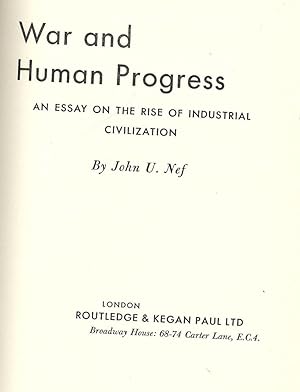
Published by Routledge & Kegan Paul Ltd 1950
- Hardcover
- First Edition
- Signed
Seller: Antic Hay Books, Asbury Park, NJ, U.S.A.Antic Hay Books
Contact seller5-star sellerNEF, John U. WAR AND HUMAN PROGRESS: AN ESSAY ON THE RISE OF INDUSTRIAL CIVILIZATION. London: Routledge & Kegan Paul Ltd., [1950]. Small 4to., black cloth. First Edition. Signed presentation from Nef on front endpaper: "For Narcissa Vanderlip with affection from John Nef. Chicago, April 23, 1954." Very Good (some browning endpap…ers). $50.00.

- Hardcover
- First Edition
Seller: Kloof Booksellers & Scientia Verlag, Amsterdam, , NetherlandsKloof Booksellers & Scientia Verlag
Contact seller4-star sellerCondition: Used - Very good
US$ 31.85
US$ 34.43 shippingShips from Netherlands to U.S.A.Quantity: 1 available
Condition: very good. Cambridge : Harvard University Press, 1950. First edition. Orig. cloth binding. Dustjacket. xii,464 pp. The illustration on the dustjacket is the Guernica Mural by Picasso, used by the courtesy of the Museum of Modern Art, New York. Dustjacket bit chipped. Tear repaired. Owner's stamp on title-page. From th…e publisher : If a third world war breaks and puts an end to civilization, the blame will lie with modern society. In War and Human Progress, Mr. Nef shows why the disease of war, its ravages limited in the past by moral, intellectual, and cultural restraints, has today become malignant; it will be difficult for the public to sidestep his conclu- sions concerning the requisite and drastic treatment. Mr. Nef presents the history of war as part of the general history of Western civilization: his book is a synthesis of industrial, cultural, and military history. He shows that it was not war, but limitations on war, which made possible the birth of industrialism and its eventual triumph. The Christian view of human nature as corrupt and sinful, the Platonic tradition, and the medieval habits of craftsmanship which put elegance and delight before utility all imposed spiritual or technological limitations on war. A further restraint was the application in education and politics of moral imperatives which originated in the Christian faith and which supplied an orderly framework for relations within and among nations. The author lays bare the gradual breakdown of the restraints on war. The growing valuation of the common man gave moral support for general conscription. The rise of philosophical positivism and relativism undermined moral imperatives. The ideal of elegance ceased to interfere with the production of efficient weapons. The values of the new industrial economy cut the ground from under polite manners, intellectual standards, and the imaginative sides of human nature. As science and technology helped to create an economy of abundance unknown to history, the use of new and overwhelmingly destructive weapons on a world scale was made possible. All roads led to the total warfare of the twentieth century. If the very advances that men have made are not to destroy mankind itself, human beings and nations must renounce in large measure the goal of success as the guiding principle of thought, labor, and even of politics. We, like our ancestors, possess facul- ties for common sense, for rational speculation, for craftsmanship, for art, for love, for charity, for faith. Man's future depends upon the encouragement given these faculties. War and Human Progress is by far the most careful general discussion of war to appear in our century. Its importance for the thoughtful citizen is great, and it cannot fail to interest all students and teachers concerned with economic, cultural, military, scientific, and social history. Condition : very good copy. Keywords : HISTORY.
