
Ibm Users Handbook (6 results)

Published by Ballantine Books, New York, 1984., 1984
- Softcover
Seller: Antiquariaat Hortus Conclusus, Bergambacht, NetherlandsAntiquariaat Hortus Conclusus
Contact seller5-star sellerCondition: Used
US$ 11.75
US$ 16.55 shippingShips from Netherlands to U.S.A.Quantity: 1 available
Add to basketPaperback. Some minor traces of use, a good copy. Please see description or ask for photos.

- Softcover
- First Edition
Seller: Tin Can Mailman, Arcata, Arcata, CA, U.S.A.Tin Can Mailman, Arcata
Contact seller5-star sellerCondition: Used - Good
US$ 40.00
US$ 5.00 shippingShips within U.S.A.Quantity: 1 available
Paperback. Condition: Good. 1st. Good condition. Spine is scuffed but well bound. Text block appears unmarked. Includes shelf wear, small creases, scuffs, rubbing, and perusal wear.
Published by Ballantine Books, New York, 1984
- First Edition
Seller: Between the Covers-Rare Books, Inc. ABAA, Gloucester City, NJ, U.S.A.Between the Covers-Rare Books, Inc. ABAA
Contact seller5-star sellerCondition: Used - Very good
US$ 19.50
US$ 5.50 shippingShips within U.S.A.Quantity: 1 available
Add to basketCondition: Very Good. First Edition. First edition. Very good. Edges and corners are worn. Shelf rubbing to cover.
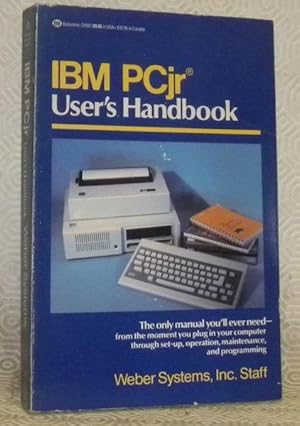
Published by Weber Systems Inc. Staff - Ballantine Books, New York,, 1984
- Softcover
Seller: Bouquinerie du Varis, Russy, FR, SwitzerlandBouquinerie du Varis
Contact seller5-star sellerCondition: Used
US$ 28.68
US$ 36.46 shippingShips from Switzerland to U.S.A.Quantity: 1 available
Add to basketIBM PCjr. User's Handbook. New York, Weber Systems Inc. Staff - Ballantine Books,1984, 215x140mm, 300pages, paperback. Envois Europe jusqu'à valeur du colis 150 EUR : TVA inclus dans montant final. Exceptions taxes postales locales à la charge de l'acheteur (~2 EUR). Contact via notre page d'accueil en cas de problème. / Shipmen…ts to Europe with a package value of up to 150 EUR : VAT included in total amount. Local postal fees apply to buyers in Euroe (~2 EUR). Contact us via our homepage if needed.
Published by Horizons Technology Inc. for Defense Nuclear Agency, Alexandria, VA, 1988
- Softcover
- First Edition
Seller: Ground Zero Books, Ltd., Silver Spring, MD, U.S.A.Ground Zero Books, Ltd.
Contact seller5-star sellerCondition: Used - Very good
US$ 125.00
US$ 5.00 shippingShips within U.S.A.Quantity: 1 available
Add to basketSpiral bound. Condition: Very good. The format is approximately 6.25 inches by 8.5 inches. Various paginations (80 pages per Standard Form 298). Illustrations. Tables, Appendices. Cited References. RARE surviving copy. This was prepared for the Defense Nuclear Agency as part of their Electronic Handbook Series. The BLUEOUT progr…am calculates the reverberant environment at a sonar receiver following an underwater nuclear detonation. I requires the following inputs: locations of the detonation and receiver; frequency of interest; ambient noise level of the ocean basin, amount below the ambient level a signal may fall and still be considered significant, number of interaction with the basin boundary to be calculated, and yield of the weapon. Output includes the amplitude, bearing, and start and end times of each signal that reaches the receiver, as well as the total signal level vs. time history. BLUEOUT can calculate the reverberant environment for the North Atlantic and North Pacific ocean basins. The models under by the BLUEOUT programs were developed by the Naval Surface Warfare Center and were originally implemented on a CYBER 720 mainframe computer in a program called REVERB. BLUEOUT is an adaptation of REVERB to run on an IBM PC or compatible computer. Presumed First Edition, First printing [Version 1.0 stated].
Published by Horizons Technology Inc. for Defense Nuclear Agency, San Diego, CA and Washington, DC, 1988
- Softcover
- First Edition
Seller: Ground Zero Books, Ltd., Silver Spring, MD, U.S.A.Ground Zero Books, Ltd.
Contact seller5-star sellerCondition: Used - Very good
US$ 125.00
US$ 5.00 shippingShips within U.S.A.Quantity: 1 available
Add to basketSpiral bound. Condition: Very good. The format is approximately 6.25 inches by 8.5 inches. Various paginations (76 pages per Standard Form 298). Illustrations. Tables, Appendices. Cited References. Additional References. RARE surviving copy. This was prepared for the Defense Nuclear Agency as part of their Electronic Handbook Se…ries. Extremely low frequency (ELF) is the ITU designation for electromagnetic radiation (radio waves) with frequencies from 3 to 30 Hz, and corresponding wavelengths of 100,000 to 10,000 kilometers, respectively. In atmospheric science, an alternative definition is usually given, from 3 Hz to 3 kHz. In the related magnetosphere science, the lower frequency electromagnetic oscillations (pulsations occurring below ~3 Hz) are considered to lie in the ULF range, which is thus also defined differently from the ITU radio bands. ELF radio waves are generated by lightning and natural disturbances in Earth's magnetic field, so they are a subject of research by atmospheric scientists. Because of the difficulty of building antennas that can radiate such long waves, ELF frequencies have been used in only a very few human-made communication systems. ELF waves can penetrate seawater, which makes them useful in communication with submarines. The United States, Russia, India, and China are the only countries known to have constructed these ELF communication facilities. The U.S. facilities were used between 1985 and 2004 but are now decommissioned. The ELF Propagation program is intended to provide the user with a semi-quantitative appreciation of the effect of a widespread ("uniform spread debris") nuclear environment on Extremely Low Frequency (ELF) signal strength at a signal strength at a specified receiver location. Inputs include the fission debris yield and the time after burst the date, time and frequency of the transmission, the dipole moment of the transmitter,and the latitude and longitude of the receiver. The transmitter is, additionally, assumed to be located at the U.S. Navy Wisconsin Test Facility, nominally at 40 degrees north latitude and 91 degress west longitude; the receiver can be anywhere. Outputs are the vertical electric field at the receiver under ambient conditions, the vertical electric field at the receiver under nuclear-disturbed conditions, the difference in field strength, and the phase difference in the two signals (in degrees or radians). Optional outputs are the attenuation rate, the phase velocity and the vertical excitation factor as a function of distance from the transmitter. Results may be saved to two output files containing all inputs,outputs, and listing of the ionospheric profiles used during a particular run. Presumed First Edition, First printing [Version 1.0 stated].

