
Order Total (1 Item Items):
Shipping Destination:

Introduction Graph Neural Networks by Zhou Jie (17 results)
Skip to main search results
Search filters
Product Type
- All Product Types
- Books (17)
- Magazines & Periodicals (No further results match this refinement)
- Comics (No further results match this refinement)
- Sheet Music (No further results match this refinement)
- Art, Prints & Posters (No further results match this refinement)
- Photographs (No further results match this refinement)
- Maps (No further results match this refinement)
- Manuscripts & Paper Collectibles (No further results match this refinement)
Condition Learn more
- New (15)
- As New, Fine or Near Fine (2)
- Very Good or Good (No further results match this refinement)
- Fair or Poor (No further results match this refinement)
- As Described (No further results match this refinement)
Binding
- All Bindings
- Hardcover (No further results match this refinement)
- Softcover (17)
Collectible Attributes
- First Edition (No further results match this refinement)
- Signed (No further results match this refinement)
- Dust Jacket (No further results match this refinement)
- Seller-Supplied Images (12)
- Not Print on Demand (12)
Language (2)
Price
- Any Price
- Under US$ 25 (No further results match this refinement)
- US$ 25 to US$ 50
- Over US$ 50
Free Shipping
Seller Location
Seller Rating
-
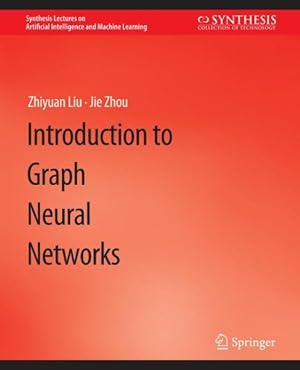
Condition: As New. Unread book in perfect condition.
-

-

Introduction to Graph Neural Networks
Book 2 of 2: Synthesis Lectures on Artificial Intelligence and Machine LearningPublished by Springer International Publishing AG, CH, 2020
ISBN 10: 3031004590 ISBN 13: 9783031004599
Language: English
Seller: Rarewaves.com USA, London, LONDO, United Kingdom
Seller rating 5 out of 5 stars

US$ 47.40
Free Shipping
Ships from United Kingdom to U.S.A.Quantity: Over 20 available
Add to basketPaperback. Condition: New. Graphs are useful data structures in complex real-life applications such as modeling physical systems, learning molecular fingerprints, controlling traffic networks, and recommending friends in social networks. However, these tasks require dealing with non-Euclidean graph data that contains rich relational information between elements and cannot be well handled by traditional deep learning models (e.g., convolutional neural networks (CNNs) or recurrent neural networks (RNNs)). Nodes in graphs usually contain useful feature information that cannot be well addressed in most unsupervised representation learning methods (e.g., network embedding methods). Graph neural networks (GNNs) are proposed to combine the feature information and the graph structure to learn better representations on graphs via feature propagation and aggregation. Due to its convincing performance and high interpretability, GNN has recently become a widely applied graph analysis tool.This book provides a comprehensive introduction to the basic concepts, models, and applications of graph neural networks. It starts with the introduction of the vanilla GNN model. Then several variants of the vanilla model are introduced such as graph convolutional networks, graph recurrent networks, graph attention networks, graph residual networks, and several general frameworks. Variants for different graph types and advanced training methods are also included. As for the applications of GNNs, the book categorizes them into structural, non-structural, and other scenarios, and then it introduces several typical models on solving these tasks. Finally, the closing chapters provide GNN open resources and the outlook of several future directions.
-

Introduction to Graph Neural Networks (Synthesis Lectures on Artificial Intelligence and Machine Learning)
Book 2 of 2: Synthesis Lectures on Artificial Intelligence and Machine LearningSeller: Ria Christie Collections, Uxbridge, United Kingdom
Seller rating 5 out of 5 stars
US$ 40.28
US$ 15.99 shipping
Ships from United Kingdom to U.S.A.Quantity: Over 20 available
Add to basketCondition: New. In English.
-

Introduction to Graph Neural Networks
Book 2 of 2: Synthesis Lectures on Artificial Intelligence and Machine LearningSeller: GreatBookPricesUK, Woodford Green, United Kingdom
Seller rating 5 out of 5 stars
US$ 39.92
US$ 20.02 shipping
Ships from United Kingdom to U.S.A.Quantity: Over 20 available
Add to basketCondition: New.
-

Introduction to Graph Neural Networks
Book 2 of 2: Synthesis Lectures on Artificial Intelligence and Machine LearningSeller: GreatBookPricesUK, Woodford Green, United Kingdom
Seller rating 5 out of 5 stars
US$ 44.70
US$ 20.02 shipping
Ships from United Kingdom to U.S.A.Quantity: Over 20 available
Add to basketCondition: As New. Unread book in perfect condition.
-
-
Condition: New. 1st edition NO-PA16APR2015-KAP.
-

Introduction to Graph Neural Networks
Book 2 of 2: Synthesis Lectures on Artificial Intelligence and Machine LearningPublished by Springer International Publishing AG, CH, 2020
ISBN 10: 3031004590 ISBN 13: 9783031004599
Language: English
US$ 43.70
US$ 86.76 shipping
Ships from United Kingdom to U.S.A.Quantity: Over 20 available
Add to basketPaperback. Condition: New. Graphs are useful data structures in complex real-life applications such as modeling physical systems, learning molecular fingerprints, controlling traffic networks, and recommending friends in social networks. However, these tasks require dealing with non-Euclidean graph data that contains rich relational information between elements and cannot be well handled by traditional deep learning models (e.g., convolutional neural networks (CNNs) or recurrent neural networks (RNNs)). Nodes in graphs usually contain useful feature information that cannot be well addressed in most unsupervised representation learning methods (e.g., network embedding methods). Graph neural networks (GNNs) are proposed to combine the feature information and the graph structure to learn better representations on graphs via feature propagation and aggregation. Due to its convincing performance and high interpretability, GNN has recently become a widely applied graph analysis tool.This book provides a comprehensive introduction to the basic concepts, models, and applications of graph neural networks. It starts with the introduction of the vanilla GNN model. Then several variants of the vanilla model are introduced such as graph convolutional networks, graph recurrent networks, graph attention networks, graph residual networks, and several general frameworks. Variants for different graph types and advanced training methods are also included. As for the applications of GNNs, the book categorizes them into structural, non-structural, and other scenarios, and then it introduces several typical models on solving these tasks. Finally, the closing chapters provide GNN open resources and the outlook of several future directions.
-
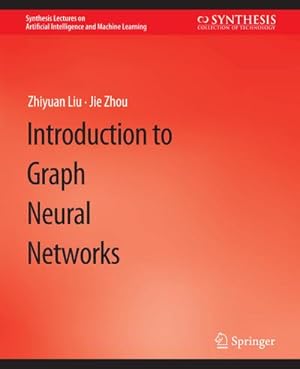
Introduction to Graph Neural Networks
Book 2 of 2: Synthesis Lectures on Artificial Intelligence and Machine LearningPublished by Springer International Publishing, 2020
ISBN 10: 3031004590 ISBN 13: 9783031004599
Language: English
Taschenbuch. Condition: Neu. Druck auf Anfrage Neuware - Printed after ordering - Graphs are useful data structures in complex real-life applications such as modeling physical systems, learning molecular fingerprints, controlling traffic networks, and recommending friends in social networks. However, these tasks require dealing with non-Euclidean graph data that contains rich relational information between elements and cannot be well handled by traditional deep learning models (e.g., convolutional neural networks (CNNs) or recurrent neural networks (RNNs)). Nodes in graphs usually contain useful feature information that cannot be well addressed in most unsupervised representation learning methods (e.g., network embedding methods). Graph neural networks (GNNs) are proposed to combine the feature information and the graph structure to learn better representations on graphs via feature propagation and aggregation. Due to its convincing performance and high interpretability, GNN has recently become a widely applied graph analysis tool.This book provides a comprehensive introduction to the basic concepts, models, and applications of graph neural networks. It starts with the introduction of the vanilla GNN model. Then several variants of the vanilla model are introduced such as graph convolutional networks, graph recurrent networks, graph attention networks, graph residual networks, and several general frameworks. Variants for different graph types and advanced training methods are also included. As for the applications of GNNs, the book categorizes them into structural, non-structural, and other scenarios, and then it introduces several typical models on solving these tasks. Finally, the closing chapters provide GNN open resources and the outlook of several future directions.
-

Introduction to Graph Neural Networks
Book 2 of 2: Synthesis Lectures on Artificial Intelligence and Machine LearningPublished by Springer Nature Switzerland, 2020
ISBN 10: 3031004590 ISBN 13: 9783031004599
Language: English
Taschenbuch. Condition: Neu. Introduction to Graph Neural Networks | Jie Zhou (u. a.) | Taschenbuch | xvii | Englisch | 2020 | Springer Nature Switzerland | EAN 9783031004599 | Verantwortliche Person für die EU: Springer Verlag GmbH, Tiergartenstr. 17, 69121 Heidelberg, juergen[dot]hartmann[at]springer[dot]com | Anbieter: preigu.
-

paperback. Condition: New. Paperback. Pub Date: 2021-04-01 Pages: 147 Language: Chinese Publisher: People's Posts and Telecommunications Publishing House Graph Neural Network (GNN) is a graph data processing method based on deep learning. which has attracted wide attention due to its excellent performance.?This book comprehensively introduces the basic concepts. specific models and practical applications of GNN.?The book first outlines the basic concepts of mathematics and neural networks and graph neural networks. and.
-

Introduction to Graph Neural Networks
Book 2 of 2: Synthesis Lectures on Artificial Intelligence and Machine LearningPublished by Springer International Publishing Mrz 2020, 2020
ISBN 10: 3031004590 ISBN 13: 9783031004599
Language: English
Seller: BuchWeltWeit Ludwig Meier e.K., Bergisch Gladbach, Germany
Seller rating 5 out of 5 stars
Taschenbuch. Condition: Neu. This item is printed on demand - it takes 3-4 days longer - Neuware -Graphs are useful data structures in complex real-life applications such as modeling physical systems, learning molecular fingerprints, controlling traffic networks, and recommending friends in social networks. However, these tasks require dealing with non-Euclidean graph data that contains rich relational information between elements and cannot be well handled by traditional deep learning models (e.g., convolutional neural networks (CNNs) or recurrent neural networks (RNNs)). Nodes in graphs usually contain useful feature information that cannot be well addressed in most unsupervised representation learning methods (e.g., network embedding methods). Graph neural networks (GNNs) are proposed to combine the feature information and the graph structure to learn better representations on graphs via feature propagation and aggregation. Due to its convincing performance and high interpretability, GNN has recently become a widely applied graph analysis tool.This book provides a comprehensive introduction to the basic concepts, models, and applications of graph neural networks. It starts with the introduction of the vanilla GNN model. Then several variants of the vanilla model are introduced such as graph convolutional networks, graph recurrent networks, graph attention networks, graph residual networks, and several general frameworks. Variants for different graph types and advanced training methods are also included. As for the applications of GNNs, the book categorizes them into structural, non-structural, and other scenarios, and then it introduces several typical models on solving these tasks. Finally, the closing chapters provide GNN open resources and the outlook of several future directions. 128 pp. Englisch.
-
-
-

Introduction to Graph Neural Networks
Book 2 of 2: Synthesis Lectures on Artificial Intelligence and Machine LearningPublished by Springer, Berlin|Springer International Publishing|Morgan & Claypool|Springer, 2020
ISBN 10: 3031004590 ISBN 13: 9783031004599
Language: English
Condition: New. Dieser Artikel ist ein Print on Demand Artikel und wird nach Ihrer Bestellung fuer Sie gedruckt. Graphs are useful data structures in complex real-life applications such as modeling physical systems, learning molecular fingerprints, controlling traffic networks, and recommending friends in social networks. However, these tasks require dealing with n.
-

Introduction to Graph Neural Networks
Book 2 of 2: Synthesis Lectures on Artificial Intelligence and Machine LearningPublished by Springer Nature Switzerland, Springer International Publishing Mär 2020, 2020
ISBN 10: 3031004590 ISBN 13: 9783031004599
Language: English
Seller: buchversandmimpf2000, Emtmannsberg, BAYE, Germany
Seller rating 5 out of 5 stars
Taschenbuch. Condition: Neu. This item is printed on demand - Print on Demand Titel. Neuware -Graphs are useful data structures in complex real-life applications such as modeling physical systems, learning molecular fingerprints, controlling traffic networks, and recommending friends in social networks. However, these tasks require dealing with non-Euclidean graph data that contains rich relational information between elements and cannot be well handled by traditional deep learning models (e.g., convolutional neural networks (CNNs) or recurrent neural networks (RNNs)). Nodes in graphs usually contain useful feature information that cannot be well addressed in most unsupervised representation learning methods (e.g., network embedding methods). Graph neural networks (GNNs) are proposed to combine the feature information and the graph structure to learn better representations on graphs via feature propagation and aggregation. Due to its convincing performance and high interpretability, GNN has recently become a widely applied graph analysis tool.This book provides a comprehensive introduction to the basic concepts, models, and applications of graph neural networks. It starts with the introduction of the vanilla GNN model. Then several variants of the vanilla model are introduced such as graph convolutional networks, graph recurrent networks, graph attention networks, graph residual networks, and several general frameworks. Variants for different graph types and advanced training methods are also included. As for the applications of GNNs, the book categorizes them into structural, non-structural, and other scenarios, and then it introduces several typical models on solving these tasks. Finally, the closing chapters provide GNN open resources and the outlook of several future directions.Springer Verlag GmbH, Tiergartenstr. 17, 69121 Heidelberg 128 pp. Englisch.

