

Order Total (1 Item Items):
Shipping Destination:

Introduction Numerical Methods Differential by Holmes Mark (24 results)
Skip to main search results
Search filters
Product Type
- All Product Types
- Books (24)
- Magazines & Periodicals (No further results match this refinement)
- Comics (No further results match this refinement)
- Sheet Music (No further results match this refinement)
- Art, Prints & Posters (No further results match this refinement)
- Photographs (No further results match this refinement)
- Maps (No further results match this refinement)
- Manuscripts & Paper Collectibles (No further results match this refinement)
Condition Learn more
Binding
Collectible Attributes
- First Edition (3)
- Signed (No further results match this refinement)
- Dust Jacket (No further results match this refinement)
- Seller-Supplied Images (9)
- Not Print on Demand (16)
Language (2)
Free Shipping
Seller Location
Seller Rating
-

paperback. Condition: Good. Connecting readers with great books since 1972! Used textbooks may not include companion materials such as access codes, etc. May have some wear or writing/highlighting. We ship orders daily and Customer Service is our top priority!
-
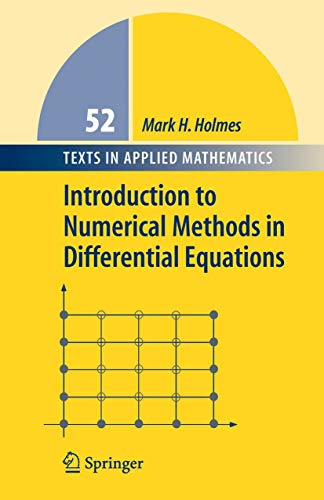
Introduction to Numerical Methods in Differential Equations (Texts in Applied Mathematics, Vol. 52) (Texts in Applied Mathematics, 52)
Book 7 of 55: Texts in Applied MathematicsLanguage: English
Published by Springer (edition 2007), 2006
ISBN 10: 0387308911 ISBN 13: 9780387308913
Hardcover. Condition: Fair. 2007. The item might be beaten up but readable. May contain markings or highlighting, as well as stains, bent corners, or any other major defect, but the text is not obscured in any way.
-

Introduction to Numerical Methods in Differential Equations
Published by Springer, 2007
ISBN 10: 0387308911 ISBN 13: 9780387308913
Seller: Attic Books (ABAC, ILAB), London, ON, Canada
Seller rating 5 out of 5 stars

Hardcover. Condition: ex library-very good +. Texts in Applied Mathematics 52. xi, 238 p. 24 cm. Ex library with labels on spine and front, ink stamps on top edge and title. A bit of soiling at top of spine.
-
Hardcover. Condition: As New. Unread, like new. Immediately dispatched from Germany.
-
Introduction to Numerical Methods in Differential Equations (Texts in Applied Mathematics, 52)
Book 7 of 55: Texts in Applied MathematicsSeller: Ria Christie Collections, Uxbridge, United Kingdom
Seller rating 5 out of 5 stars
US$ 68.07
US$ 16.06 shipping
Ships from United Kingdom to U.S.A.Quantity: Over 20 available
Add to basketCondition: New. In.
-
Introduction to Numerical Methods in Differential Equations
Book 7 of 55: Texts in Applied MathematicsUS$ 65.73
US$ 20.76 shipping
Ships from United Kingdom to U.S.A.Quantity: 10 available
Add to basketPF. Condition: New.
-
Introduction to Numerical Methods in Differential Equations
Book 7 of 55: Texts in Applied MathematicsUS$ 90.78
US$ 13.41 shipping
Ships from United Kingdom to U.S.A.Quantity: 2 available
Add to basketPaperback. Condition: Brand New. 249 pages. 9.29x6.06x0.71 inches. In Stock.
-
-
Introduction to Numerical Methods in Differential Equations (Texts in Applied Mathematics, Vol. 52)
Book 7 of 55: Texts in Applied MathematicsSeller: Ria Christie Collections, Uxbridge, United Kingdom
Seller rating 5 out of 5 stars
US$ 96.10
US$ 16.06 shipping
Ships from United Kingdom to U.S.A.Quantity: Over 20 available
Add to basketCondition: New. In.
-
Introduction to Numerical Methods in Differential Equations (Paperback)
Book 7 of 55: Texts in Applied MathematicsLanguage: English
Published by Springer-Verlag New York Inc., New York, NY, 2010
ISBN 10: 144192163X ISBN 13: 9781441921635
First Edition
Paperback. Condition: new. Paperback. The title gives a reasonable ?rst-order approximation to what this book is about. To explain why, lets start with the expression di?erential equations. These are essential in science and engineering, because the laws of nature t- ically result in equations relating spatial and temporal changes in one or more variables.Todevelopanunderstandingofwhatisinvolvedin?ndingsolutions, the book begins with problems involving derivatives for only one independent variable, and these give rise to ordinary di?erential equations. Speci?cally, the ?rst chapter considers initial value problems (time derivatives), and the second concentrates on boundary value problems (space derivatives). In the succeeding four chapters problems involving both time and space derivatives, partial di?erential equations, are investigated. This brings us to the next expression in the title: numerical methods. This is a book about how to transform differential equations into problems that can be solved using a computer.The fact is that computers are only able to solve discrete problems and generally do this using ?nite-precision arithmetic. What this means is that in deriving and then using a numerical algorithmthecorrectnessofthediscreteapproximationmustbeconsidered,a s must the consequences of round-o? error in using ?oating-point arithmetic to calculatetheanswer.Oneoftheinterestingaspectsofthesubjectisthatwhat appears to be an obviously correct numerical method can result in complete failure. Consequently, although the book concentrates on the derivation and use of numerical methods, the theoretical underpinnings are also presented andusedinthedevelopment. This brings us to the next expression in the title: numerical methods. This is a book about how to transform differential equations into problems that can be solved using a computer.The fact is that computers are only able to solve discrete problems and generally do this using ?nite-precision arithmetic. Shipping may be from our Sydney, NSW warehouse or from our UK or US warehouse, depending on stock availability.
-
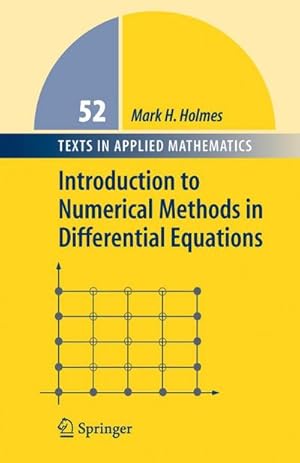
Introduction to Numerical Methods in Differential Equations
Book 7 of 55: Texts in Applied MathematicsLanguage: English
Published by Springer New York, Springer US, 2010
ISBN 10: 144192163X ISBN 13: 9781441921635
Taschenbuch. Condition: Neu. Druck auf Anfrage Neuware - Printed after ordering - The title gives a reasonable rst-order approximation to what this book is about. To explain why, let's start with the expression 'di erential equations.' These are essential in science and engineering, because the laws of nature t- ically result in equations relating spatial and temporal changes in one or more variables.Todevelopanunderstandingofwhatisinvolvedin ndingsolutions, the book begins with problems involving derivatives for only one independent variable, and these give rise to ordinary di erential equations. Speci cally, the rst chapter considers initial value problems (time derivatives), and the second concentrates on boundary value problems (space derivatives). In the succeeding four chapters problems involving both time and space derivatives, partial di erential equations, are investigated. This brings us to the next expression in the title: 'numerical methods.' This is a book about how to transform differential equations into problems that can be solved using a computer.The fact is that computers are only able to solve discrete problems and generally do this using nite-precision arithmetic. What this means is that in deriving and then using a numerical algorithmthecorrectnessofthediscreteapproximationmustbeconsidered,as must the consequences of round-o error in using oating-point arithmetic to calculatetheanswer.Oneoftheinterestingaspectsofthesubjectisthatwhat appears to be an obviously correct numerical method can result in complete failure. Consequently, although the book concentrates on the derivation and use of numerical methods, the theoretical underpinnings are also presented andusedinthedevelopment.
-
Taschenbuch. Condition: Neu. Introduction to Numerical Methods in Differential Equations | Mark H. Holmes | Taschenbuch | Texts in Applied Mathematics | xi | Englisch | 2010 | Springer | EAN 9781441921635 | Verantwortliche Person für die EU: Springer Verlag GmbH, Tiergartenstr. 17, 69121 Heidelberg, juergen[dot]hartmann[at]springer[dot]com | Anbieter: preigu.
-
Introduction to Numerical Methods in Differential Equations (Texts in Applied Mathematics (52))
Book 7 of 55: Texts in Applied MathematicsUS$ 127.03
US$ 33.51 shipping
Ships from United Kingdom to U.S.A.Quantity: 1 available
Add to basketPaperback. Condition: Like New. LIKE NEW. SHIPS FROM MULTIPLE LOCATIONS. book.
-
hardcover. Condition: New. In shrink wrap. Looks like an interesting title!
-

Introduction to Numerical Methods in Differential Equations
Book 7 of 55: Texts in Applied MathematicsUS$ 112.40
US$ 56.92 shipping
Ships from Germany to U.S.A.Quantity: Over 20 available
Add to basketGebunden. Condition: New. Over 100 illustrations Numerous exercise sets, MATLAB computer codes (for both students and instructors), instructor overheads, and movies includedOver 100 illustrationsNumerous exercise sets, MATLAB computer codes (for both stud.
-

Buch. Condition: Neu. Druck auf Anfrage Neuware - Printed after ordering - The title gives a reasonable rst-order approximation to what this book is about. To explain why, let's start with the expression 'di erential equations.' These are essential in science and engineering, because the laws of nature t- ically result in equations relating spatial and temporal changes in one or more variables.Todevelopanunderstandingofwhatisinvolvedin ndingsolutions, the book begins with problems involving derivatives for only one independent variable, and these give rise to ordinary di erential equations. Speci cally, the rst chapter considers initial value problems (time derivatives), and the second concentrates on boundary value problems (space derivatives). In the succeeding four chapters problems involving both time and space derivatives, partial di erential equations, are investigated. This brings us to the next expression in the title: 'numerical methods.' This is a book about how to transform differential equations into problems that can be solved using a computer.The fact is that computers are only able to solve discrete problems and generally do this using nite-precision arithmetic. What this means is that in deriving and then using a numerical algorithmthecorrectnessofthediscreteapproximationmustbeconsidered,as must the consequences of round-o error in using oating-point arithmetic to calculatetheanswer.Oneoftheinterestingaspectsofthesubjectisthatwhat appears to be an obviously correct numerical method can result in complete failure. Consequently, although the book concentrates on the derivation and use of numerical methods, the theoretical underpinnings are also presented andusedinthedevelopment.
-
Condition: new. Questo è un articolo print on demand.
-
Introduction to Numerical Methods in Differential Equations (Paperback)
Book 7 of 55: Texts in Applied MathematicsLanguage: English
Published by Springer-Verlag New York Inc., New York, NY, 2010
ISBN 10: 144192163X ISBN 13: 9781441921635
First Edition Print on Demand
Paperback. Condition: new. Paperback. The title gives a reasonable ?rst-order approximation to what this book is about. To explain why, lets start with the expression di?erential equations. These are essential in science and engineering, because the laws of nature t- ically result in equations relating spatial and temporal changes in one or more variables.Todevelopanunderstandingofwhatisinvolvedin?ndingsolutions, the book begins with problems involving derivatives for only one independent variable, and these give rise to ordinary di?erential equations. Speci?cally, the ?rst chapter considers initial value problems (time derivatives), and the second concentrates on boundary value problems (space derivatives). In the succeeding four chapters problems involving both time and space derivatives, partial di?erential equations, are investigated. This brings us to the next expression in the title: numerical methods. This is a book about how to transform differential equations into problems that can be solved using a computer.The fact is that computers are only able to solve discrete problems and generally do this using ?nite-precision arithmetic. What this means is that in deriving and then using a numerical algorithmthecorrectnessofthediscreteapproximationmustbeconsidered,a s must the consequences of round-o? error in using ?oating-point arithmetic to calculatetheanswer.Oneoftheinterestingaspectsofthesubjectisthatwhat appears to be an obviously correct numerical method can result in complete failure. Consequently, although the book concentrates on the derivation and use of numerical methods, the theoretical underpinnings are also presented andusedinthedevelopment. This brings us to the next expression in the title: numerical methods. This is a book about how to transform differential equations into problems that can be solved using a computer.The fact is that computers are only able to solve discrete problems and generally do this using ?nite-precision arithmetic. This item is printed on demand. Shipping may be from multiple locations in the US or from the UK, depending on stock availability.
-

Introduction to Numerical Methods in Differential Equations
Book 7 of 55: Texts in Applied MathematicsLanguage: English
Published by Springer New York Nov 2010, 2010
ISBN 10: 144192163X ISBN 13: 9781441921635
Seller: BuchWeltWeit Ludwig Meier e.K., Bergisch Gladbach, Germany
Seller rating 5 out of 5 stars
Taschenbuch. Condition: Neu. This item is printed on demand - it takes 3-4 days longer - Neuware -This book shows how to derive, test and analyze numerical methods for solving differential equations, including both ordinary and partial differential equations. The objective is that students learn to solve differential equations numerically and understand the mathematical and computational issues that arise when this is done. Includes an extensive collection of exercises, which develop both the analytical and computational aspects of the material. In addition to more than 100 illustrations, the book includes a large collection of supplemental material: exercise sets, MATLAB computer codes for both student and instructor, lecture slides and movies. 252 pp. Englisch.
-

Condition: New. Dieser Artikel ist ein Print on Demand Artikel und wird nach Ihrer Bestellung fuer Sie gedruckt. Over 100 illustrations Numerous exercise sets, MATLAB computer codes (for both students and instructors), instructor overheads, and movies includedThis book shows how to derive, test and analyze numer.
-

Introduction to Numerical Methods in Differential Equations
Book 7 of 55: Texts in Applied MathematicsLanguage: English
Published by Springer New York Okt 2006, 2006
ISBN 10: 0387308911 ISBN 13: 9780387308913
Seller: BuchWeltWeit Ludwig Meier e.K., Bergisch Gladbach, Germany
Seller rating 5 out of 5 stars
Buch. Condition: Neu. This item is printed on demand - it takes 3-4 days longer - Neuware -The title gives a reasonable rst-order approximation to what this book is about. To explain why, let's start with the expression 'di erential equations.' These are essential in science and engineering, because the laws of nature t- ically result in equations relating spatial and temporal changes in one or more variables.Todevelopanunderstandingofwhatisinvolvedin ndingsolutions, the book begins with problems involving derivatives for only one independent variable, and these give rise to ordinary di erential equations. Speci cally, the rst chapter considers initial value problems (time derivatives), and the second concentrates on boundary value problems (space derivatives). In the succeeding four chapters problems involving both time and space derivatives, partial di erential equations, are investigated. This brings us to the next expression in the title: 'numerical methods.' This is a book about how to transform differential equations into problems that can be solved using a computer.The fact is that computers are only able to solve discrete problems and generally do this using nite-precision arithmetic. What this means is that in deriving and then using a numerical algorithmthecorrectnessofthediscreteapproximationmustbeconsidered,a s must the consequences of round-o error in using oating-point arithmetic to calculatetheanswer.Oneoftheinterestingaspectsofthesubjectisthatwhat appears to be an obviously correct numerical method can result in complete failure. Consequently, although the book concentrates on the derivation and use of numerical methods, the theoretical underpinnings are also presented andusedinthedevelopment. 239 pp. Englisch.
-
Introduction to Numerical Methods in Differential Equations (Paperback)
Book 7 of 55: Texts in Applied MathematicsLanguage: English
Published by Springer-Verlag New York Inc., New York, NY, 2010
ISBN 10: 144192163X ISBN 13: 9781441921635
First Edition Print on Demand
US$ 76.61
US$ 49.60 shipping
Ships from United Kingdom to U.S.A.Quantity: 1 available
Add to basketPaperback. Condition: new. Paperback. The title gives a reasonable ?rst-order approximation to what this book is about. To explain why, lets start with the expression di?erential equations. These are essential in science and engineering, because the laws of nature t- ically result in equations relating spatial and temporal changes in one or more variables.Todevelopanunderstandingofwhatisinvolvedin?ndingsolutions, the book begins with problems involving derivatives for only one independent variable, and these give rise to ordinary di?erential equations. Speci?cally, the ?rst chapter considers initial value problems (time derivatives), and the second concentrates on boundary value problems (space derivatives). In the succeeding four chapters problems involving both time and space derivatives, partial di?erential equations, are investigated. This brings us to the next expression in the title: numerical methods. This is a book about how to transform differential equations into problems that can be solved using a computer.The fact is that computers are only able to solve discrete problems and generally do this using ?nite-precision arithmetic. What this means is that in deriving and then using a numerical algorithmthecorrectnessofthediscreteapproximationmustbeconsidered,a s must the consequences of round-o? error in using ?oating-point arithmetic to calculatetheanswer.Oneoftheinterestingaspectsofthesubjectisthatwhat appears to be an obviously correct numerical method can result in complete failure. Consequently, although the book concentrates on the derivation and use of numerical methods, the theoretical underpinnings are also presented andusedinthedevelopment. This brings us to the next expression in the title: numerical methods. This is a book about how to transform differential equations into problems that can be solved using a computer.The fact is that computers are only able to solve discrete problems and generally do this using ?nite-precision arithmetic. This item is printed on demand. Shipping may be from our UK warehouse or from our Australian or US warehouses, depending on stock availability.
-
Introduction to Numerical Methods in Differential Equations
Book 7 of 55: Texts in Applied MathematicsLanguage: English
Published by Springer-Verlag New York Inc., 2006
ISBN 10: 0387308911 ISBN 13: 9780387308913
Seller: THE SAINT BOOKSTORE, Southport, United Kingdom
Seller rating 5 out of 5 stars
US$ 114.12
US$ 21.70 shipping
Ships from United Kingdom to U.S.A.Quantity: Over 20 available
Add to basketHardback. Condition: New. This item is printed on demand. New copy - Usually dispatched within 5-9 working days.
-

Introduction to Numerical Methods in Differential Equations
Book 7 of 55: Texts in Applied MathematicsLanguage: English
Published by Springer New York, Springer US Nov 2010, 2010
ISBN 10: 144192163X ISBN 13: 9781441921635
Seller: buchversandmimpf2000, Emtmannsberg, BAYE, Germany
Seller rating 5 out of 5 stars
Taschenbuch. Condition: Neu. This item is printed on demand - Print on Demand Titel. Neuware -The title gives a reasonable rst-order approximation to what this book is about. To explain why, let¿s start with the expression ¿di erential equations.¿ These are essential in science and engineering, because the laws of nature t- ically result in equations relating spatial and temporal changes in one or more variables.Todevelopanunderstandingofwhatisinvolvedin ndingsolutions, the book begins with problems involving derivatives for only one independent variable, and these give rise to ordinary di erential equations. Speci cally, the rst chapter considers initial value problems (time derivatives), and the second concentrates on boundary value problems (space derivatives). In the succeeding four chapters problems involving both time and space derivatives, partial di erential equations, are investigated. This brings us to the next expression in the title: ¿numerical methods.¿ This is a book about how to transform differential equations into problems that can be solved using a computer.The fact is that computers are only able to solve discrete problems and generally do this using nite-precision arithmetic. What this means is that in deriving and then using a numerical algorithmthecorrectnessofthediscreteapproximationmustbeconsidered,as must the consequences of round-o error in using oating-point arithmetic to calculatetheanswer.Oneoftheinterestingaspectsofthesubjectisthatwhat appears to be an obviously correct numerical method can result in complete failure. Consequently, although the book concentrates on the derivation and use of numerical methods, the theoretical underpinnings are also presented andusedinthedevelopment.Springer Verlag GmbH, Tiergartenstr. 17, 69121 Heidelberg 252 pp. Englisch.


