
Large Historiated Initial: First Edition (2 results)

Published by Italy (Siena), c.1300. 1200
- First Edition
Seller: Bernard Quaritch Ltd ABA ILAB, London, , United KingdomBernard Quaritch Ltd ABA ILAB
Contact seller5-star sellerCondition: Used
US$ 9,246.80
US$ 42.56 shippingShips from United Kingdom to U.S.A.Quantity: 1 available
First Edition. Large initial (c.124 x 129mm), the initial in pale pink against a quadrangular background of deep blue and enclosing the Nativity of the Virgin Mary, Anne lying pensively on a wooden bed before an arched background and the infant Mary being bathed by two nurses in the foreground, the whole painted in shades of blu…e, pink, orange, brown, and white and with both burnished and shell gold, the verso with part of two lines of text and music in square and diamond-shaped notation on four-line red staves (stave height c.30mm); trimmed to the edges of the quadrangular blue background, slightly rubbed with some loss of burnished gold, but generally in very good condition.A very fine large initial painted in a style associated with the Master of the Gradual of Cortona, an artist named for a Franciscan gradual produced c.1290 for the church of San Francesco in Cortona (now Vatican City, BAV, MS Ross.612). The architectural setting is unusual, as is the frontal pose of the small naked infant being washed in a bath shaped like a baptismal font, a composition derived ultimately from Byzantine models. For a closely comparable initial, probably by the same hand and conceivably from the same parent manuscript, see Christie's sale of 13 July 2022, lot 3, a complete leaf with an historiated initial of the Annunciation (stave height also c.30mm). Visible beneath the initial in the upper left-hand corner is the name 'marie', doubtless a direction (or part thereof) to the artist. The text on the reverse comprises part of the antiphon '[Benedicta tu in mu]lieribus et be[nedictus fructus ve]ntris tui'. Provenance: Formerly in the Albright-Knox Art Gallery, Buffalo, NY, acquired with the Elisabeth H.Gates Fund, 1940. Language: Latin.
 More images
Published by np, Germany 1491
- First Edition
- Manuscript
Seller: Manhattan Rare Book Company, ABAA, ILAB, New York, NY, U.S.A.Manhattan Rare Book Company, ABAA, ILAB
Contact seller5-star sellerCondition: Used - Very good
US$ 7,500.00
US$ 6.00 shippingShips within U.S.A.Quantity: 1 available
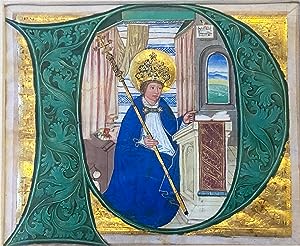
Framed. Condition: Very Good. First edition. LARGE HISTORIATED INITIAL DEPICTING A POPE, FINELY ILLUMINATED IN GOLD AND RICH COLOUR. Reading from a lectern, the Pope is depicted in full regalia, wearing the distinctive triple crown, or triregnum, and holding the crucifix-topped crosier. His robe is a deep blue and likely pigment…ed by lapis lazuli-a mineral so valuable in Medieval Europe that is typically reserved for the Virgin Mary and occasionally referred to as blue gold. A vista of green hillsides and blue mountains is seen from a window within the miniature. Noteworthy are the multiple textiles displayed in the room, including mauve drapery as well as the lectern cloth whose embroidered design is emulated here in gold filagree. Highly intricate, monochromatic green acanthine detail adorns the body of the initial. If such handiwork does not alone merit admiration, the gilding of the initial's field as well as that of the Pope's halo showcase excellent tooling-the use of metal stamps to create blind impressions on the surface of the gold. Tooled flowers and foliage pattern the field while circles of varying design radiate around the papal triple crown. A liturgical calendar in the top right of the miniature reads "1491", providing both a terminus ad quo for the manuscript and a possible identity for the miniature's subject. Pope Innocent VIII reigned from 1484 to 1492, and so perhaps he is represented in this miniature, but it is equally possible the image simply represents a generic figure of a pope. Size as visible through frame: 125 x 102 mm (5.0 x 4.0 inches). With frame: approx. 10x9 in. S. Germany, c.1491. Some loss to the colour around the curve of the "P". Striking contrast of green, blue and burnished gold. Uncommon subject for historiated initials, with much to appreciate historically and aesthetically in this handsomely-sized piece. With linen matte and early frame (some chips on frame). Not examined out of frame. References: Joseph Hansen, Geschichte des Hexenwhns und der Hexenverfolgung im Mittelalter (Bonn: Georgi, 1907) Alan Charles Kors and Edward Peters, Witchcraft in Europe, 400-1700: A Documentary History, 2nd edn. (Philadelphia: University of Pennsylvania Press, 2001).

