
Leger by Fernand Leger: Signed (22 results)
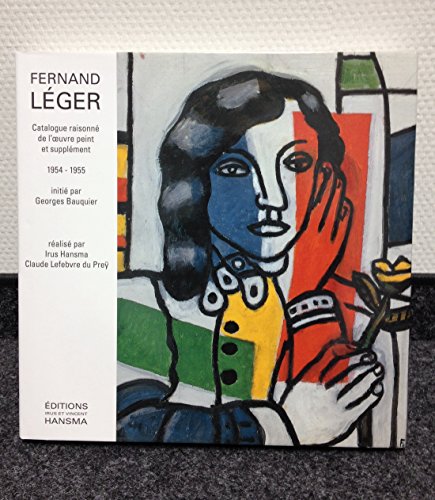
FERNAND LEGER. Catalogue Raisonné de l'oeuvre peint et supplément. Tome X. 1954-1955
Irus Hansma, Georges Bauquier, and Claude Lefebvre du Preÿ (Fernand Léger)
- Hardcover
- First Edition
- Signed
Seller: Cole & Contreras / Sylvan Cole Gallery, Sitges, B, SpainCole & Contreras / Sylvan Cole Gallery
Contact seller5-star sellerCondition: Used
US$ 375.00
US$ 28.77 shippingShips from Spain to U.S.A.Quantity: 1 available
The tenth and final volume of the catalogue raisonné. 216 pp. 127 color plates; 9 b&w plates. Large 4to. Publisher's cloth. NEW.

Published by Editions Cercle d'art 1955
- Hardcover
- First Edition
- Signed
Seller: Librairie Le Feu Follet, Paris, , FranceLibrairie Le Feu Follet
Contact seller5-star sellerCondition: Used
US$ 81.78
US$ 34.52 shippingShips from France to U.S.A.Quantity: 1 available
Couverture rigide. Editions Cercle d'art | Paris 1955 | 21.50 x 26.50 cm | reliure de l'éditeur | Edition originale. Reliure de l'éditeur en pleine toile crème, dos lisse, premier plat illustré. Texte de Pierre Descargues, envoi autographe signé de ce dernier. Iconographie, bel exemplaire. | [ENGLISH DESCRIPTION FOLLOWS] First e…dition. Publisher's full cream cloth binding, smooth spine, illustrated front board. Text by Pierre Descargues, signed autograph inscription from the latter. Iconography, handsome copy. *.
 More images
Published by Les Éditions de l'Arbre,, Montréal 1947
- Softcover
- Signed
Seller: DACART Livres rares & manuscrits (ALAC), Saint-Lambert, QC, CanadaDACART Livres rares & manuscrits (ALAC)
Contact seller5-star sellerCondition: Used - Fine
US$ 547.79
US$ 25.00 shippingShips from Canada to U.S.A.Quantity: 1 available
Condition: Très bon. In-4, couverture souple, 96 pages + 38 planches. Légère usure en marges de la couverture. Exemplaire signé par Fernand Léger sur la page titre illustrée additionnelle. Fernand Léger a séjourné à Montréal durant la Deuxième Guerre mondiale. Proche de Pellan, il a notamment exposé à la Galerie Dominion. Signé…par l'artiste.
 More images
Published by Teriade 1950
- Hardcover
- First Edition
- Signed
Seller: Marninart, Inc (ABAA - ILAB), Reston, VA, U.S.A.Marninart, Inc (ABAA - ILAB)
Contact seller5-star sellerCondition: Used - Very good
US$ 20,000.00
US$ 30.00 shippingShips within U.S.A.Quantity: 1 available
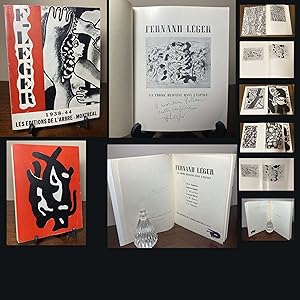
Hardcover. Condition: Very Good. 1st Edition. Teriade, Paris 1950. Fernand Leger. Portfolio with 63 lithographs in color and black and 22 manuscripted lithographic text with decorations. This portfolio is entirely conceived and realized by Leger in collaboration with the editor Teriade and his associate Marguerite Lange. It comp…rises 34 lithographs in color and 29 in black, the manuscripted text with 22 decorations are also lithographs, Limited in 300 copies, signed on justification page by Leger. Loose as issued, printed in Arches paper, in the original wrappers with two lithographs in front and back, guarded in hard chemise and slipcase. Complete and in very good conditions, but with off printing due to the rich color of the lithographs, hard chemise with spine tanned. Disclose: Some of the lithographs bear a signature by leger, we do not guarantee the authenticity of these signatures Ref: Saphire n 44-106. Signed by Illustrator(s).
 More images
Published by Les Editions de l'Arbre, Montreal 1945
- Softcover
- First Edition
- Signed
Seller: TBCL The Book Collector's Library, Montreal, QC, CanadaTBCL The Book Collector's Library
Contact seller5-star sellerCondition: Used
US$ 4,000.00
US$ 25.00 shippingShips from Canada to U.S.A.Quantity: 1 available
1st Edition. 1st Edition. Outstanding Association Presentation Copy with ownership stamp of Alfred Pellan. Inscribed by Léger on the half-title to Alfred Pellan. "A mon ami Pellan / votre confrere / F. Léger." First Edition. Squarish 8vo, decorated black and red wrappers, pp. 100. 38 pp. of dramatic black and white reproductions…. Very uncommon thus. Poem by Francois Hertel, philosophical argument by Leger, critical text by Maurice Gagnon, M.- A. Couturier, S. Giedion, S. M. Kootz and James Johnson Sweeney. Entire text In French. The international art comm u nity recognized a half century ago, the truly momentous contribution made by Alfred Pellan, to the arts and none more so than Léger himself, whom Pellan called both an inspirational colleague and a dear friend. During the war years, Léger spent time in North America, living for a brief period in Montreal, where he had an opportunity to enjoy Pellan's company as they had during Pellan's Paris years. Léger Presentations are Rare and Association Copies Impossible to acquire. A near fine copy showing just a hint of rubbing. A superb portfolio of his art. [. Signed.
 More images
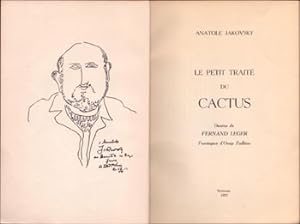
Le Petit traité du cactus. Dessins de Fernand Léger. Frontispice d'Ossip Zadkine. Signed first edition with an original drawing by Jakovsky.
Jakovsky, Anatole (1909-1983) ; Fernand Léger; Ossip Zadkine, artistes.
Published by Verviers, Velgium: Temps me?le?s 26-27 1957
- Softcover
- Signed
Seller: Wittenborn Art Books, San Francisco, CA, U.S.A.Wittenborn Art Books
Contact seller4-star sellerCondition: Used - Good
US$ 700.00
US$ 10.00 shippingShips within U.S.A.Quantity: 1 available
Condition: Good. 12mo. 13.8 x 19 cm. 29 pages, 12 unnumbered leaves of plates : illustrations, portrait. Enriched with a signed pictogram drawing by the author. Double number 26-27 of temps mêlés, 1957. OCLC Number 459566983.A whimsical tale set in Paris illustrated by two original hors-texte reproductions after original drawing…s by Fernand Leger (and a frontispiece portrait of the author by Ossip Zadkine. Jakovsky was a well connected art critic who after close friendships with Picasso, Braque, Delauney and others turned to an interest in outsider art after an accidental encounter with the work of le Dounier Rousseau.in-12. Broché. Broché.Anatole JAKOVSKY, Le petit traité du cactus, dessins de Fernand Léger, frontispice d'Ossip Zadkine. Verviers, 1957.
Published by Les Éditions de L'Arbre, Montréal. 1945
- Softcover
- First Edition
- Signed
Seller: Peter Ellis, Bookseller, ABA, ILAB, London, , United KingdomPeter Ellis, Bookseller, ABA, ILAB
Contact seller5-star sellerCondition: Used
US$ 753.44
US$ 19.95 shippingShips from United Kingdom to U.S.A.Quantity: 1 available
First edition. Royal octavo. 96 pages. 38 plates. Wrappers. Contains Léger's essay "A Propos du Corps Humain Considéré Comme un Objet", as well as pieces on him by M.-A. Couturier, Maurice Gagnon, S. Giedion, S.M. Kootz and J.J. Sweeney. Introductory poem by François Hertel. Presentation copy, inscribed by the artist on the fron…tispiece plate: "à C.O. Schniewind - Cordialement - F Leger". The recipient, Carl O. Schiewind, was an art historian and, at the time of the presentation, curator at the Art Institute of Chicago. Covers a little creased and rubbed at edges. Lower corner of pages bruised all the way through. Very good. On the front free endpaper is the rubber-stamp of The Art Institute of Chicago Department of Prints and Drawings which has been stamped over "Withdrawn". There are no other library marks.
 More images
Fernarnd Leger. La Forme Humaine Dans L'Espace
COUTURIER, M.-A; MAURICE GAGNON; S. GIEDION; FRANCOIS HERTEL; S.M. KOOTZ; FERNAND LEGER; J.J. SWEENEY
Published by Les Editions De L'Arbre, Montreal 1945
- Softcover
- First Edition
- Signed
Seller: Contact Editions, ABAC, ILAB, Toronto, ON, CanadaContact Editions, ABAC, ILAB
Contact seller5-star sellerCondition: Used - Very good
US$ 2,000.00
US$ 33.00 shippingShips from Canada to U.S.A.Quantity: 1 available
Original Wrappers. Condition: Very Good. First Edition. Red and black illustrated card covers with the cover title: "F. Legere 1938-44. Les Editions De L'Arbre - Montreal", pp.100 followed by 32 pages containing 38 black & white illustrations. INSCRIBED by Leger: "A. Schapiro / Cordialement / F Leger" on the additional illustrat…ed title-page. Covers a little scuffed, otherwise a very good copy. Text in French. Size: Square Octavo. INSCRIBED BY THE ARTIST. Book.

Fernand Léger et le nouveau espace. [Widmungsexemplar mit Fotografien als Beilage].
Léger, Fernand - Douglas Cooper [; René Groebli (Fotogr.); Curt Burgauer]
Language: French
Published by Genf, Éditions des Trois Collines 1949
- Signed
Seller: Antiquariat Uhlmann, Zürich, SwitzerlandAntiquariat Uhlmann
Contact seller5-star sellerCondition: Used
US$ 2,318.98
US$ 37.97 shippingShips from Switzerland to U.S.A.Quantity: 1 available
Brosch. m. OU. Gr.8°, montiertes farbiges Frontispiz, 194 S. mit 125 Abb. auf Tafeln (davon 7 farbig u. montiert), 1 Bl. Impressum; 4 lose Streifen Kontaktabzüge. Rücken broschurbedingt etw. knickspurig, OU etw. unsauber, innen tadellos. Französischsprachige EA. Mit Widmung von Fernand Léger in blauem Kugelschreiber an den Schwe…izer Kunstsammler und Mäzen Curt Burgauer auf Schmutztitel («a M. Burgauer / Cordialement / Zurich 20 - 3 - [19]50 / F. Léger»); ebendort zwei montierte Kontaktabzüge von Fotografien von René Groebli, Burgauer und Léger in einem (wohl) Zürcher Restaurant zeigend (einmal den Künstler beim Signieren des vorliegenden Exemplars, einmal die beiden mit Begleitung [jeweils ca. 6,0 x 6,0 cm]). Lose beiliegend 4 Streifen mit 10 weiteren Abzügen gleichen Formats und ähnlichen Inhalts (deren 2 verso mit Teilen desselben grünen Stempels des Fotografen [«Copyright by / René Groebli / Zurich»]).
 More images
Published by Musee National Fernand Léger, Biot, Biot, France
- Signed
Seller: Rareeclectic, pound ridge, NY, U.S.A.Rareeclectic
Contact seller5-star sellerCondition: Used - Very good
US$ 1,350.00
Free ShippingShips within U.S.A.Quantity: 1 available
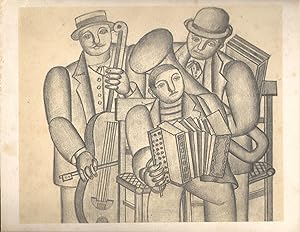
No Binding. Condition: Very Good. Once listed, I believe this will be the only such New Year's Card with Nadia Léger's signature or signed inscription. On the front is a reproduction of one of the four versions of Fernand Léger's painting, Les Trois Musiciens.'Les Trois musiciens personifies the Jazz Age and the joie de vivre of… Paris in the years leading up to the war. One version of the painting hangs in the Museum of Modern Art in New York City. Léger took his inspiration here from the performers at the bals musettes, where working-class Parisians would come on any given Saturday and Sunday afternoon to dance to the melody of an accordionist, the harmony of a horn player and the rhythmic thump of a bass player. Sometimes accompanied by a chanteuse like Edith Piaf, their music resonated in the dance halls of hard-scrabble neighborhoods throughout the city and became anthems of the urban life.' Besides being a fine artist in her own right, Nadia Léger ran the Académie Moderne with Georges Bauquier, whom she married after Léger's death in 1955. She was involved in creating many of the works attributed to Léger after the war. She collaborated with architect Andreï Svetchine to build the Fernand Léger Museum in Biot, Alpes-Maritimes near Antibes in 1960, which was donated to the French state in 1967. The French Minister of Culture, André Malraux, opened the Musée national Fernand Léger on 4 February 1969. She also converted Léger's farm at Lisores in Normandy into a museum, the Ferme-Musée Fernand Léger, completed in 1970.' I have provided photographs of all four sides of this large 'card'. It is in good shape, no tears, one crease at the top inside corner of the signed page, and one at the top left corner of the illustration. There is also a small stain off the top edge of the signed page, and as you can see there is some spotting/foxing on all four sides, though the light of the camera accentuates it iin a way the naked eyes does not. The blank rear side is by far the most foxed. Inscribed by Author(s).
Published by sans nom (vers 1953), Sans lieu 1953
- Signed
Seller: Librairie Blaizot, Paris, , FranceLibrairie Blaizot
Contact seller5-star sellerCondition: Used
US$ 6,518.47
US$ 23.01 shippingShips from France to U.S.A.Quantity: 1 available
Affichette (H. 320 x L. 217 mm) imprimée sur un papier légèrement crème, comportant un portrait photographique en noir et blanc de Paul EluardRare exemplaire de cette affichette, portant sous le portrait ces trois célèbres vers qui figurent à la fin de l'édition de L'Honneur des Poètes II publiée sous l'occupation en 1944: Je di…s ce que je voisCe que je saisCe qui est vrai.Ces vers ont été accompagnés d'un petit dessin original par Pablo Picasso, représentant un profil de chien, exécuté et signé à la mine de plomb d'un trait fin (hauteur du dessin 50 x largeur 550 mm).Le document est également enrichi d'une composition originale réalisée au crayon rouge par Fernand Léger, comportant deux signatures autographes de l'artiste (dont une placée sur le corps du chien de Picasso) et une arabesque sur toute la hauteur de la marge de droite entrecoupée par une colombe.Trace de pli horizontal au centre de l'affichette.A figuré dans le catalogue de la Librairie Demarest à Paris, intitulé La Mémoire des Lettres, sous le n°381.
 More images
Language: French
- Signed
- Art Print
Seller: BENTOM FINE ARTS, Soisy-sous-Montmorency, FranceBENTOM FINE ARTS
Contact seller5-star sellerCondition: Used - Fine
US$ 152.89
US$ 10.36 shippingShips from France to U.S.A.Quantity: 1 available
Condition: Tres bon. Fernand LEGER (1881-1955) - Nature morte aux pommes Lithographie en couleurs d'après une peinture de l'artiste - Signée dans la planche - Sur Vélin 58 x 49 cm (c. 23 x 19 inches) - Imprimée dans les Ateliers Arte/Maeght (Paris, France) - Excellent état. LEGER Fernand (illustrator).
 More images
Language: French
- Signed
- Art Print
Seller: BENTOM FINE ARTS, Soisy-sous-Montmorency, FranceBENTOM FINE ARTS
Contact seller5-star sellerCondition: Used - Fine
US$ 152.89
US$ 10.36 shippingShips from France to U.S.A.Quantity: 1 available
Condition: Tres bon. Fernand LEGER (1881-1955) - Les constructeurs Affiche en lithographie en couleurs - Signée dans la planche du monogramme de l'artiste - Sur papier affiche 50 _ 70 cm (c. 20 x 28 inches) - Imprimée dans les Ateliers Arte/Maeght (Paris, France) Excellent état INFORMATION : Affiche éditée à l'occasion de l'expo…sition "A propos de dessin" de l'artiste à la galerie Maeght en 1985. LEGER Fernand (illustrator).
 More images
Language: French
- Signed
- Art Print
Seller: BENTOM FINE ARTS, Soisy-sous-Montmorency, FranceBENTOM FINE ARTS
Contact seller5-star sellerCondition: Used - Fine
US$ 152.89
US$ 10.36 shippingShips from France to U.S.A.Quantity: 1 available
Condition: Tres bon. Fernand LEGER (1881-1955) - Hommage à l'artiste Affiche en lithographie en couleurs - Signée dans la planche du monogramme de l'artiste - Sur papier affiche 48 x 63 cm (c. 19 x 25 inches) Excellent état INFORMATION : Affiche éditée à l'occasion de l'exposition "Hommage à Fernand LEGER" à la galerie Maeght en… 1955. LEGER Fernand (illustrator).
 More images
Language: French
- Signed
- Art Print
Seller: BENTOM FINE ARTS, Soisy-sous-Montmorency, FranceBENTOM FINE ARTS
Contact seller5-star sellerCondition: Used - Fine
US$ 152.89
US$ 10.36 shippingShips from France to U.S.A.Quantity: 1 available
Condition: Tres bon. Fernand LEGER (1881-1955) - Chaise et vache Lithographie en couleurs d'après une peinture de l'artiste - Signée dans la planche - Sur Vélin 61 x 50 cm (c. 24 x 20 inches) - Editée par les Ateliers Arte/Maeght (Paris) - Excellent état. LEGER Fernand (illustrator).
 More images
Language: French
- Signed
- Art Print
Seller: BENTOM FINE ARTS, Soisy-sous-Montmorency, FranceBENTOM FINE ARTS
Contact seller5-star sellerCondition: Used - Fine
US$ 176.59
US$ 10.36 shippingShips from France to U.S.A.Quantity: 1 available
Condition: Tres bon. Fernand LEGER (1881-1955) - Les constructeurs Lithographie en couleurs d'après une peinture de l'artiste - Signée dans la planche - Sur Vélin 63 x 50 cm (c. 25 x 20 inches) - Editée par les Ateliers Arte/Maeght (Paris) - Excellent état. LEGER Fernand (illustrator).
 More images
Language: French
- Signed
- Art Print
Seller: BENTOM FINE ARTS, Soisy-sous-Montmorency, FranceBENTOM FINE ARTS
Contact seller5-star sellerCondition: Used - Fine
US$ 176.59
US$ 10.36 shippingShips from France to U.S.A.Quantity: 1 available
Condition: Tres bon. Fernand LEGER (1881-1955) - La parade à cheval Lithographie en couleurs d'après une peinture de l'artiste - Signée dans la planche - Sur Vélin 65 x 50 cm (c. 26 x 20 inches) - Editée par les Ateliers Arte/Maeght (Paris) - Excellent état. LEGER Fernand (illustrator).
 More images
Language: French
- Signed
- Art Print
Seller: BENTOM FINE ARTS, Soisy-sous-Montmorency, FranceBENTOM FINE ARTS
Contact seller5-star sellerCondition: Used - Fine
US$ 176.59
US$ 10.36 shippingShips from France to U.S.A.Quantity: 1 available
Condition: Tres bon. Fernand LEGER (1881-1955) (d'après) - Couple amoureux et cheval Lithographie en couleurs d'après une peinture de l'artiste - Signée dans la planche du monogramme de l'artiste - Sur Vélin 56 x 76 cm (c. 22 x 30 inches) - Imprimée dans les Ateliers Arte/Maeght (Paris, France) - Authentifiée par le cachet Maegh…t au verso - Excellent état. LEGER Fernand (illustrator).

- Signed
Seller: Traces Ecrites, Paris, , FranceTraces Ecrites
Contact seller5-star sellerCondition: Used
US$ 1,125.92
US$ 17.26 shippingShips from France to U.S.A.Quantity: 1 available
1 lettre autographe signée 1 p. In-12 13 juin 1930 Ecrite sur carte-lettre avec adresse autographe au verso. Une perforation de classeur "Mon cher Ami. Suis navré de mon étourderie, de votre lettreje n'ai retenu que vous n'étiez pas libre le mercredi et le rendez-vous àvendredi m'a échappé. En la relisant j'ai vu mon erreur. Exc…usez-moi et je pourrai vous voir semaine prochaine. A vous. FLeger". Fernand Léger a beaucoup peint pour Léonce Rosenberg dont il partageait les goûts pour l'architecture. Peintre, céramiste, sculpteur etdessinateur français.

- Signed
Seller: Traces Ecrites, Paris, , FranceTraces Ecrites
Contact seller5-star sellerCondition: Used
US$ 948.14
US$ 17.26 shippingShips from France to U.S.A.Quantity: 1 available
1 lettre autographe signée 1 p. In-4 (petit) "Dimanche" [20 juillet 1947] Très pâles piqûres. Fernand Léger avertit le peintre brésilien Carlos Scliar que « les deux tableaux : celui pour Mr Levy et celui pour Mr Marx [peut-être l'architecte Roberto Burle Marx (1909-1994)] sont à disposer, sont déposés, chez Mr Lefèvre-Foinet Em…balleur et marchand de couleurs 19 rue Vavin. J'espère que cette lettre vous trouvera en vacances ». Il donne son adresse « Fernand Léger 86 Rue Notre Dame des Champs ». Peintre, céramiste, sculpteur etdessinateur français.
 More images
- Signed
Seller: Schulson Autographs, Ltd., Millburn, NJ, U.S.A.Schulson Autographs, Ltd.
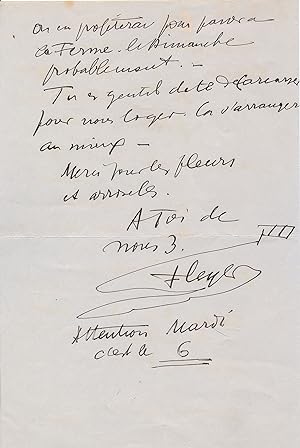
Contact seller5-star sellerFernand Leger, Autograph Letter Signed, on the topic of film. A small Drawing is part of his signature. Leger references his Surrealist film, "Ballet Mecanique." "Received letter dated 22nd. Heard: Leger en Amerique, 16 mm 20 to 25 minutes, talky, noisy. If you want Ballet Mechanique, in 35 or in 16. I believe I have both, lengt…h 20 to 25 min. So Tuesday, May 5 - I think we will be Me - Nadia - Wanda, so 3. We should plan on 3 rooms or at least 3 beds.We'll.come by the farm probably Sunday." He ends, "A Tois de mois 3, " and signs, "F. Leger," drawing a line around his signature starting from the "r" and ending in what could be the French Flag outlined. Leger refers to his film, "Ballet Mecanique," produced 1923 - 24. He wrote and co-directed this Surrealist movie with help form Man Ray and co-director, American filmmaker, Dudley Murphy (1897-1968). The American composer George Antheil (1900- 59) composed the score. The letter is written In French, 2 pages on one folded sheet, 8vo, April, 25, 1952. In addition to other works in 1952, a pair of Léger murals was installed in the General Assembly Hall of the United Nations headquarters in New York City. Signed.
 More images
- First Edition
- Signed
- Manuscript
Seller: Librairie Le Feu Follet, Paris, , FranceLibrairie Le Feu Follet
Contact seller5-star sellerCondition: Used
US$ 13,629.54
US$ 34.52 shippingShips from France to U.S.A.Quantity: 1 available
Pas de couverture. La Maison-Forestière 28 mai 1915 | 13.40 x 21.30 cm | 4 pp. sur un feuillet double | Fabuleuse lettre autographe du peintre Fernand Léger rédigée en première ligne durant la bataille d'Argonne, adressée au marchand d'art parisien Adolphe Basler. 92 lignes à l'encre noire, quatre pages sur un feuillet double, d…até par Léger du 28 mai 1915. La lettre autographe est présentée sous une chemise en demi maroquin vert sapin, plats de papier vert à motif stylisé, contreplats doublés d'agneau vert, étui bordé du même maroquin, ensemble signé Goy & Vilaine. La lettre a été choisie pour l'anthologie de Cécile Guilbert, Les plus belles lettres manuscrites de Voltaire à Édith Piaf, Robert Laffont, 2014. * Véritable chef-d'uvre de la correspondance, cette exceptionnelle missive de Fernand Léger révèle l'importance fondamentale de l'expérience des tranchées sur son uvre à venir. Mobilisé dans les troupes du Génie en 1914, Léger reste deux ans en poste sur le front d'Argonne, dans le secteur de la Maison-Forestière, d'où il écrit cette lettre le 28 mai 1915, «?pendant que les obus [lui] passent au-dessus de la tête?». En toute liberté de ton et de forme, la lettre surprend par le charme célinien de son style et annonce la période «?mécanique?» de sa peinture d'après-guerre. On assiste entre les lignes à l'éveil de sa conscience politique au contact des hommes rencontrés sur le front, dont le mérite et la bravoure marquèrent durablement le peintre. Son analyse particulièrement lucide de l'inhumanité de la guerre place cette missive parmi les plus belles lettres de combattant de la première Guerre Mondiale. Fernand Léger répond à Adolphe Basler, critique d'art polonais, qui fut le secrétaire de Guillaume Apollinaire et négociant de tableaux. Basler fit probablement la rencontre de Léger autour de 1910, alors que celui-ci fréquentait la «?bande à Picasso?» et subissait fortement l'influence du cubisme aux côtés de Derain, Maurice de Vlaminck et Max Jacob. S'essayant au monochrome puis à l'abstraction, Léger applique les préceptes de décomposition des formes et de distorsions de perspectives. Son travail auprès des cubistes devient prémonitoire de l'apocalypse à venir. Quelques années plus tard, ce vocabulaire cubiste devient en effet pour Léger la parfaite illustration de la guerre, qu'il décrit ainsi à Basler?: «?C'est linéaire et sec comme un problème de géométrie. Tant d'obus en tant de temps sur une telle surface, tant d'hommes par mètre et à l'heure fixe en ordre.?» Plus que jamais, l'innovation cubiste permet de traduire le monde contemporain oscillant entre rationalisme et chaos. Le contact des tranchées opère chez le peintre un véritable bouleversement tant intellectuel qu'artistique. Comme le remarque Blaise Cendrars «?cest à la guerre que Fernand Léger a eu la révélation soudaine de la profondeur d'aujourd'hui.?». Léger confie à Basler sa vision d'une guerre industrielle, inhumaine et dépersonnalisée?: «?Le flottement c'est fini. C'est une guerre sans «?déchet?», une guerre moderne. Tout vaut. Tout s'organise pour un maximum de rendement. Cette guerre-là, c'est l'orchestration parfaite de tous les moyens de tuer, anciens et modernes. C'est intelligent jusqu'au bout des ongles. C'en est même emmerdant, il n'y a plus d'imprévu?». Cette pertinente analyse de Léger se traduisit dans ses toiles d'après-guerre par une véritable esthétique du calcul et de l'équilibre, un «?rendement pictural?», à l'image de la guerre moderne à laquelle il prit part. Chez Léger en effet, la leçon cubiste s'accompagne d'une profonde réflexion sur la modernité et «?les hommes modernes?» qu'il désire représenter dans sa peinture. La lettre révèle la gestation de son style pictural d'après-guerre, gardant la fragmentation cubiste tout en faisant vibrer ses toiles de couleurs et de motifs saisis au contact des tranchées. En effet, Léger donne à Adolphe Basler un aperçu de sa célèbre «?période mécanique?» des années 1920, dont on peut voir une préfiguration dan.


