
Libro Dabbaco (2 results)
 More images
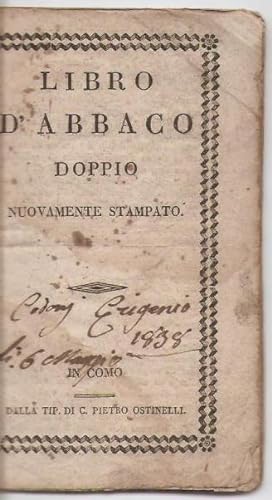
Published by In Como, Dalla tip. di C. Pietro Ostinelli 1830
- Hardcover
- First Edition
Seller: Rometti Vincent, Nice, , FranceRometti Vincent
Contact seller5-star sellerCondition: Used - Fair
US$ 47.69
US$ 46.30 shippingShips from France to U.S.A.Quantity: 1 available
Couverture rigide. Condition: Moyen. Edition originale. In Como, Dalla tip. di C. Pietro Ostinelli, sans date [vers 1830]. Brochure (147x95mm) de 20pp. sous couverture cartonnée muette. Ex-librs manuscrit sur le titre. Cartonnage défraichi, pâles mouillures.
 More images
Published by [Milan?], second half of the 15th century CE.
- Manuscript
Seller: Antiquariat INLIBRIS Gilhofer Nfg. GmbH, Vienna, A, AustriaAntiquariat INLIBRIS Gilhofer Nfg. GmbH
Contact seller5-star sellerCondition: Used
US$ 196,718.58
US$ 34.73 shippingShips from Austria to U.S.A.Quantity: 1 available
4to (150 x 200 mm). Italian and Latin manuscript on paper. 184 ff. (collation: I:18, II-XII:16; complete, missing only a few blanks). Rubrics, diagrams and manicules throughout, the latter often very elaborate, in red ink. A female profile (f. 131r) and a male one (f. 135r) in the style of certain wooden ceiling tablets widespre…ad in the Lombardy area. Contemporary limp calf in wallet style, lower cover decorated in ink. Abacus books, of which the present manuscript is an excellent example, were compilations of practical and recreational mathematics, of geometrical questions and of algebra, used by merchants in Renaissance northern Italy (Folkerts, XII, 1), a tradition which flourished after Leonardo Fibonacci's "Liber abbaci" (1202/28) (Van Egmond, 6; Folkerts, XII, 1). Some three hundred extant copies were surveyed by Van Egmond in 1980, who does not record this manuscript; only two other unrecorded examples had surfaced in commerce since then (Sotheby's, 1999; and one in private hands). - While Fibonacci was responsible for first introducing Hindu-Arabic numerals to Western Europe, abacus books, which derive from the first Italian translations of his Liber abbaci, "brought the Arabic system to Western Europe and made it a part of our common heritage" (Van Egmond, 32). Several personalities of the Renaissance were educated in the abacus tradition, including Leonardo da Vinci and Luca Pacioli, whose famous mathematical "Summa" was printed in Venice in 1494, while the renowned painter and mathematician Piero della Francesca wrote his own abacus treatise (Van Egmond, 13; Folkerts, XII, 1). - While books of this kind very rarely credited sources, this specimen includes the name of Euclid (f. 126r), the only authority Fibonacci mentioned in his treatise. Moreover, some interesting material makes this manuscript stand apart: a section (f. 110r) dedicated to the first four perfect numbers, of which Fibonacci had only mentioned the first three (Sigler, II, 25), and a so-called "magic square" (f. 8v). Magic squares were introduced to late medieval Europe through the Arabic tradition and were strongly associated with astrology; examples in Latin Europe before the 1500s, especially showing no errors, are scarce (Comes, 2016). - The structure of this manuscript closely follows the one given by Van Egmond when describing the standard content of abacus books (21-26). The main corpus of the manuscript occupies ff. 1r-141v, 183r-184r (incipit: "Nomen Algus vocabitur"); ff. 189r-190r contain a table of contents, written in red ink. The various sections comprise: ff. 1v-12r: arithmetic operations; 12v-19v: conversion of different units of measure; 19v-26r: aspect ratio; 26r-29r: currency exchanges; 29r-45v: fractional numbers; 46r-71v: division of capital and interests between partners; 71v-82r: barter; 82v-86v: calculation of interest; 87r-101v: silver lineage; 102-105v: lineage of gold; 106r-113v: recreational exercises ("de numero esvariati"); 114r-125r: so-called position rule, for the solution of 1st degree equations; 126r-141v: geometrical definitions and problems. On f. 143v a different scribe has inserted, under the date 1470, a concise instruction for the production of woollen fabrics, outlining the various investment items and specifying the use of English wool as the most valuable. - Spine a little wormed; binding shows some minor soiling. A few thumbstains to the paper, but overall in excellent condition, clean and fresh. - Various linguistic clues (of which the clearest one is the "sova" form of the feminine possessive) suggest a Milanese origin of the manuscript. This is confirmed by the history of the owners, in particular by the 17th-century note written on f. 1r: "Io Gio. Pietro Vegezo nela contrà del Gambaro Milano" (repeated on f. 162r). Giovan Pietro Vegezzi served as Grand Treasurer of the Chamber of Gold and Silver Merchants of Milan, which would sufficiently explain his interest in a manuscript of this type. A portrait of him as an old man, painted after 1664 by Francesco Prata, is kept in the Art Collections of the Ospedale Maggiore. - On f. 188r is an additional ownership by an unidentified Giovan Pietro da Bergamo, dated 1537, with an ink drawing of his coat of arms on the lower cover of the binding (apparently he had been allowed to use the imperial eagle). - W. Van Egmond, Practical Mathematics in the Italian Renaissance: A Catalog of Italian Abbacus Manuscripts and Printed Books to 1600 (Florence, 1980). Cf. P. Mainoni, "Il mercato della lana a Milano dal XIV al XV secolo. Prime indagini", Archivio Storico Lombardo CX (1984), pp. 20-43. Laurence Sigler (ed. and transl.), Fibonacci's Liber Abaci: A Translation into Modern English of Leonardo Pisano's Book of Calculation (Springer, 2003). Michael of Rhodes Project Team, Dibner Institute, and WGBH Interactive, "Mathematics: The Abacus Tradition", 2005. M. Folkerts, The Development of Mathematics in Medieval Europe: The Arabs, Euclid, Regiomontanus (London, 2006). R. Comes, "The Transmission of Azarquiel's Magic Squares in Latin Europe" in: F. Wallis & R. Wisnovsky (eds.), Medieval Textual Cultures. Agents of Transmission, Translation and Transformation (De Gruyter, 2016), pp. 159-198.

