

Order Total (1 Item Items):
Shipping Destination:

Lincoln Unknown, Signed (23 results)
Skip to main search results
Search filters
Product Type
- All Product Types
- Books (23)
- Magazines & Periodicals (No further results match this refinement)
- Comics (No further results match this refinement)
- Sheet Music (No further results match this refinement)
- Art, Prints & Posters (No further results match this refinement)
- Photographs (No further results match this refinement)
- Maps (No further results match this refinement)
- Manuscripts & Paper Collectibles (No further results match this refinement)
Condition Learn more
- New (1)
- As New, Fine or Near Fine (5)
- Very Good or Good (10)
- Fair or Poor (No further results match this refinement)
- As Described (7)
Binding
Collectible Attributes
Language (2)
Free Shipping
Seller Location
Seller Rating
-

Things You Never Knew or Were Told Not to Believe: Unknown Facts About Lincoln, the War, Black Bondage, and Rising Imperialism
Language: English
Published by iUniverse, Inc., Bloomington, 2012
ISBN 10: 1469763494 ISBN 13: 9781469763491
Seller: Clausen Books, RMABA, Colorado Springs, CO, U.S.A.
Association Member: IOBA RMABA
Seller rating 5 out of 5 stars

Signed
Wraps. Condition: Near Fine. Author's inked signature on title page. Immaculate and tight, gift quality copy! 183pp., including bibliography. Signed by Author. Paperback.
-
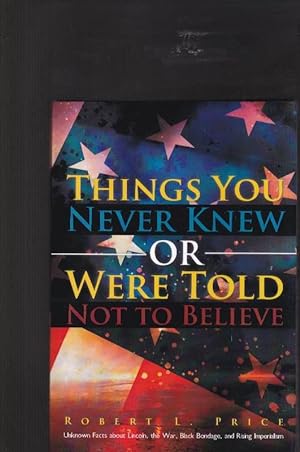
Things You Never Knew or Were Told Not To Believe: Unknown Facts About Lincoln, the War, Black Bondage, and Rising Imperialism
Language: English
Published by iUniverse, Bloomington, 2012
ISBN 10: 1469763516 ISBN 13: 9781469763514
Seller: Clausen Books, RMABA, Colorado Springs, CO, U.S.A.
Association Member: IOBA RMABA
Seller rating 5 out of 5 stars
Signed
Boards. Condition: Fine. Dust Jacket Condition: Near Fine (in mylar). Immaculate and unread; Dust jacket has a hint of edge-rubbing; 183p., including bibliography. A book by a man who lives only in his own echo chamber; Conversely, he documents the plight of African Americans in today's society, and the continued racism and silent bigotry against the African American community, committed by the courts, the Police, business leaders, and by city, county and state officials. Size: 8vo - Over 7 3/4" -9 3/4 " Tall. Signed by Author. Hard Cover.
-

Things You Never Knew or Were Told Not to Believe: Unknown Facts About Lincoln, the War, Black bondage, and Rising Imperialism
Published by iUniverse, Inc., Bloomington, 2012
Seller: Clausen Books, RMABA, Colorado Springs, CO, U.S.A.
Association Member: IOBA RMABA
Seller rating 5 out of 5 stars
First Edition Signed
Wraps. Condition: Near Fine. First Edition. Author's inked signature on title page; Covers minimally edge-worn; 183p., including bibliography; errata slip laid in. Size: 8vo - over 7¾" - 9¾" tall. Signed by Author. Paperback.
-

Lincoln the Unknown
Published by Perma Giants, New York, 1949
Seller: Ground Zero Books, Ltd., Silver Spring, MD, U.S.A.
Seller rating 5 out of 5 stars
Signed
Hardcover. Condition: as is. Reprint Edition. 305 pages. Bibliography, rear board weak, text darkened and stained, boards soiled, spine faded, bookplate signed by Dale Carnegie. Small tears and small pieces missing at top and bottom of spine, board corners worn.
-
US$ 18.48
Free Shipping
Ships from United Kingdom to U.S.A.Quantity: Over 20 available
Add to basketPaperback. Condition: New. Print on Demand. This book unearths a trove of hidden stories and personal accounts surrounding the iconic figure of Abraham Lincoln. The author scoured historical records and uncovered rare artifacts, including a letter signed by Lincoln himself and a photograph of him with a young boy in his arms. Through meticulous research, the author reveals the lesser-known facets of Lincoln's character and his profound impact on the lives of those around him. This book offers a fresh perspective on one of America's most revered presidents, shedding light on his humanity and the enduring legacy he left behind. This book is a reproduction of an important historical work, digitally reconstructed using state-of-the-art technology to preserve the original format. In rare cases, an imperfection in the original, such as a blemish or missing page, may be replicated in the book. print-on-demand item.
-
Hardcover. 8vo. Condition: Good. Signed. Green glossy illustrated boards have straight edges and pointed corners. Head of spine has an open tear present. Foot is lightly creased with damp stains. Text block is square with deckled pages and toned edges. Damp stain present on lower edge. Binding is tight. 305p. You can find Carnegie's signature in blue ink on Award plate on front fly leaf, along with previous owners name. End pages are toned. Interior is otherwise unmarked.
-
Lincoln: The Unknown The Most Astounding Story In American History
Published by Forest Hills Publishing Co. January 1932, 1932
Signed
Hardcover. Condition: Good - Cash. No Jacket. *** SIGNED BY AUTHOR *** Light green hardcover binding with the title done in red lettering on the spine and front cover. There is an illustration of Abraham Lincoln of to the side done in a darker green, and an illustration of covered wagons and log cabins are done in the same red as the title. Corners are bumped, showing the boards beneath it. Some light soiling on the spine, and a cut on the back cover.Top page edges are done in red, there is some light yellowing on the page edges. Pages are in immaculate condition. There is an award paper attatched to the ffep, signed by Dale Carnegie. Stock photos may not look exactly like the book. Signed By Author.
-
Hardcover. Condition: Good. No Jacket. Aware slip attached to front endpaper. As with many others, signed by Mr. Carnegie. This award is from Class Number 1109. No DJ. Light wear to covers. Content pages are clean and unmarked. 305 pages. Signed by Author.
-
Lincoln the Unknown
Language: English
Published by Dale Carnegie & Associates, Inc., Garden City, NY, 1959
Seller: BookEnds Bookstore & Curiosities, Ojai, CA, U.S.A.
Seller rating 5 out of 5 stars
Signed
Hardcover. Condition: Very Good. Dust Jacket Condition: Very Good. Hardcover Signed by the Class participants of Dale Carnegie Course/Class of December 12, 1989. Green boards with mauve titling on the spine. Includes Bibliography, 256 pages. The DJ is in Very Good condition with the exception rubbing/wearing to the extremities. Signed by Author(s).
-
Lincoln the Unknown
Language: English
Published by Forest Hills Publishing Co., Forest Hills New York, 1932
First Edition Signed
Hardcover. Condition: Near Fine. No Jacket. 1st Edition. Signed by Dale Carnegie. Book is in very good+ condition. Boards have light wear to top and tail end. Unmarked text. Signed by Author(s).
-
LINCOLN THE UNKNOWN
Published by D. Appleton-Century: NY, 1938
Seller: John K King Used & Rare Books, Detroit, MI, U.S.A.
Seller rating 4 out of 5 stars

Signed
Hardcover. Condition: Very Good. 8 x 5.5", green cloth, 305pp with Bibliography, a very worn copy, extremities bumped and fraying, spine ends tearing, inner front hinge cracked, frontis torn out, pp toned, dogeared, etc. But SIGNED BY THE AUTHOR, DALE CARNEGIE IN GREEN INK AT BOTTOM OF FRONT BLANK PAGE (though someone in the last 84 years has crossed it out in pencil). SWAF.
-
Hard Cover. Condition: Good. No Jacket. Green boards, burgundy lettering, boards rubbed on corners, lightly chipped at tip. Bookplate on fep is signed by Dale Carnegie. Pages are tanning in margins, no markings in text, binding sound. Size: 8vo - 7¾" - 9¾". Signed by Author.
-
Hardcover. Condition: Good. No Jacket. 1st Edition. Lincoln the Unknown by Dale Carnegie was published by the Forest Hills Publishing Co., Forest Hills, New York, in 1932. Not an ex-library copy, this 82-year-old, 305-page, 5 1/2" X 8", signed offering is in G+ condition. It does NOT appear to be a First Edition as, though it "says" it was copyrighted in 1932, it has pictorial laminated boards, which I do not believe were "used" back in 1932. It IS a really nice older SIGNED edition. There is spotty, light staining on the back cover board, noticeable shelf wear at top two outer tips of boards, and more modest shelf wear at top and bottom edges of volume's spine. Staining from original glue is observed on front/back end papers, and there is modest yellowing of same as well as pages of text. There is a 2 1/2" X 4 3/4" Award Plate attached to bottom-third portion of front loose end page, and said Plate is SIGNED by the author. This is, Reader, a most fascinating telling of the life of Abraham Lincoln, written as it is by a man who himself was born in poverty/extremely humble circumstances, but who rose, in his lifetime, to astounding heights of success and acclaim and wealth. Although Carnegie appropriately details our sixteenth President's accomplishments and triumphs, the author tilts decidedly towards ".the personal side of his career: to his sorrows, his repeated failures, his poverty, his great love for Ann Rutledge, and his tragic marriage to Mary Todd"(from "How This Book Was Written--and Why", immediately preceding Chapter I of Part One). Indeed, this literary effort on Carnegie's part may well document the MOTHER OF ALL EXAMPLES OF PICKING ONE'S SELF UP AND CARRYING ON/TRYING AGAIN AFTER EACH LETDOWN/DISAPPOINTMENT. As with all books that fascinate, this one must be read, obviously, to experience its amazing grasp upon one's attention. If Lincoln is one who interests you, this is one, among the thousands of books written about him, that you should seriously consider reading. Organized in three parts, stretching over some thirty-three chapters, there is also a Bibliography included. Thank you!! Signed by Author(s).
-
Lincoln the Unknown
Published by Dale Carnegie Publishers, Inc. - New York, 1932
Seller: Barberry Lane Booksellers, Bar Harbor, ME, U.S.A.
Seller rating 4 out of 5 stars
Signed
Hardcover. Condition: Near Fine. Grass green cloth on boards with stamped brown lettering to spine. Book is tight, square, relatively sharp-cornered and free of markings and flaws inside and out, other than a staple to FFEP, and the pasted in "Award" label presenting this book to Jean Loopman who took Dale Carnegie's Class Number 393, and signed by Dale Carnegie. Signed by Author(s).
-
Hardcover. Condition: Good - Cash. No Jacket. Signed by the author. Green cover with black text on the cover and spine. General reader wear to the corners, edges, and cover. Corners have been bumped a bit. The spine is sun discolored. The covers have some water doplet stains/discoloration. The pages show some general reader wear as well. The book is in good condition with some normal reader wear. Stock photos may not look exactly like the book. Signed By Author.
-
Lincoln the Unknown
Published by D. Appleton Century Co., 1941
Seller: Old Editions Book Shop, ABAA, ILAB, North Tonawanda, NY, U.S.A.
Seller rating 5 out of 5 stars
Signed
Hardcover. Condition: Very Good-. Dust Jacket Condition: Very Good-. Mild shelfwear and bumping to green cloth boards. Unclipped DJ protected in mylar, mild soiling, chipping and small tears. Solid binding and clean text. Offsetting on some early pages. Dale Carnegie Institute award bookplate on ffep with former owner name and signature of author. ; 8vo 8" - 9" tall; 305 pages; Signed by Author.
-
Lincoln The Unknown [Signed]
Published by Forest Hills Publishing Co, Forest Hills, NY, 1932
Seller: Lorne Bair Rare Books, ABAA, Winchester, VA, U.S.A.
Association Member: ABAA ILAB IOBA
Seller rating 5 out of 5 stars
Signed
Octavo (21cm); glossy pictorial boards; brown topstain; x,305,[3]pp. With an Award label signed by Carnegie mounted to the front endpaper. Gentle sunning to spine, light wear to extremities, with a few tiny tears and indentations to spine ends; contents clean; Near Fine, without dustjacket, as issued. Attractive copy of this early work by Carnegie, preceding his best-selling How to Win Friends and Influence People by four years. A biographical work on the life of Abraham Lincoln, detailing his early years, the difficulties he faced in the White House, his marriage, and leading the nation during the Civil War. First published by The Century Company in 1932, the title was reprinted numerous times over several decades, frequently given out as a prize in the Dale Carnegie Course. Signed.
-
Lincoln, the unknown
Published by Perma Giants, 1949
Seller: Books From California, Simi Valley, CA, U.S.A.
Seller rating 4 out of 5 stars
Signed
hardcover. Condition: Good. Signed. SIGNED by the author. It is inscribed. No jacket. Book has shelf wear and edge wear. Fading to the spines cover. Pages are tanned.
-
Hardcover. Condition: Good. Dust Jacket Condition: Fair. Sign by Dale Carnegie on plate on inside page some chips on dust jacket. Signed by Author(s).
-
Lincoln the Unknown
Published by Perma Giants, New York, 1949
Seller: Ground Zero Books, Ltd., Silver Spring, MD, U.S.A.
Seller rating 5 out of 5 stars
Signed
Hardcover. Condition: Good. [2], x, 305, [3] pages. Bibliography, board corners and top and bottom spine edges worn/small chips, small piece missing at spine. Comments and underling noted. Some pencil erasures noted. Nice inscription signed by Carnegie on fep. Dale Harbison Carnegie (November 24, 1888 November 1, 1955) was an American writer and lecturer and the developer of famous courses in self-improvement, salesmanship, public speaking, and interpersonal skills. He was the author of How to Win Friends and Influence People (1936), a bestseller that remains popular today. He also wrote, Lincoln the Unknown (1932), and several other books. One of the core ideas is that it is possible to change other people's behavior by changing one's behavior toward them. By 1916 Dale was able to rent Carnegie Hall itself for a lecture to a packed house. Carnegie's first collection of his writings was Public Speaking: a Practical Course for Business Men (1926), later entitled Public Speaking and Influencing Men in Business (1932). His crowning achievement, however, was when Simon & Schuster published How to Win Friends and Influence People. Lincoln the Unknown is a biography of Abraham Lincoln, written in 1932 by Dale Carnegie and given out as a prize in the Dale Carnegie Course. One spring day, Dale Carnegie came across a column in the Morning Post newspaper entitled "Men and Memories". On that particular morning and for several mornings following, that column was devoted to Abraham Lincolnthe personal side of his career. Carnegie read those with profound interest, and surprise. He determined to write a book on Lincoln, himself. Carnegie began the work in Europe, and then went to Illinois, to write of Lincoln on the very ground where Lincoln himself had dreamed and toiled. He delved among old books, letters, speeches, newspapers and court records, trying to understand Lincoln. Carnegie wrote many of the chapters in Springfield. Some in the sitting-room of the old home where Lincoln lived, some at the desk where he composed his first inaugural address, and others where he came to court Mary Todd. Later edition from an additional publisher.
-
Lincoln the Unknown
Published by Forest Hills Publishing Co, Forest Hills, NY, 1932
Seller: Ground Zero Books, Ltd., Silver Spring, MD, U.S.A.
Seller rating 5 out of 5 stars
Signed
Hardcover. Condition: fair to good. Early edition. 305 pages. Bibliography, board corners and top and bottom spine edges worn/small chips, small piece missing at top of spine. Dale Harbison Carnegie (November 24, 1888 - November 1, 1955) was an American writer and lecturer and the developer of famous courses in self-improvement, salesmanship, corporate training, public speaking, and interpersonal skills. He was the author of How to Win Friends and Influence People (1936), a bestseller that remains popular today. He also wrote How to Stop Worrying and Start Living (1948), Lincoln the Unknown (1932), and several other books. One of the core ideas in his books is that it is possible to change other people's behavior by changing one's behavior toward them. Carnegie changed the spelling of his last name from "Carnagey" to Carnegie, at a time when Andrew Carnegie (unrelated) was a widely revered and recognized name. As Dale Carnagey he worked as assistant to Lowell Thomas in his famous travelogue "With Allenby in Palestine and Lawrence in Arabia". He managed and delivered the travelogue in Canada. By 1916 Dale was able to rent Carnegie Hall itself for a lecture to a packed house.[5] Carnegie's first collection of his writings was Public Speaking: a Practical Course for Business Men (1926), later entitled Public Speaking and Influencing Men in Business (1932). His crowning achievement, however, was when Simon & Schuster published How to Win Friends and Influence People. Carnegie died at his home in Forest Hills, New York, where this early edition was published. Bookplate signed by Dale Carnegie awarding this book to a student in class number 16 as a prize for his excellent talk on "How to Win Friends and Influence People." Lincoln the Unknown is a biography of Abraham Lincoln, written in 1932 by Dale Carnegie. It is published by Dale Carnegie and Associates, and given out as a prize in the Dale Carnegie Course. Abraham Lincoln, a farm boy, becomes the president of The United States. He travels miles to borrow books; reading being the dominant passion of his for quarter of a century. He mourns the loss of his first love his whole life. He humors his colleagues in the White House, and lives with the difficulties of the marriage with his second love, while in war with the South. One spring day, Dale Carnegie was breakfasting at a hotel in London. He came across a column in the Morning Post newspaper entitled "Men and Memories". On that particular morning and for several mornings following, that column was devoted to Abraham Lincoln-the personal side of his career. Carnegie read those with profound interest, and surprise. He had always been interested in the United States history. Aroused by the articles in the Morning Post, Carnegie went over to the British Museum Library and read a number of Lincoln books; the more he read, the more fascinated he became. Finally he determined to write a book on Lincoln, himself. Carnegie began the work in Europe, and labored over it for a year there, and then for two years in New York. Finally he tore up all that he had written and tossed it into a waste-basket. He then went to Illinois, to write of Lincoln on the very ground where Lincoln himself had dreamed and toiled. For months he lived among people whose fathers had helped Lincoln survey land, build fences and drive hogs to market. For months he delved among old books, letters, speeches, half-forgotten newspapers and musty court records, trying to understand Lincoln. Carnegie spent one summer in the little town of Petersburg. He went there because it is only a mile away from the restored village of New Salem, where Lincoln spent the happiest and most formative years of his life. The same white oaks under which Lincoln studied, wrestled and made love were still standing. Every morning Carnegie used to take his typewriter and motor up there from Petersburg, and wrote half of the chapters of his book under those trees. He often used to go alone to the woods along the banks of the Sangamon, on summer.
-
Four Speeches by Abraham Lincoln: Hitherto Unpublished or Unknown With an autographed letter signed by Earl Wellington Wiley to the author and editor Worthing C. Ford. The book appears to be Worthing C. Ford's working copy, as it is signed by him on the front endpaper and contains 8 to 10 pages of his notes (typed and handwritten) which have been laid in
Published by Ohio State University, Columbus, Ohio, 1927
Seller: Brainerd Phillipson Rare Books, Holliston, MA, U.S.A.
Association Member: SNEAB
Seller rating 5 out of 5 stars
First Edition Signed
Hardcover. Dust Jacket Included. 1st Edition. Splendidly bound in finely woven linen cloth with the red moroccan label on the spine. Not only does the book have the original glassine, waxy dust wrapper, but it has the heavy stock paper dust jacket as well. The jacket is in very good plus condition and has been price-clipped. The book is crisp, clean and remarkable as it was Worthington C. Ford's personal copy, signed by him on the front endpaper with an occasional marginal note. Ford has also glued in a folded letter to him from Earl Wellington Wiley who wrote the introduction for this book. Wiley's letter is written on his Ohio State University, Depart. of English stationery: Dear Dr. Ford: I have ordered a copy of "Four Speeches of Lincoln" sent you, and hope it will be sent out shortly. It included the Scott Club speech. I am very interested in the Lincoln biography you are working on and shall look forward to its publication. I am working on Lincoln as a public speaker. Very cordially, Earl W. WileyWorthington C. Ford was the youngest member of a distinguished and notorious family. He was the great-grandson (through his mother) ofNoah Webster.[2]His two younger brothers werePaul Leicester Ford, an eminent biographer and novelist, andMalcolm Webster Ford, a distinguished amateur athlete. Both died May 8, 1902 in amurder-suicidewhen Malcolm shot Paul and then himself.[3] Ford was best known for his edited collections of a number ofFounding Fathersdocuments, including "The writings of George Washington (14 Volumes)", "Alexander Hamilton's notes in the Federal convention of 1787", and "Writings of John Quincy Adams". He also edited collections of the correspondence ofThomas Jefferson,John Adams, and other figures in early American history.[4]Ford's historical work was also notable for his tenure as chief of the newly established Manuscripts Division at theLibrary of Congress. During his time in charge, from 1903 to 1909,[4]he organized a significant effort to photograph and copy manuscripts pertaining to early American history which resided in foreign archives (especially France, Britain, and Spain). In this way, copies of many documents which had been missing since 1812 or earlier were recovered.[5]In addition, he edited and published the completeJournals of the Continental Congress, 17741789. (Wikipedia) From the Preface: "Like Saul of Tarsus, Lincoln when he addressed the Scott Club carried a commission to persecute the unfaithful, -- and the Scott Club speech may be construed as the 'stoning' of Stephen [Douglas]. At least, critics partial to sensational testimony may find cause in the speech to represent Lincoln as malicious and uncharitable. That was in 1852. Then, on some road to Damascus, he looked at politics in another light; and henceforth he spoke against his political rivals in a spirit less vindictive than he had used in his early days. But he grew in power of argument as well as in kindliness of spirit. For years, for example, he struggled to demonstrate the proposition which he eventually demonstrated at Cooper Union. But six years it took him to make the argument effective. Thus, slowly grew Lincoln to power. It is my purpose in the Introduction to trace this two-fold development of Abraham Lincoln: first, to show how he abandoned the spirit of the partisan. For this purpose, the Scott Club speech is compared to the 'Apple of Gold Speech.' To show how Lincoln grew in power of debate, the argument used in the Indianapolis and Leavenworth speeches is compared to the same argument as used in Cooper Union." First edition with matching dates of 1927 on the title and copyright pages; no subsequent printings listed.
-
LINCOLN THE UNKNOWN Signed
Published by Forest Hills Publishing Company, New York, 1932
First Edition Signed
Hardcover. First Edition; First Printing. Very Good+ in a Very Good dust jacket. Rubbing, few open tears along panel edges. Chipping at spine crown/heel. ; Signed by author on bookplate on FEP. ; Signed by Author. Signed.


![Seller image for Lincoln The Unknown [Signed] for sale by Lorne Bair Rare Books, ABAA](https://pictures.abebooks.com/inventory/md/md31475651314.jpg)

