
Manuscript Leaf: First Edition (25 results)

Language: English
Published by Zurich, Publication Foundation for Museum Rietberg, 2020
- Softcover
- First Edition
Seller: Books and Beaches, Anna Bechteler, Icking, , GermanyBooks and Beaches, Anna Bechteler
Contact seller5-star sellerCondition: Used - Fine
US$ 38.21
US$ 55.64 shippingShips from Germany to U.S.A.Quantity: 1 available
Condition: Sehr gut. Original softcover binding, 87 pages, numerous illustrations, very good condition. Wonderful publication of an highly interesting manuscript, which is actually a forgery, but is nonetheless an absolute marvel. Sprache: Englisch Gewicht in Gramm: 550.
 More images
Language: English
Published by Original ms 1889
- Softcover
- First Edition
- Signed
Seller: The Plantagenet King ABA : ILAB : PBFA, Birchington, KENT, United KingdomThe Plantagenet King ABA : ILAB : PBFA
Contact seller5-star sellerCondition: Used - Very good
US$ 172.73
US$ 33.54 shippingShips from United Kingdom to U.S.A.Quantity: 1 available
Soft cover. Condition: Very Good. 1st Edition. MARTIN (Sir Theodore, 1816-1909). Autograph Manuscript Leaf Signed, quoting Heinrich Heine, dated June 1889. 1 p., 8vo, in ink on laid paper, the verso with old paper adhesions, crease and an old fold. Good. From Heinrich Heine's Poems and Ballads in Martin's hand, written out and…signed is this quotation: "The rose, the lily, the sun, and the dove, I loved them all with a passion of love. That is past; now one only is dear to me, My pretty, my witty, pure, peerless she; She herself, source of all that is worthy love, Is rose, and lily, and sun, and dove." From Heine, by Theodore Martin. June 1889. Sir Theodore's acclaimed English translation of Heine's Buch der Lieder (1854) introduced the German poet's lyrical romanticism to Victorian readers and influenced later Anglophone verse renderings. This autograph transcription—made thirty-five years later—shows Martin's lasting affection for Heine's poetry. Sir Theodore Martin was a Scottish poet, translator and man of letters, best known for his translations of Heine, Horace, and Catullus, and for his monumental Life of the Prince Consort. He was also the husband of the celebrated Shakespearean actress and author of On Some of Shakespeare's Female Characters, Lady Helen (Faucit) Martin. It is rare to find a manuscript leaf like this from him. Signed by Author(s).

- Hardcover
- First Edition
Seller: Stefan Küpper, Duisburg, , GermanyStefan Küpper
Contact seller4-star sellerCondition: Used
US$ 71.64
US$ 11.53 shippingShips from Germany to U.S.A.Quantity: 1 available
Zürich, Artibus Asiae Publishers at Museum Rietberg 2006. 255 S. m. zahlr. Abbildungen. OLn. m. OU. 30,4 x 23,8 cm. Sehr gutes Exemplar.
 More images
Published by The Riverside Press (Houghton Mifflin Co.), Cambridge, MA 1904
- Hardcover
- First Edition
- Signed
Seller: APPLEDORE BOOKS, ABAA, WACCABUC, NY, U.S.A.APPLEDORE BOOKS, ABAA
Contact seller5-star sellerCondition: Used - Near fine
US$ 6,500.00
US$ 6.00 shippingShips within U.S.A.Quantity: 1 available
3/4 leather. Condition: Near Fine. First Edition. A very attractive example of this sumptuous collection of the "Complete Works of Ralph Waldo Emerson", bound in a lavish 3/4 dark-green morocco over marbled boards, with fine gilt-tooling at the compartments. Complete in 12 octavo volumes. The 1903-1904 "Autograph Centenary Editi…on", here honoring Emerson's 1803 birth. This set #67 of 600 copies issued of the "Autograph Centenary Edition", EACH SIGNED "HOUGHTON MIFFLIN & CO." AT THE LIMITATION AND EACH ALSO INCLUDING AN ORIGINAL MANUSCRIPT LEAF, IN THIS CASE AN 1854 HANDWRITTEN LETTER --ADDRESSED FROM CONCORD-- IN VOLUME I IN RALPH WALDO EMERSON'S FLOWING HAND, TAKING UP BOTH SIDES OF THE BOUND-IN SINGLE SHEET. THE ALS GRACIOUSLY OFFERS THANKS FOR EMERSON'S "ELECTION AS AN HONORARY MEMBER OF 'THE EVERETT LITERARY ASSOCIATION'", WHILE ADMITTING "I AM MUCH TO BLAME FOR ALLOWING YOUR NOTE INFORMING ME OF MY ELECTION TO REMAIN UNACKNOWLEDGED HITHERTO". The set is bright and crisp and easily VG+ to Near Fine. Top-edges bright-gilt, deckled fore and bottom-edges. Very faint mustiness to several of the volumes, clean as could be internally, with no writing or markings of any kind. Illustrated in photogravure throughout, matching marbled endsheets and pastedowns as well. A lasting, significant collection of Emerson's full body of writings. Signed.
 More images
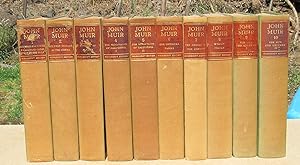
The Writings of John Muir: The Manuscript Edition. --- complete set WITH partial leaf of John Muir's handwriting taken from the manuscripts of his books -- The Story Of My Boyhood And Youth, A Thousand-Mile Walk to the Gulf, My First Summer in the Sierra, Travels in Alaska, The Mountains of California, Our National Parks, The Cruise of the Corwin, Steep Trails, The Life and Letters of John Muir
Muir, John & William Frederic Bade (for last two volumes Life And Letters)
Published by Houghton Mifflin Company 1916-1924, Boston 1916
- Hardcover
- First Edition
- Signed
Seller: JP MOUNTAIN BOOKS, PORTLAND, OR, U.S.A.JP MOUNTAIN BOOKS
Contact seller5-star sellerCondition: Used - Very good
US$ 4,250.00
US$ 5.38 shippingShips within U.S.A.Quantity: 1 available
Hardcover. Condition: Very Good. No Jacket. 1st Edition. This is a first edition complete 10 volume set of THE WRITINGS OF JOHN MUIR by John Muir, edited by William Frederic Bade with additional biographical material in volumes 9 and 10 by Bade. Edition of 750 sets, this set being number 200 with that number being handwritten in… each volume on the limitation page. The sets were published over a number of years starting in 1916 and concluding in 1924. Each volume measures 231mm tall x 155mm and has a b/w frontispiece with tissue guard. The set requires approximately 410mm (16.25 inches) of shelf space when the volumes are positioned upright. The following is copied from Kimes' bibliography of John Muir's books: v. 1. Nine photogravures with printed tissues, incl. front.; 8 halftone plates of author's sketches and map tipped in. v. 2. Eight photogravures with printed tissues, inc. front.; 16 halftone plates of author's sketches and map tipped in. v. 3. Eight photogravures with printed tissues, incl. front., and map tipped in. v. 4. Eight photogravures with printed tissues, incl. front., and map tipped in. v. 5. Six photogravures with printed tissues, incl. front., and map tipped in. v. 6. Seven photogravures with printed tissues, incl. front., and map tipped in. v. 7. Five photogravures with printed tissues, incl. front.; 10 halftone plates of author's sketches and map tipped in. v. 8. Six photogravures with printed tissues, incl. front., and map tipped in. v. 9. Seven photogravures with printed tissues, incl. front., and 1 plate of author's drawing tipped in. v. 10. Five photogravures with printed tissues, incl. front., and 1 plate of author's drawing tipped in. Price: $6.00 per v. In correspondence with the Houghton Mifflin Company, we learned that The Writings was a publication of the Private Library Department and that no records were available. The set was sold by subscription only. According to the publisher's announcement of the manuscript edition, the first six volumes were to be published in the fall of 1916, and the remaining four volumes would be published as soon as "the work of compilation and editing" could be accomplished. Since A Thousand-Mile Walk to the Gulf, included in volume one, was not published until November, 1916, the six volumes could have been available in December, but it may not have been until early in 1917. Volumes seven and eight were published in 1918; volume nine did not appear until late in 1923, and volume ten in 1924. Correspondence indicates that the war was a deterring factor in the company's publication schedule. Customers were inquiring for the last two volumes as early as 1919 and 1920. A hand-written note (Dr. Bade) on a publisher's announcement indicates that the manuscript edition, issued in a variety of formats, was completely sold. CONDITION: Each volume is bound in original green buckram, with leather title patch on spine lettered in gilt, with front and bottom edges of text block uncut, and with each volume hand-numbered (all volumes have the same number which indicates that this is not a mixed set). The spines have faded to tan (usual for this binding) and the leather title patches have some usual wear with loss to the patches of volume 1, volume 2, and volume 3. No previous owner marks or writing on any pages, no foxing, solid bindings, complete.PHOTOS ARE OF ACTUAL ITEM BEING OFFERED. Signed by Author(s).
 More images
Published by Ticknor & Fields; Houghton Mifflin and Company, Boston; Boston and New York 1906
- Hardcover
- First Edition
Seller: Manhattan Rare Book Company, ABAA, ILAB, New York, NY, U.S.A.Manhattan Rare Book Company, ABAA, ILAB
Contact seller5-star sellerCondition: Used - Very good
US$ 22,000.00
US$ 6.00 shippingShips within U.S.A.Quantity: 1 available
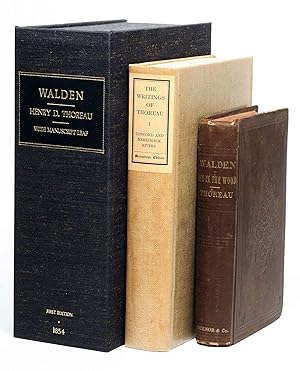
Original cloth. Condition: Very Good. First edition. FIRST EDITION OF A SEMINAL WORK OF AMERICAN LITERATURE WITH MANUSCRIPT LEAF FROM THOREAU'S MEMOIRS. First published in a run of two-thousand copies in Thoreau's native Massachusetts, Walden; Or, Life in the Woods (1854) synthesises the thematic core of the Transcendentalist mo…vement: a simple life with immediate connection to the natural world. During the second quarter of the nineteenth century, Thoreau cloistered himself in a cabin built by himself within the acreage of Ralph Waldo Emerson's woodland in Concord, Massachusetts. From this isolated sojourn emerged Thoreau's most prolific work, which encapsulates his ideas on self-reliance and humankind's relationship with nature. "If a man does not keep pace with his companions, perhaps it is because he hears a different drummer," writes Thoreau, continuing, "Let him step to the music which he hears, however measured or far away." (Walden, p. 348). At the turn of the century and following the author's death in 1862, Thoreau's collected works were published in twenty volumes by Houghton Mifflin. The project including a limited run of highly sought-after Manuscript Editions-which contained a leaf from Thoreau's manuscripts mounted and bound into the first volume of each set. The present copy is one such first volume, and its leaf constitutes an excerpt in Thoreau's hand from his posthumously-published 1866 memoir A Yankee in Canada. The work details his travels in Montreal and the present passage, from the chapter "The Walls of Quebec", describes his encounter with a Scots emigré in Quebec as they walk from a barrack along the famous walls of the city. A Yankee in Canada documented the only excursion Thoreau made outside of the United States, with this particular passage featuring a conversation with an individual he meets there, thus providing a thematic counterpoint to the hermitic life recorded in Walden-as attested by the timeless line "I want the flower and fruit of a man" (Walden, p. 83). Another insight offered by this unique holograph of A Yankee in Canada concerns how Thoreau modulates his celebrated style natural observation to a mode of recounting human interaction. "Thus being naturally drawn together", he pens while recalling how he meets the Scots-Canadian, whereas the authorised editions of the work read, "being thus mutually drawn together" (A Yankee in Canada, p. 75). The alteration is slight, and whether it is an authorial emendation or one from an editor is uncertain. But, of the two word, "naturally" better reflects Thoreau's sensibilities towards the certain idées fixes which inspired much of his literary engagement with the Transcendental movement: environmentalism and natural history. Yet, with "mutually" Thoreau perhaps affords a closer, more sympathetic bond to the stranger in contrast to the relationships he forages with the environment, recognising in a fellow human motivations better described as mutual than natural. THOREAU, HENRY DAVID. Walden; Or, Life in the Woods. Boston: Ticknor & Fields, 1854. First edition. Octavo. [ii], 357, [7], 8 (advertisements dated June 1854); original sepia cloth with gilt spine and boards stamped in blind, custom presentation box. Cancelled bookplate of Universalist Sabbath School. Inscribed: "Beatrice Criss Cullum". Bottom page creased with misaligned type on p. 50; some foxing; tear in the margin of one leaf (p. 69/70), light wear to spine ends, stab-holes visible through cloth. Exceptionally well-preserved copy of a book difficult to find in collectible edition and with unrestored, original cloth. GrolierAmerican63. with THOREAU, HENRY DAVID. The Writings of Henry David Thoreau. Boston and New York: Houghton Mifflin and Company, 1906. Manuscript edition, no. 307 of 600. Tall octavo, xlvii, 435 pp.; first of twenty volumes (A Week on the Concord and Merrimack Rivers). Frontispiece portrait of Thoreau in daguerreotype. Original sage pebble cloth with paper label. With a manuscript leaf from Thoreau's diaries mounted on.

Published by Plantin Press for Dawson's Book Shop, Los Angeles 1956
- Hardcover
- First Edition
Seller: Blue Sky Rare Books, Palm Springs, CA, U.S.A.Blue Sky Rare Books
Contact seller5-star sellerCondition: Used - Very good
US$ 950.00
US$ 5.50 shippingShips within U.S.A.Quantity: 1 available
Hardcover. Condition: Very Good +. First edition. Strong VG+, just a little wear to the bottom inside corners (not bumps, just tiny paper split). Nice clean copy. 1611 leaf is very clean, minor creasing. Nice copy of this leaf book classic. Hamel & Silver, Disbound and Dispersed 113.
Published by N.p. N.d.
- First Edition
Seller: THE FINE BOOKS COMPANY / A.B.A.A / 1979, ROCHESTER, MI, U.S.A.THE FINE BOOKS COMPANY / A.B.A.A / 1979
Contact seller4-star sellerFirst Edition. MANUSCRIPT OF AUTHORS OWN BOOK TITLES BEING one HOLOGRAPHIC LEAf on yellow lined paper, about fine, written on both verso and rectos, about 250 words, listing 82 book titles and categorizing each under its' proper series when applicable. A very nice souvenir / remembrance in the authors own hand.
 More images
Published by np, Italy 1525
- First Edition
- Manuscript
Seller: Manhattan Rare Book Company, ABAA, ILAB, New York, NY, U.S.A.Manhattan Rare Book Company, ABAA, ILAB
Contact seller5-star sellerCondition: Used - Very good
US$ 6,800.00
US$ 6.00 shippingShips within U.S.A.Quantity: 1 available
vellum; framed. Condition: Very Good. first edition. ILLUMINATED ANTIPHONAL LEAF WITH EXCEPTIONALLY LARGE HISTORIATED INITIAL OF KING DAVID AS PSALMIST. The recto features a stunning, large (6 1/4 x 7 in.) initial "T" featuring a miniature of David the Psalmist, captured mid-song with instrument in hand as an angel unfurls the o…pening of the Psalm 110 (Dixit Dominus)a classic image of divine inspiration rendered with rich pigments and a thickly burnished gold initial "T". The "T" frames and divides the image, with King David and the angel occupying the right half. The Psalm's beginning ("DIXIT DOMINUS") is displayed on the angel's banner, emphasizing the divine inspiration for the Psalm. David is pictured with elegant flowing blue robes and, while he's playing a stringed instrument, there is another harp lying beneath his feet. The left side of the "T" (for the opening "Tecum principium") depicts a finely painted landscape, with a winding road, a bridge, and a town in the distance. The verso continues Psalm 110, but then transitions with a large red-and-organge painted "R" into a section of Psalm 111 (Redemptionem misit Dominus populo suo). Leaf size: 13x19.25 inches; archival framed to an overall size of 19x26 in.) Likely Italian, c.1550-1550. Vellum. Some mild toning and creasing to vellum. Some lines of cracking to color on miniature from the creasing. Small closed tear at top margin. Overall, the color (particularly the gilt) is exceptionally bright. A magnificent leaf.
 More images
Published by np, France 1475
- First Edition
- Manuscript
Seller: Manhattan Rare Book Company, ABAA, ILAB, New York, NY, U.S.A.Manhattan Rare Book Company, ABAA, ILAB
Contact seller5-star sellerCondition: Used - Very good
US$ 2,750.00
US$ 6.00 shippingShips within U.S.A.Quantity: 1 available
custom folder. Condition: Very Good. First edition. ILLUMINATED MANUSCRIPT LEAF FROM A FRENCH BOOK OF HOURS, WITH MINIATURE OF THE VIRGIN AND CHILD IN A QUIET, TOUCHING SCENE WITH TEXT FROM "OBSECRO TE" A finely illuminated leaf on vellum from a French Book of Hours, featuring a delicate miniature of the Virgin Mary and the Chri…st Child set in an interior space. Mary, dressed in a blue robe with gold detailing, tenderly cradles the child on her lap, lovingly inclining her head toward him and wrapping him in her robe. The background shows open windows revealing a soft green landscape. The simple and sweet portrayal emphasizes the humble circumstances in which the Son of God was raised. The miniature is framed by a richly decorated three-quarter border of acanthus leaves, floral sprays, fruits, and leaves in green and gold on a hairline-scroll, a style consistent with high-quality Parisian or Rouen workshops. Above the text block appears a two-line initial O opening the prayer with a cross motif in blue and pink on a gold background. Recto contains 10 lines of text in a dark brown ink. The text below the miniature, in Latin, is the beginning of "Obsecro Te" beginning with the large 2-line initial O and reads as follows: Obsecro te, Domina Sancta Maria, Mater Dei, pietate plenissima, summi regis filia, Mater gloriosissima, Mater orphanorum, consolatio desolatorum, via errantium, salus et spes in te sperantium, Virgo ante partum, Virgo in partu, et Virgo post partum, fons misericordiae, fons salutis et Translation I beseech thee, Lady Holy Mary, Mother of God, most full of piety, daughter of the Most High King, Mother most glorious, Mother of orphans, consolation of the desolate, way of the straying, health and hope of those hoping in thee, virgin before giving birth, virgin during birth, and virgin after giving birth. I beseech thee font of mercy, font of grace and well-being Size of Leaf: 157 x 110 mm (approx 6.2 x 4.3 inches) Size of Miniature: 39x39 mm (approx 1.5 x 1.5 inches) Northern France, c. 1475. Miniature, text, and border clean and bright. A hint of soiling and natural crinkling of the vellum to margins of leaf. A well preserved leaf offering a tender rendition of the Madonna and Child. In custom presentation folder.
 More images
Published by np, Lyon, France 1500
- First Edition
Seller: Manhattan Rare Book Company, ABAA, ILAB, New York, NY, U.S.A.Manhattan Rare Book Company, ABAA, ILAB
Contact seller5-star sellerCondition: Used - Fine
US$ 5,400.00
US$ 6.00 shippingShips within U.S.A.Quantity: 1 available
No Binding. Condition: Fine. 1st Edition. SPECTACULAR RICHLY ILLUMINATED AND FINELY DETAILED MINIATURE BY THE RENOWNED ENTRY MASTER FROM LYON, FRANCE. In Luke 2.8-2.9, an angel appears before a group of shepherds, a moment where "the glory of the Lord shone around them, and they were terrified." In this magnificently painted min…iature, the artist captures the glory and the terror of the moment. Two of the three shepherds hold up their hands shielding them from the blinding light emanating from the angel, whereas one has even collapsed to the ground from terror. The powerful scene is complemented by a richly illuminated border with a bird, acanthus leaves and a floral motif. Verso(miniature side) contains a large initial D (4 lines) painted in blue with a flower on a red background. Recto contains 14 lines of text with an elaborate border on the right side of the leaf. The text beneath the miniature is from the Hours of the Virgin and reads: Deus in adiutorium meum intende Domine ad adiuvandum me festina Translation Incline unto my aid O God O Lord make haste to help me Recto contains 14 lines of text as follows: tua cunctam repelle nequitiam: iter, actus, et voluntates nostras, et omnium famulorum tuorum in salutis suae prosperitate dispone: benefactoribus nostris sempiterna bona retribue: et omnibus fidelibus defunctis requiem aeternam concede. Per Dominum nostrum Iesum Christum filium tuum: Qui tecum vivit et regnat in unitate spiritus sancti Deus, per omnia saecula saeculorum Translation: from thy Church repel all wickedness: and dispose our way, acts, and wills, and of all thy servants in the prosperity of thy salvation: and yield unto our benefactors perpetual good things: and grant eternal rest to all faithful departed. Through our Lord Jesus Christ thy son: Who liveth and reigneth, God, with thee, in the unity of the holy Ghost, world without end. The Entry Master (or Maître de l'Entrée de François Ier à Lyon) was an artist active in Lyon between approximately 1493 and 1517. He is named after a copy of the account of the royal entry of François I into Lyon in 1515 (Wolfenbüttel, Herzog August Bibliothek, Cod. Extr. 86.4; Burin, 2001, cat. 94). The scholar E. Burin has hypothetically identified him as Jean Pingault, a writer and illuminator responsible for the painted decorations commemorating the royal entry. The Entry Master is credited with numerous manuscripts, including a Lectionary and Benedictionary produced for the collegiate church of Saint-Nizier in Lyon (BM, MS 5136; Burin, 2001, cat. 74), as well as a charter relating to the priory of Saint-Albin, notable for its large illuminated page framed in a compartmentalised design (Paris, ENSBA, Masson 135). He also illustrated several books of hours, such as Lyon, BM, MS 577 (featuring an Annunciation to the Shepherds, fol. 56); Paris, BnF, latin 1404; and BnF, latin 9475. Manuscripts attributed to the Entry Master often share distinctive features, including compartmentalized borders, a characteristic rendering of grass and vegetation, and a recurring motif of a radiant cloud in the sky. These elements can be observed, for instance, in the Missal held at the Museum of the Order of Saint John in London (Burin, 2001, cat. 70). For further study, see Burin, E., Manuscript Illumination in Lyons, 14731530, Turnhout, 2001, especially the chapter "Entry Master," pp. 3133; and Hermant, M., "Production et commande de manuscrits enluminés à Lyon à la fin du Moyen Âge et à la Renaissance," in L. Virassamynaïken (ed.), Lyon Renaissance: arts et humanisme, Paris and Lyon, 2015, pp. 274279. Size of leaf: 213 x 140 mm (approx. 8.4 x 5.5 inches) Size of Miniature: 121 x 66 mm (approx. 4.8 x 2.6 inches) Lyon, France. 1500. In outstanding condition with a mounting square on the lower border (recto) that does not interfere with the text. Stunning miniature from a well known master illuminator.
 More images
Published by np, France 1475
- First Edition
Seller: Manhattan Rare Book Company, ABAA, ILAB, New York, NY, U.S.A.Manhattan Rare Book Company, ABAA, ILAB
Contact seller5-star sellerCondition: Used - Very good
US$ 4,200.00
US$ 6.00 shippingShips within U.S.A.Quantity: 1 available
No Binding. Condition: Very Good. 1st Edition. ILLUMINATED MANUSCRIPT LEAF FROM A LATE 15TH CENTURY FRENCH BOOK OF HOURS FEATURING A POIGNANT MINIATURE DEPICTING THE CRUCIFIXION. The miniature offered here [recto] captures the Crucifixion with notable emotional depth. Christ is shown on the Cross, flanked by the Virgin Mary in d…eep blue robes, her hands crossed in grief, and St. John the Evangelist who supports her. To the right stands a Roman soldier, possibly Longinus, rendered in vivid red. Behind Longinus stands a phalanx of soldiers in gray. Particularly striking is the artist's rendering of Christ's face, which powerfully conveys his pain and exhaustion. The delicate lines and shadows around the eyes and mouth give the figure a haunting realism, demonstrating the illuminator's careful attention to the humanity of Christ's suffering. The emotional intensity heightens the devotional function of the leaf, inviting the viewer into a moment of profound empathy and reverence. Surrounding the large miniature are margins richly embellished with sprays of acanthus leaves, red and blue flowers, and a finely detailed bird perched among the vines. In the right margin is a figure with a ladder. The text opens with a 4 line initial D, elegantly drawn in pink surrounding a delicate pink flower. Verso contains 15 lines of text with two 2-line initials decorated with embedded figures and a border of flowers and acanthus leaves. Numerous line fillers and illuminated initials decorate the text. The text is from the opening lines of Matins from the Hours of the Cross. The Latin text below begins Matins: Domine labia mea aperies. Et os meum annunciabit laudem tuam. Deus in adiutorium meum intende. Domine ad adiuvandum me festina. Gloria Patri et Filio et Spiritui sancto. Sicut erat in principio et nunc et semper et in saecula saeculorum, Amen. Allelujah. English translation: Thou O Lord wilt open my lips. And my mouth shall declare thy praise. Incline unto my aid O God. O Lord make haste to help me. Glory be to the Father and to the Son and to the Holy Ghost. Even as it was in the beginning and now and ever and world without end, Amen Alleluia. Size: 178 x 119 mm (approx. 7.0 x 4.7 inches) Miniature: 123 x 60 mm (approx. 4.8 x 2.4 inches) France. Late 15th century. Some smudging to the right lower section of the miniature (area with the Roman solders). A particularly moving depiction of the Crucifixion.
 More images
Published by Printed for Dawson's Book Shop at The Plantin Press, Los Angeles 1956
- First Edition
Seller: James Cummins Bookseller, ABAA, New York, NY, U.S.A.James Cummins Bookseller, ABAA
Contact seller5-star sellerdj. 1st Edition. First edition. One of 290 copies for sale, elegantly printed by Saul and Lillian Marks at the Plantin Press. Accompanied by an original leaf (in this case from the Psalms) from the 1611 Bible. Accompanied by an original leaf (in this case from St. Matthews) from the 1611 Bible. Facsimiles. Quarter linen and pict…orial paper over boards. In dj. GTS bookplate only Accompanied by an original leaf (in this case from St. Matthews) from the 1611 Bible. Facsimiles First edition. One of 290 copies for sale, elegantly printed by Saul and Lillian Marks at the Plantin Press. Accompanied by an original leaf (in this case from the Psalms) from the 1611 Bible.
 More images
Published by np, Tours, France 1500
- First Edition
- Manuscript
Seller: Manhattan Rare Book Company, ABAA, ILAB, New York, NY, U.S.A.Manhattan Rare Book Company, ABAA, ILAB
Contact seller5-star sellerCondition: Used - Very good
US$ 18,000.00
US$ 6.00 shippingShips within U.S.A.Quantity: 1 available
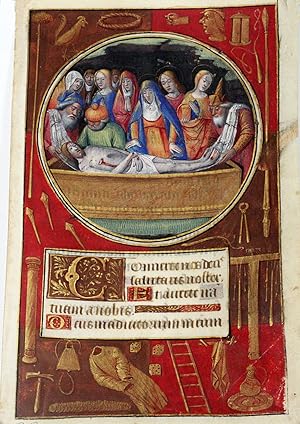
nb. Condition: Very Good. first edition. EXTRAORDINARY ILLUMINATED MANUSCRIPT LEAF FEATURING A MINIATURE OF THE ENTOMBMENT BY A FOLLOWER OF JEAN BOURDICHON AND JEAN POYER. C.1500. A stunning leaf from a Book of Hours by an illuminator working in Tours, France, c.1500, in the style of master illuminators Jean Poyer (fl. 1483-1503…) and Jean Bourdichon (c.1459-1521) of the celebrated "School of Tours". The Entombment, shown in a periscopic view, features figures rendered with a remarkable level of detail and superb artistic quality. The scene is shown at night, with a dark background providing a striking contrast highlighting the colorful fabrics and gold highlights of the subjects. The magnificent border features instruments of the Passion -cross, crown of thorns, dice, etc. - painted in gold on a rich burgundy background. The text is that of the opening compline of the Long Hours of the Cross (Hours of the Passion). Introduced with a highly decorated "C", it begins with "Converte nos deus salutaris noster." on the recto, continuing with 21 lines of text on the verso. Tours, France. 174 x 110mm. Housed in glass case and slipcase. In outstanding condition with only a small smudge to right side of recto border ands remnant of mount to verso margin. A LEAF OF EXTREMELY HIGH QUALITY, WITH COLORS REMARKABLY BRIGHT.
 More images
- Hardcover
- First Edition
- Manuscript
Seller: Jonathan A. Hill, Bookseller Inc., New York, NY, U.S.A.Jonathan A. Hill, Bookseller Inc.
Contact seller5-star sellerCondition: Used
US$ 28,875.00
US$ 20.00 shippingShips within U.S.A.Quantity: 1 available
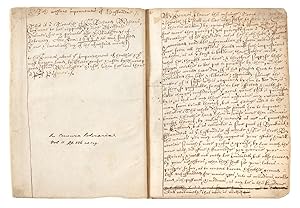
1 p.l., 35 pages, numbered in upper outer corners, and 17 blank leaves. Small 4to (200 x 150 mm.), modern cloth, upper cover stamped in gilt "Rothamsted Laboratory Lawes Trust." United Kingdom: 9 February 1649. A manuscript copy by Archdale Palmor, with variations from the first printed edition, of Weston's highly important work…, which describes farming rotation for the first time in England. Our manuscript precedes the first printed edition by one year. Weston (1591-1652), canal builder and agriculturalist, while already having had considerable successful experience in farming in Surrey, made a series of observations on the agricultural methods of the Low Countries during his exile in Belgium in 1644-45, which changed English agriculture. "Sir Richard's account of Flemish husbandry was written about 1645, and addressed to his sons from abroad. This was circulated in manuscript, and there is no evidence that it was printed before 1650, when an imperfect copy was published by Samuel Hartlib, with a dedication to the council of state. Hartlib did not at this time know who the author was. The account is the first English description of the use of a farming rotation including turnips and clover to obtain maximum output from heathlands formerly considered of little agricultural value. Although it is not known to what extent Sir Richard emulated on his own estates what he saw in Flanders, he described a farming system that was to become the cornerstone of the English 'agricultural revolution' a century later."ODNB. The first edition appeared in 1650, published by Samuel Hartlib, and a second edition appeared two years later with the addition of Hartlib's dedication and his two letters addressed to Weston, stating he is the author. "Archdale Palmor" was probably Archdale Palmer, High Sheriff of Leicestershire in 1641. Very good condition. The first and second leaves have been carefully strengthened on the fore edge (the first leaf) and the upper outer corner (second leaf).
 More images
Published by np, France 1480
- First Edition
- Manuscript
Seller: Manhattan Rare Book Company, ABAA, ILAB, New York, NY, U.S.A.Manhattan Rare Book Company, ABAA, ILAB
Contact seller5-star sellerCondition: Used - Very good
US$ 3,500.00
US$ 6.00 shippingShips within U.S.A.Quantity: 1 available
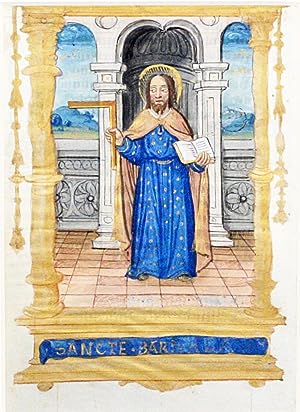
Framed. Condition: Very Good. First edition. STUNNING FULL-PAGE MINIATURE OF SAINT BARNABAS FROM A 15TH-CENTURY BOOK OF HOURS. The full-page miniature on vellum, with fine detail and rich color, depicts the prophet dressed in a blue robe with a gold cape, (presumably) in the act of preaching with (as he is usually shown) a book…cradled in his left hand. He stands before columns and arches revealing a mountainous landscape and blue sky in the distance. The image is framed by gold pillars and with ?Sancte Barnaba? written in gold on a blue background in the base. Saint Barnabas, ?son of consolation. stands first on the list of prophets and teachers of the church at Antioch? (Easton?s Bible Dictionary). The reverse, with one large two-line decorated initial, contains the end of the text dedicated to Saint Matthias, with the heading for Saint Barnabas. Judging from the style, the leaf appears to be from a French Book of Hours, c.1480. Beautifully matted and framed under UV-protecting museum glass. Leaf size: 4.25x5.75 in (108x148mm); framed: 11.25x13.25 in. ?Sancte Barnaba? at the base partially obscured by smudge; a few very minor spots of soiling. A beautiful, colorful leaf with sharp detail in outstanding condition.
 More images
Published by np, France 1475
- First Edition
Seller: Manhattan Rare Book Company, ABAA, ILAB, New York, NY, U.S.A.Manhattan Rare Book Company, ABAA, ILAB
Contact seller5-star sellerCondition: Used - Very good
US$ 4,400.00
US$ 6.00 shippingShips within U.S.A.Quantity: 1 available
No Binding. Condition: Very Good. 1st Edition. Illuminated manuscript leaf (c1475) from a French Book of Hours with a colorful, vivid miniature of Mary and God on vellum. The miniature, colored with bright blues, gold, brown, and gray, depicts Mary with crown kneeling before God the Father. God is wearing the characteristic beeh…ive-shaped crown as he holds the sovereign's orb in his left hand; with his right hand, God is in the act of blessing Mary and anointing her Queen of Heaven. Surrounding the miniature is a wide acanthus-leaf border with greens, blues, reds, and gold. Beneath the miniature is five lines of text ("Converte nos, Deus salutaris noster, et averte iram tuam a nobis. / Convert us, O God our saviour: and turn off thy anger from us. .) with a large floral initial and two gold single-line initials. The verso, which contains most of Psalm 12, is highlighted by six red, blue, and gold initials. Size: 163 x 112 mm (approx. 6.5 x 4.5 inches) Miniature: 85 x 60 mm (approx. 3.25 x 2.25 inches) France: c.1475. A few smudges at the bottom of Mary's robe extending into text, a few small creases to vellum. Generally, a clean and bright leaf representing the Coronation of the Virgin, one of the more popular and enduring subjects of medieval art.

Published by c. 1500, Paris 1500
- First Edition
Seller: Raptis Rare Books, Palm Beach, FL, U.S.A.Raptis Rare Books
Contact seller5-star sellerRare illuminated leaf from a 16th Century French Book of Hours, likely executed by Gilles and Germain Hardouyn. The detailed miniature is elaborately decorated with gold leaf and depicts the Annunciation of the Shepherds on the recto. The verso contains text, illuminated initials and elaborate decorated borders. In near fine con…dition. The entire piece measures 8.5 inches by 5.25 inches. A collection of prayers to be recited at canonical hours, the book of hours became popular in the Middle Ages, with illumination and decoration restricted to decorated capital letters at the start of prayers and psalms in most examples. Books created for wealthier patrons, however, were often decorated with lavish full-page miniature scenes depicting the eight Hours of the Virgin and the Labours of the Months and signs of the zodiac. The earliest example of full-page calendar miniatures in a book of hours were found in the Trà s Riches Heures of the Duke de Berry, the most famous and possibly the best surviving example of French Gothic manuscript illumination. The Dresden Prayerbook (actually a Book of Hours, now destroyed) had such a series, and its illuminator was especially favored for his calendar scenes, often contributing them to manuscripts painted by other artists.

Published by c. 16th century, Indonesia
- First Edition
- Signed
Seller: Raptis Rare Books, Palm Beach, FL, U.S.A.Raptis Rare Books
Contact seller5-star sellerRare Balinese palm leaf manuscript. Eight leaves, inscribed on both sides in Hindu text manuscript, binding thread intact. In near fine condition. The oldest surviving palm leaf manuscripts date back to the 5th century BCE and have been found in Nepal, Tibet and central Asia. Used as writing materials in the Indian subcontinent…of Asia, the manuscripts were created to copy and preserve classical Hindu and Sudanese scriptural texts.
- First Edition
- Signed
Seller: Raptis Rare Books, Palm Beach, FL, U.S.A.Raptis Rare Books
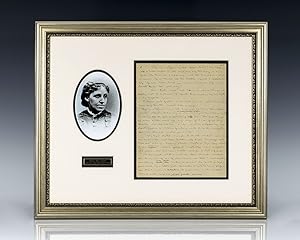
Contact seller5-star sellerAutograph manuscript page from Louisa May Alcott's Jack and Jill, Chapter VIII, page 129. One page. The manuscript page reads, âup no capers with that child! The idea of a hot bath in the middle of the day, and him full of dinner, and croupy into the bargain! Wet a corner of a towel at the kettle-spout and polish him off if you…like, but you wonât risk his life in no bath-tubs this cold day.' Miss Batâs word was law in some things, so Molly had to submit, and took Boo away, saying, loftily, as she left the room, 'I shall ask father, and do it tonight, for I will not have my brother look like a pig.' 'My patience! How the Siamese do leave their things around,'she exclaimed [crossed out a moment after'] as she surveyed her room after making up the fire and polishing off Boo. 'Iâll put things in order, and then mend up my rags, if I can find my thimble. Now, let me see,' and she went to exploring her closet, bureau, and table, finding such disorder everywhere that her courage nearly gave out. She had clothes enough, but all needed care; even her best dress had two buttons off, and her drawers were a perfect chaos of soiled ruffles, off gloves, old ribbons, boot lacings, and bits of paper. 'Oh, my heart, what a muddle! Mrs. Minot wouldn't think much of me if she could see that,' said Molly, recalling [crossed out 'that Mrs.'] how that lady once said she could judge a good deal of a little girl's character & habits by a peep at her top drawer, & went on to guess how each of the schoolmates kept hers, with great success." The final printing reads slightly differently.ÂMatted and framed opposite a photograph of Alcott. The entire piece measures 17.5 inches by 20 inches. Manuscript pages from Alcott seldom enter the market. Jack and Jill: A Village Story was originally published in 1880. The story takes place in a small New England town after the Civil War where Jack Minot and Janey Pecq are best friends and next door neighbors. Always seen together, Janey gets the nickname of Jill, to mimic the old rhyme. The two go up a hill one winter day, and then suffer a terrible accident. Seriously injured in a sledding accident, they recover from their physical injuries, while learning life lessons along with their many friends. They are helped along their journey to recovery by various activities created by their mothers.
- First Edition
Seller: Jonathan A. Hill, Bookseller Inc., New York, NY, U.S.A.Jonathan A. Hill, Bookseller Inc.
Contact seller5-star seller2 p.l., 77 pp. 8vo, modern red sheep-backed marbled boards, spine lettered in gilt. London: "which will be sold by Auction, by Mr. Evanson Friday, February 7, and Saturday, February 8, 1817." After Borromeo's death in 1813, his library was purchased en bloc by Payne and Foss, who sold it by auction through Evans. The catalogue,…most interestingly, is written in Italian throughout with its own title-page, the only English sale catalogue in that language. The catalogue was based on Borromeo's own catalogues of 1794 and 1805 but with additional notes marked with three asterisks. It contained the true first edition of the Decameron (GW 4440), bought by Lord Spencer for 121.6.0 pounds, now in the John Rylands Library. Fine copy, priced throughout in a contemporary hand with buyers' and prices realized. Small embossed stamp on titles and elsewhere of the Athenaeum Library, 1850. Bookplates of Wilfred Merton and A.R.A. Hobson. ? Gustave Brunet, Dictionnaire de Bibliologie Catholique, col. 560.
 More images
- First Edition
- Manuscript
Seller: Discovery Bay Old Books ABAA, ILAB, Brentwood, CA, U.S.A.Discovery Bay Old Books ABAA, ILAB
Contact seller4-star sellerCondition: Used - Fine
US$ 1,250.00
US$ 4.15 shippingShips within U.S.A.Quantity: 1 available
No Binding. Condition: Fine. 1st Edition. Illuminated Manuscript Leaf from a Book of Hours. France, Second half of the 15th Century. On vellum, Latin Gothic script with burnished gold initials. 5 x 6 inches. Matted. Inventory #C-571. Price: $1,250.

- First Edition
Seller: Raptis Rare Books, Palm Beach, FL, U.S.A.Raptis Rare Books
Contact seller5-star sellerRare collection of six illuminated leaves from three late 15th century Books of Hours. Six vellum leaves decorated with illuminated initials and borders. Each leaf is framed allowing visibility of both sides of each page. In near fine condition. An exceptional collection. A collection of prayers to be recited at canonical hours,… the book of hours became popular in the Middle Ages, with illumination and decoration restricted to decorated capital letters at the start of prayers and psalms in most examples. Books created for wealthier patrons, however, were often decorated with lavish full-page miniature scenes depicting the eight Hours of the Virgin and the Labours of the Months and signs of the zodiac. The earliest example of full-page calendar miniatures in a book of hours were found in the Trà s Riches Heures of the Duke de Berry, the most famous and possibly the best surviving example of French Gothic manuscript illumination. The Dresden Prayerbook (actually a Book of Hours, now destroyed) had such a series, and its illuminator was especially favored for his calendar scenes, often contributing them to manuscripts painted by other artists.

- First Edition
Seller: Raptis Rare Books, Palm Beach, FL, U.S.A.Raptis Rare Books
Contact seller5-star sellerVery attractive palm leaf book in East Asian script (possibly Burmese). Approximately 159 palm leaves between two wooden covers with beveled edges, loosely bound with a cord, with a medallion at each end. Each leaf approximately 1.25 inches by 13.5 inches, with manuscript Âin black ink on rectos and versos of each leaf, initial…and final leaves blank. 19th century. Palm leaf books originated with the Buddhist tradition in India about 1200 years ago and were dispersed to the rest of South Asia and Southeast Asia after the Islamic invasion of India in theÂ12thÂcentury.
 More images
Language: Latin
- First Edition
- Manuscript
Seller: Emporium, Bridgeport, CT, U.S.A.Emporium
Contact seller5-star sellerCondition: Used - Near fine
US$ 585.00
US$ 5.75 shippingShips within U.S.A.Quantity: 1 available
No Binding. Condition: Near Fine. 1st Edition. 3.5" x 5.5". Miniscule Gothic script, with red and blue initials and fine decorations; on thin translucent vellum. Bible leaf, pre-Wycliffe. Monks eventually went blind copying works in such small (literally "miniscule" font) with such elaborate and detailed embellishment.


