
Moden: Signed (19 results)

- Hardcover
- Signed
Seller: Antiquariat Lang, Rennerod, , GermanyAntiquariat Lang
Contact seller4-star sellerCondition: Used
US$ 9.42
US$ 17.14 shippingShips from Germany to U.S.A.Quantity: 1 available
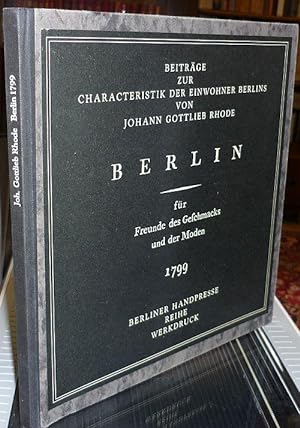
Hrsg. und mit kritischen Anmerkungen versehen von Uwe Otto. Berlin: Berliner Handpresse (= Reihe Werkdruck, No. 6), 1977. OHLn. 47 S. mit 14 ganzs. Illustrationen von Wolfgang Jörg und Erich Schöning. - 27,5 x 27. * Nummer 828 von insgesamt 1200 Exemplaren, die von Jörg u. Schöning signiert wurden. - Sehr gut erhalten .
Published by Berllin Berliner Handpresse 1977
- Signed
Seller: Antiquariat Heininger, Hamdorf, SH, GermanyAntiquariat Heininger
Contact seller4-star sellerCondition: Used
US$ 17.65
US$ 11.37 shippingShips from Germany to U.S.A.Quantity: 1 available
Reihe Werkdruck; Ohalbln.; sehr guter Zustand; Exemplar Nr. 23/1200; Illustrationen von Wolfgan gJörg u. Erich Schönig; signiert.
Published by F. Bruckmann A.-G., München, Germany 1920
- Hardcover
- Signed
Seller: Riverow Bookshop, Owego, NY, U.S.A.Riverow Bookshop
Contact seller5-star sellerCloth(Hrdcvr). Condition: G/NO DUSTJACKET. Second Edition. München, Germany: F. Bruckmann A.-G. G/NO DUSTJACKET. 1920. Second Edition. Cloth(Hrdcvr). 8vo., 180, Corners slightly rubbed, pages slightly yellowed, back inside hinge cracked, signed by former owner. . Black&White/Color Illus. (illustrator).
Language: English
Published by University of Chicago Press, Chicago, IL 1921
- Hardcover
- Signed
Seller: Bookensteins, Las Vegas, NV, U.S.A.Bookensteins
Contact seller5-star sellerCondition: Used - Very good
US$ 67.98
US$ 5.50 shippingShips within U.S.A.Quantity: 1 available
Hardcover. Condition: Very Good. No Jacket. This copy is number 38 of a special edition of one hundred and fifty signed by Joseph Pennell. The Scammon Lectures for 1920. Front board is slightly warped with an upward curve at the right side, top page edges are gilt. Pages are clean with no marks or page folds. Bookseller Inventor…y BS/RLR6062042018. Signed by Author(s).

Joh. Gottlieb Rhode : Berlin für Freunde des Geschmacks und der Moden 1799 - Beiträge zur Charakteristik der Einwohner Berlins. Herausgegeben und mit Erläuterungen versehen von Uwe Otto. Illustrationen von Wolfgang Jörg und Erich Schönig.
Berlin. - Otto, Uwe (Hrsg) / Jörg, Wolfgang (Ill) / Schönig, Erich (Ill)
Language: German
Published by Berlin, Berliner Handpresse 1977
- Hardcover
- Signed
Seller: Antiquariat an der Stiftskirche, Bad Waldsee, , GermanyAntiquariat an der Stiftskirche
Contact seller5-star sellerCondition: Used
US$ 11.77
US$ 34.28 shippingShips from Germany to U.S.A.Quantity: 1 available
4° (27x27), 47, (1) S., mit 14 Illustrationen, als Blockbuch gebunden, OHln mit montiertem Deckelschild, Papier gebräunt, sauber und wohlerhalten, [= Berliner Handpresse : Reihe Werkdruck; 6], im Impressum von beiden Illustratoren handsigniert.- nummeriertes Exemplar 461 (GA 1200).- * * * BTC on-chain & lightning accepted * * *…due to EPR-Restrictions NO SHIPPING to Bulgaria, Danmark, Greece, Luxembourg, Poland, Portugal, Romania, Sweden, Slovakia and Spain * * *.
Published by Public Affairs, New York 2001
- Signed
Seller: sonalsorises, los angeles, CA, U.S.A.sonalsorises
Contact seller2-star sellerCondition: Used - Fine
US$ 35.00
US$ 7.00 shippingShips within U.S.A.Quantity: 1 available
Condition: Fine. Dust Jacket Condition: Fine. Second Edition. Second Edition. Fine in dust jacket with the original price intact on the front flap. Signed on the half-title by Wesley Clark "For . with appreciation for your service - and best wishes, Wes Clark.". Photographs (illustrator). By the Author.
Published by Bln., . 1977
- Signed
Seller: Werner Engelmann, Lahr, BW, GermanyWerner Engelmann
Contact seller5-star sellerCondition: Used
US$ 23.54
US$ 22.85 shippingShips from Germany to U.S.A.Quantity: 1 available
Illustr., 47 S. schwarzer Orig. Halbleinenband, 27,5 x 27,5 cm. handschriftl. num. und von beiden Künstler signiert, kaum Gebrauchspuren.

- Signed
Seller: Jürgen Patzer, Konstanz, , GermanyJürgen Patzer
Contact seller4-star sellerCondition: Used
US$ 14.12
US$ 21.71 shippingShips from Germany to U.S.A.Quantity: 1 available
Eins von 1200 nummerierten Exemplaren, im Impressum von den beiden Künstlern signiert.

Published by Berlin. Berliner Handpresse 1977
- Hardcover
- Signed
Seller: Antiquariat Hennwack, Berlin, GermanyAntiquariat Hennwack
Contact seller5-star sellerCondition: Used
US$ 12.36
US$ 53.70 shippingShips from Germany to U.S.A.Quantity: 1 available
4to. 48 S. OHLn. Oberes Kapital leicht bestoßen, Kanten minimal berieben = Reihe Werkdruck No. 6. Eins von 1200 nummerierten und signierten Exemplaren (hier Nummer 249).

Published by Dortmund: Verlag Harenberg Kommunikation 1979
- First Edition
- Signed
Seller: Kunze, Gernot, Versandantiquariat, Falkensee, , GermanyKunze, Gernot, Versandantiquariat
Contact seller5-star sellerCondition: Used
US$ 21.18
US$ 30.85 shippingShips from Germany to U.S.A.Quantity: 1 available
182 Seiten, Format 12,2 x 17,6 cm, originalkartonierter Einband (Die bibliophilen Taschenbücher, Band 117). * Mit durchgehend farbigen Abbildungen (im Original handcoloriert). Reproduktionen aus dem Zeitraum 1786 bis 1827. Erhaltung: Adress-Aufkleber des Erstbesitzers auf dem Innendeckel. Am vorderen Deckel oben-rechts ein klein…er Fleck, aber nur ganz dezent. Ingesamt ein gutes Exemplar. Sprache: Deutsch.
Published by F. Bruckmann A.-G., München, Germany 1919
- Hardcover
- Signed
Seller: Riverow Bookshop, Owego, NY, U.S.A.Riverow Bookshop
Contact seller5-star sellerCloth(Hrdcvr). Condition: G/NO DUSTJACKET. München, Germany: F. Bruckmann A.-G. G/NO DUSTJACKET. 1919. Cloth(Hrdcvr). 8vo., 259, Corners slightly rubbed, pages slightly yellowed, signed by former owner. . Black&White/Color Illus. (illustrator).

Language: German
Published by Berlin, Berliner Handpresse, 1977
- Signed
Seller: Antiquariat Matthias Drummer, Berlin, GermanyAntiquariat Matthias Drummer
Contact seller5-star sellerCondition: Used
US$ 11.77
US$ 42.28 shippingShips from Germany to U.S.A.Quantity: 2 available
47 Seiten, Aus der Reihe "Werkdruck", Nummer 6. Nummer 708 von 1200 Exemplaren. Faksimile mit Illustrationen von Wolfgang Jörg und Erich Schöning. Herausgegeben und mit kritischen Anmerkungen von Uwe Otto. In Fraktur gedruckt. Von beiden Künstlern signiert. Gutes und sauberes Exemplar Sprache: Deutsch Gewicht in Gramm: 594 Origi…nal-Halbleinen, 27x27cm, Zustand: 2.
- Softcover
- Signed
Seller: Herbst-Auktionen, Detmold, , GermanyHerbst-Auktionen
Contact seller4-star sellerCondition: Used
US$ 52.96
US$ 9.71 shippingShips from Germany to U.S.A.Quantity: 1 available
ZEICHNUNGEN (Kunstkatalog) Ausstellungskatalog der Ausstellung des Mannheimer Kunstverein e.V. 1977, illustriertes Pb. kl. 4°, schön erhalten - eigenhändig signiert mit Widmung, Empfehlung, Unterschrift "Für Holger mit vielen Grüssen von EV" (für den dt. Kübstler HOLGER RUNGE 1925 geb.).
Published by Berlin. Berliner Handpresse reihe Werkdruck. 1977. 1977
- Hardcover
- Signed
Seller: Worpsweder Antiquariat, Worpswede, , GermanyWorpsweder Antiquariat
Contact seller5-star sellerCondition: Used
US$ 45.90
US$ 54.85 shippingShips from Germany to U.S.A.Quantity: 1 available
14 Illustrationen sind von Wolfgang Jörg und Erich Schönig. Orig.Halbleinen. 47 Doppelseiten. Die Ausgabe ist von 1-1200 nummeriert und signiert. Nummer: 561. Einband berieben. Schnitt angestaubt. Seiten unaufgeschnitten. Von den Illustratoren Wolfgang Jörg und Erich Schönig auf dem hinter Vorsatz signiert. Gut erhalten.
Published by F. Bruckmann A.-G., München, Germany 1920
- Hardcover
- Signed
Seller: Riverow Bookshop, Owego, NY, U.S.A.Riverow Bookshop
Contact seller5-star sellerCloth(Hrdcvr). Condition: G/NO DUSTJACKET. Later Printing. München, Germany: F. Bruckmann A.-G. G/NO DUSTJACKET. 1920. Later Printing. Cloth(Hrdcvr). Vol I: 1790-1817, Vol II: 1818-1842, Vol III: 1843-1878, Vol IV: 1878-1914. . 8vo., 173, 160, 158, Corners slightly rubbed, pages slightly yellowed, and signed by former owner on…all; front hinge slightly cracked on Vol I, front hinge and inside binding cracked on Vol II. . Black&White/Color Illus. (illustrator).
Published by Berlin-Wilmersdorf. 1921.), (A. R. Meyer 1921
- Softcover
- First Edition
- Signed
Seller: Rotes Antiquariat, Berlin, , GermanyRotes Antiquariat
Contact seller4-star sellerCondition: Used
US$ 117.69
US$ 51.42 shippingShips from Germany to U.S.A.Quantity: 1 available
11 S. Mit Titelillustr. v. Rich[ard] Scheibe. Quer-gr.-8°, Orig.-Karton mit v. A. R. Meyer handbeschr. Deckelschild. - Signiertes Exemplar! Erste Ausgabe der Gedichte. - Impressum mit eigenh. Signatur des Verfassers. - Kneitlingen am Elmwalde 77 N. Z. In Verlegung bey Rogatian Winkelhaken neben dem goldenen Lämmerschwänzchen in…der Ruhfäutchen-Twete . - Letzte Seite mit Verlagsanzeige zu Veröffentlichungen Munkepunkes . - Gedruckt bei Paul Knorr (Berlin-Wilmersdorf). - Karton an den Rändern gebräunt u. leicht bestoßen, sonst gut. - Raabe/Hannich-B. 207.42. - Raabe, Zeitschriften 144.87. - Josch A 48. - Smolen 102. gr.
Language: German
Published by Berlin : Berliner Handpresse, 1977
- Signed
Seller: Wanda Schwörer, Engelsbrand, , GermanyWanda Schwörer
Contact seller5-star sellerCondition: Used - Very good
US$ 18.53
US$ 59.99 shippingShips from Germany to U.S.A.Quantity: 1 available
Hlw. Condition: Gut. 47 S. : 14 Ill. ; 28 cm gutes Exemplar, Die Ausgabe ist von 1- 1200 numeriert und signiert. Dieses Exemplar hat die Nummer 675 Aufgrund meiner Knie-OP versende ich vorübergehend nur dienstags & freitags. Danke für eure Verständnis Sprache: Deutsch Gewicht in Gramm: 1001.
Language: German
Published by Berliner Handpresse, Berlin 1977
- First Edition
- Signed
Seller: Antiquariat Düwal, Berlin, GermanyAntiquariat Düwal
Contact seller4-star sellerCondition: Used
US$ 29.42
US$ 57.13 shippingShips from Germany to U.S.A.Quantity: 1 available
4to. Mit Illustrationen von Wolfgang Jörn und Erich Schönig. 47 S. OHlwd. m. Deckel- u. Rückentitel. Blockbuchbindung. Eines von 1200 hs. numer. Ex., im Impressum von beiden Künstlern signiert. - Berliner Handpresse. Reihe Werkdruck No. 6. - Wohlerhalten. 1100 gr.
 More images
- Softcover
- Signed
Seller: Herman H. J. Lynge & Søn ILAB-ABF, Copenhagen, , DenmarkHerman H. J. Lynge & Søn ILAB-ABF
Contact seller4-star sellerCondition: Used
US$ 1,889.44
Free ShippingShips from Denmark to U.S.A.Quantity: 1 available
[Leipzig, Industrie-Comptoir / Baumgärtner etc.], (1833-1856). Small queer-folio (22 x 28,5) cm. Nice later light brown half calf from ca. 1900 with five raised bands and gilt lines to spine (Carl Petersens Enke). Slight wear to extremities. 100 engraved plates, in contemporary colouring. A bit of even browning and occasional of…fsetting. A few plates with more browning. Some plates with tiny holes in blank margin, from original stiching (having been vertically bound with text-leaves). Occasional light creasing. One plate with a tear (no loss). A few plates signed A. Brückner, most plates numbered and dated, and some plates having "Extra-Kupfer" or "Les Modes Parisiennes Réunis" (the last five) underneath. A lovely collection of 100 beautiful contemporarily coloured engraved fashion-plates from between 1833 and 1856, importing the highest Parisian fashion of the time to Germany. This beautiful collection magnificently documents the clothing fashion and development of two decades, primarily for women, but also for children and men. Also in the mid-19th-century, Paris was seen as the quintessence of elegance and style. The Allgemeine Moden-Zeitung kept the German-speaking public up to date with the latest fashions from Paris. The magazine ?Les modes parisiennes reunites? did the same" that too was produced for the German public, despite its French title. As well as outfits for appearing in high society, eg. at the theatre, the fashion plates collected here show clothes and notably also accessories for almost all other parts of life - paying and receiving social calls, going for walks, attending different events, musical siorées, going out with the children, etc. ?As part of her evening wardrobe, every fashionable lady simply had to have elegant dresses in brightly coloured silks and satins, with frills and lace, bows and flounces, tight bodices, natural waistlines and exposed shoulders, which gave the female figure an hour-glass silhouette. The first thing that strikes one about these ladies? fashions are the stiff, voluminous underskirts. Horsehair crinolines (invented in 1850) supported wide, sweeping skirts, which could measure up to two or two-and-a-half metres in diameter and made the upper body look even slimmer.? (Deutsches Historisches Museum). "From the 1820s onwards, and particularly under the ostentatious Second Empire (1852?1870), the classicising taste of the Napoleonic era changed completely. Instead, fashion now drew inspiration from the elegance of the Rococo period, so much so that the period became known as the ?second Rococo? The waistline returned to its natural level but was awkwardly styled ? at least from a health point of view: agonisingly tight corsets emphasised the so-called ?wasp waist? Ostensibly guided by aesthetics, on closer inspection this fashion trend also had social consequences: with styles that afforded women so little freedom of movement, fashion focused on the ostentatious requirements of ladies from the upper echelons of society, who didn?t have to work. Practicality was not its concern. This ostentatious and ? certainly from the perspective of the 21st century ? inconvenient fashion style appealed not only to the fine ladies of high society, but also to women from the middle classes and the petty bourgeoisie. The expansion of the textile industry and the rise of the chemical industry made the production of dyes, fabrics, lace, and embroidery and the processing of raw materials and textiles imported from the colonies both quicker and cheaper.? (DHM).


