Order Total (1 Item Items):
Shipping Destination:

Modulor, Signed (2 results)
Skip to main search results
Search filters
Product Type
- All Product Types
- Books (1)
- Magazines & Periodicals (No further results match this refinement)
- Comics (No further results match this refinement)
- Sheet Music (No further results match this refinement)
- Art, Prints & Posters (No further results match this refinement)
- Photographs (No further results match this refinement)
- Maps (No further results match this refinement)
- Manuscripts & Paper Collectibles (1)
Condition Learn more
- New (No further results match this refinement)
- As New, Fine or Near Fine (No further results match this refinement)
- Very Good or Good (2)
- Fair or Poor (No further results match this refinement)
- As Described (No further results match this refinement)
Binding
- All Bindings
- Hardcover (1)
- Softcover (No further results match this refinement)
Collectible Attributes
Language (1)
Price
- Any Price
- Under US$ 25 (No further results match this refinement)
- US$ 25 to US$ 50 (No further results match this refinement)
- Over US$ 50
Free Shipping
- Free Shipping to U.S.A. (No further results match this refinement)
Seller Location
Seller Rating
-
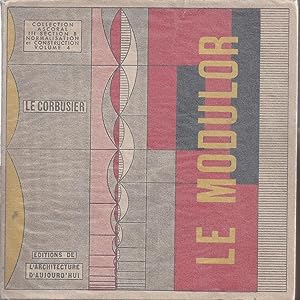
LE CORBUSIER - LE MODULOR - Inscribed by Le Corbusier
Published by Paris: L'Architecture d'Aujourd'hui, 1950, 1950
Seller: °ART...on paper - 20th Century Art Books, Lugano, Switzerland
Association Member: ILAB
Seller rating 5 out of 5 stars

First Edition Signed
US$ 3,509.08
US$ 28.69 shipping
Ships from Switzerland to U.S.A.Quantity: 1 available
Add to basketHardcover. Condition: Very Good. Dust Jacket Condition: Very Good. 1st Edition. 12° - (14.5x14.5 cm) - 230pp - B/w reproductions. The Modulor is an anthropometric scale of proportions devised by the Swiss-born French architect Le Corbusier by Le Corbusier (Charles-Édouard Jeanneret 1887-1965) Swiss-French architect, designer, painter, urban planner, writer, and one of the pioneers of what is now called modern architecture. He was born in Switzerland and became a French citizen in 1930. First edition, inscribed and signed by Le Corbusier. Original boards and pictorial dust-jacket. In Very good condition. Inscribed by Author(s).
-
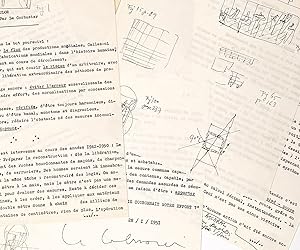
Le Modulor: Annotated Typescript Signed with Drawings
Published by np, Paris, 1951
Seller: Manhattan Rare Book Company, ABAA, ILAB, New York, NY, U.S.A.
Seller rating 5 out of 5 stars
Manuscript / Paper Collectible First Edition Signed
folder. Condition: Very Good. first edition. UNIQUE ANNOTATED TYPESCRIPT SIGNED WITH TWO FULL PAGES OF LE CORBUSIER DRAWINGS PRESENTING ONE OF HIS MOST FAMOUS AND INFLUENTIAL PHILOSOPHICAL ACHIEVEMENTS. Born in 1887, Le Corbusier found himself situated between two competing historical and architectural moments: an intricate history of grandiose Gothic and Renaissance style, and the sleek, efficient creation of the Second Industrial Revolution. In his canonical 1923 Towards an Architecture, Le Corbusier argued that modernity must be matched with architectural innovation. Functionality took a core place in Le Corubusier's thinking. Houses were to be understood as machines for living, said Le Corbusier famously, and machines were to be governed by the economies in which they existed. From this conviction came Le Corbusier's famous villas, his massive housing blocks in the suburbs of Paris, and, perhaps most importantly, a fathering of modern architecture as defined by an emphasis on function, simplicity, and new material [Towards an Architecture]. In 1942, Le Corbusier was asked to create a universal measurement for construction materials. What Le Corbusier deemed necessary was not only the creation of a new unit, but the arduous task of unifying metric and Anglo-Saxon systems, integrating the inch and the centimeter into one intuitive scale. Although an ambitious project, this unification, coined Modulor, existed within the ethos of Le Corbusier's New Architecture. As Le Corbusier identified it, the importance of an architect was in their giving of "a [physical] order which we feel to be in accordance with that of [the] world." This order was not only in aesthetic sleekness, but in an ethos of design that mirrored the social, moral, and political reality surrounding the architect. Therefore, units of measurement as enablers of creationwere to reflect modern efficiency with new universal standards [Towards an Architecture]. It was not immediately clear what should be the basis for the new standardized units. Metric and Anglo-Saxon systems, after all, are based on different 'orders'a meter defined by the speed of light, a law of science; a foot defined by the proportions of the human body. Le Corbusier framed this tension in this rare manuscript: "the human body [exists] on one side, and the mathematicians on the other." Le Corbusier struggled with the concept of the Modulor over many years and the present text, dated by Le Corbusier [28/1/1951], represents a more mature and developed presentation of his theories. It reads as a manifesto-like preamble to the Modulor's ambitions in the postwar world: to "harmonize the flow of worldwide production," to systematize standardization without deadening compromise, and to reduce the friction of incompatible systems (metric versus footinch). Le Corbusier presents the Modulor as a human-scale "gamut" of measurementsexplicitly compared to the musician's scalegrounding chosen dimensions in bodily proportion and number. He invokes the golden ratio and the Fibonacci series as ordering principles, and includes the well-known endorsement attributed to Einstein ("a scale of proportions that makes the bad difficult and the good easy"), framing the Modulor as a tool of order, rigor, and harmony applicable from the architect's drafting table to the engineer's office and the building site. The two full drawing sheets, marked with figure callouts (e.g., "Fig. 35," "Fig. 65," "Fig. 100") and geometric/proportional constructions (including a right-angle scheme marked "90°" and ? symbols), reinforce the document's working character: argument paired with visual proof, capturing Le Corbusier's drive to make proportion not merely theoretical, but operational. Although we haven't been able to find this exact text published anywhere, the present typescript closely alignsoften in phrasing and argumentative sequencewith Le Corbusier's published presentation of the Modulor, and can be read as a self-contained "preamble" distilled from that larger.