
Organization Man: Signed (8 results)

- Hardcover
- Signed
Seller: Wonder Book, Frederick, MD, U.S.A.Wonder Book
Contact seller5-star sellerCondition: Used - Good
US$ 16.74
Free ShippingShips within U.S.A.Quantity: 1 available
Condition: Good. Signed Copy . Very Good dust jacket. Inscribed by author on front endpage. Writing inside. Highlighting inside.
- Hardcover
- Signed
Seller: Wonder Book, Frederick, MD, U.S.A.Wonder Book
Contact seller5-star sellerCondition: Used - Very good
US$ 17.06
Free ShippingShips within U.S.A.Quantity: 1 available
Condition: Very Good. Signed Copy . Very Good dust jacket. Inscribed by author on half title page.

- Softcover
- Signed
Seller: Ageless Pages, Cottonwood, AZ, U.S.A.Ageless Pages
Contact seller5-star sellerCondition: Used - Very good
US$ 14.95
US$ 5.75 shippingShips within U.S.A.Quantity: 1 available
Trade Paperback. Condition: Very Good. Inscribed "For John Clark, Best Wishes, Bruce Tucker 10/16/92." Picking up where the path-breaking bestseller The Organization Man left off, this fascinating guide defines the values and outlook of America's baby boomers. The New Individualists offers a revealing study of the sons and daugh…ters of the original organization men. Inscribed and Signed By Author.
- Hardcover
- First Edition
- Signed
Seller: HORSE BOOKS PLUS LLC, Boston, VA, U.S.A.HORSE BOOKS PLUS LLC
Contact seller5-star sellerCondition: Used - Fine
US$ 22.00
US$ 6.95 shippingShips within U.S.A.Quantity: 1 available
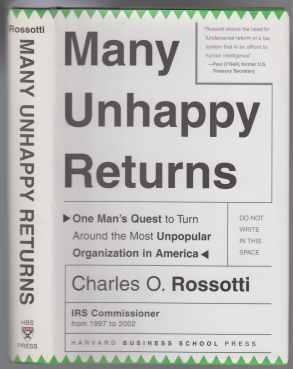
Hardcover. Condition: Fine. Dust Jacket Condition: Fine. First Edition. Brilliant 1st edition hardcover with presentation plate on fep, signed by author: "To Suzie Turner With best wishes, Charles Rossotti". 340 pgs. Unclipped dj in new mylar displays well without chips or tears. Imagine that after decades of running a successfu…l corporation, you get an offer to lead a crucial government agency. The organization is maligned by the public, beset by profound management and technology problems, and trapped in a political minefield. This is the scenario Charles O. Rossotti faced in 1997, when her became the first businessman to lead the IRS. "Many Unhappy Returns" tells the remarkable story of how Rossotti transformed the agency's outdated bureaucracy to run more like a 21st century business. Infused with keen wit and business wisdom, this book will illuminate the perils and possibilities of leading any organization. Signed by Author(s).
- Hardcover
- First Edition
- Signed
Seller: David H. Gerber Books (gerberbooks), Austin, TX, U.S.A.David H. Gerber Books (gerberbooks)
Contact seller5-star sellerCondition: Used - Very good
US$ 25.00
US$ 4.50 shippingShips within U.S.A.Quantity: 1 available
Hard Cover. Condition: Very Good. Dust Jacket Condition: Very Good. First Printing. xii, 340pp [short, flapped tear to dj at top front spine] ---- Bookplate on front free endpaper inscribed and signed by the author ---- Size: 8vo - over 7¾" - 9¾" tall. Inscribed and Signed By the Author.
Language: English
Published by Harvard Business School Press, Boston, MA 2005
- Hardcover
- First Edition
- Signed
Seller: Ground Zero Books, Ltd., Silver Spring, MD, U.S.A.Ground Zero Books, Ltd.
Contact seller5-star sellerCondition: Used
US$ 45.00
US$ 5.00 shippingShips within U.S.A.Quantity: 1 available
Hardcover. First edition. First printing [stated]. Glued binding. Paper over boards. xii, 340 p. Illustrations. Notes. Bibliography. Index. The author was Commissioner of the IRS from 1997 to 2002. This is one of the Leadership for Common Good series. From WIkipedia: "Charles O. Rossotti (born January 17, 1941) is an American bu…sinessman, and former Commissioner of Internal Revenue. Rossotti has a Bachelor of Arts degree in economics from Georgetown University (1962) and an MBA from Harvard Business School (1964). Rossotti was born in 1941 in New York City. After obtaining his MBA, Rossotti was the first ever MBA hire for the Boston Consulting Group. But after only a year, Rossotti went to work for the Office of the Secretary of Defense. From 1965 to 1969, Rossotti worked for Robert McNamara, becoming Deputy Assistant Secretary of Defense for Systems Analysis at age 29. In 1970, Rossotti and several DOD colleagues co-founded American Management Systems, a technology and management consulting firm. Rossotti served as Chief Executive Officer from the late 1980s to the mid-1990s. In 1997, Rossotti was named Commissioner of Internal Revenue by then President Bill Clinton where he served for 5 years. He was considered a reformer, upgrading the agency's technology, as well as turning the IRS into a more customer service oriented agency. Rossotti received a waiver from the Clinton administration that allowed him to retain his AMS stock in a blind trust. After leaving the IRS, Rossotti joined The Carlyle Group, a global private equity firm in Washington, D.C., as a Senior Advisor." Very good in very good dust jacket. Signed by author. Inscribed to Len Shapiro (of the Washington Post? ) DJ has slight wear and soiling.
- Hardcover
- First Edition
- Signed
Seller: Lower Beverley Better Books, Lyndhurst, ON, CanadaLower Beverley Better Books
Contact seller5-star sellerCondition: Used - Very good
US$ 228.19
US$ 22.00 shippingShips from Canada to U.S.A.Quantity: 1 available
Hardcover. Condition: Very Good. No Jacket. First Edition. Book divisions: Part I - The Ideology of Organization Man, 5 chapters; Part II - The Training of Organization Man, 5 chapters; Part III - The Neuroses of Organization Man, 3 chapters; Part IV -The Testing of Organization Man, 2 chapters; Part V, The Organization Scientis…t, 3 chapters; Part VI -The Organization Man in Fiction, 2 chapters; Part VII - The New Surburbia, Organization Man at Home, 9 chapters.410 pp. plus: Acknowledgments, Index, About the author. Duotone cloth covered boards have red title box with silver gilt text on spine. Faux silver gilt author's signature on front panel. Book is tight and square. Digital images available on request. Inscription, " 2/2/57/ Per Justin Oppenheim - - / Chuck Lamm describes you as a fellow raconteur so very [underscored] best regards/ Henry Whyte " SIGNED and dated by author. Bookseller's Inventory # 242678. Jean Pruchnik, George B. Schaller (illustrator). Inscribed by Author(s).

Published by Simon & Schuster, New York 1956
- Softcover
- First Edition
- Signed
Seller: Raptis Rare Books, Palm Beach, FL, U.S.A.Raptis Rare Books
Contact seller5-star sellerFirst edition of one of the most influential books on management ever written. Octavo, original half cloth. Inscribed by the author on the front free endpaper, "Best to Lydia Bronte about whom this book was not written! Holly Whyte 4/18/89." Additionally signed "William H. Whyte" on the title page. Near fine in a very good price…-clipped dust jacket with a few small chips to the crown of the spine. Uncommon signed and inscribed. William H. Whyte was an American urbanist, organizational analyst, journalist and self-proclaimed people-watcher. The Organization Man is "[r]ecognized as a benchmark, Whyte's book reveals the dilemmas at the heart of the group ethos that emerged in the corporate and social world of the postwar era" (Nathan Glazer). While employed by Fortune Magazine, Whyte did extensive interviews with the CEOs of major American corporations such as General Electric and Ford. A central tenet of the book is that average Americans subscribed to a collectivist ethic rather than to the prevailing notion of rugged individualism. A key point made was that people became convinced that organizations and groups could make better decisions than individuals, and thus serving an organization became logically preferable to advancing one's individual creativity. Whyte felt this was counterfactual and listed a number of examples of how individual work and creativity can produce better outcomes than collectivist processes. He observed that this system led to risk-averse executives who faced no consequences and could expect jobs for life as long as they made no egregious missteps. Whyte's book led to deeper examinations of the concept of "commitment" and "loyalty" within corporations. It "established the categories Americans now use when thinking about the workplace, the suburbs, and their lives" (Newsweek).


