Order Total (1 Item Items):
Shipping Destination:

Pauling Linus, Signed (17 results)
Skip to main search results
Search filters
Product Type
- All Product Types
- Books (13)
- Magazines & Periodicals (No further results match this refinement)
- Comics (No further results match this refinement)
- Sheet Music (No further results match this refinement)
- Art, Prints & Posters (No further results match this refinement)
- Photographs (1)
- Maps (No further results match this refinement)
- Manuscripts & Paper Collectibles (3)
Condition Learn more
- New (No further results match this refinement)
- As New, Fine or Near Fine (1)
- Very Good or Good (12)
- Fair or Poor (No further results match this refinement)
- As Described (4)
Binding
Collectible Attributes
Language (3)
Free Shipping
- Free Shipping to U.S.A. (No further results match this refinement)
Seller Location
Seller Rating
-

Linus Pauling: Scientist and Peacemaker
Language: English
Published by Oregon State Univ Pr, 2001
ISBN 10: 0870714899 ISBN 13: 9780870714894
Signed
hardcover. Condition: Very Good. Dust Jacket Condition: Very Goood. Signed. A very good hardcover in a very good dust jacket. Inscribed and signed by co-editor Clifford Mead.
-

Roots of Molecular Medicine: A Tribute to Linus Pauling
Language: English
Published by W.H. Freeman & Company, 1986
ISBN 10: 0716717611 ISBN 13: 9780716717614
Seller: A Squared Books (Don Dewhirst), South Lyon, MI, U.S.A.
Seller rating 5 out of 5 stars

Signed
Hardcover. Condition: Very Good. Dust Jacket Condition: Very Good. 1986; New York; tan glossy paper dust jacket with red titles; dust jacket contains minimal sun damage and rubbing; author signature and inscription on ffep; Interior is clean and unmarked; 8vo, 7 3/4"-9 3/4" tall; 289 pages. Signed by Author.
-

THE MOON AND LINUS PAULING A Collectioni of short stories
Published by Trail Press
Seller: Thomas J. Joyce And Company, Chicago, IL, U.S.A.
Seller rating 2 out of 5 stars

Signed
stapled wrappers. Condition: Very Good. Octavo, 20 pages, Presentation copy from the author to bookseller "Philip [Krapp]" / Happy Birthday". This collection was published by Trail Press, the Illinois Bloom Township High School [ Chicago Heights ], which carefully printed this eighth book of the press. Illustrated cover by Mike Recupito.
-

Lamp at Midnight. With a Foreword By Linus Pauling
Published by Dramatists Play Services, New York, 1955
Seller: Good Reading Secondhand Books, Benalla, VIC, Australia
Seller rating 4 out of 5 stars

Signed
Stapled Card Wraps. Condition: Very Good. The front cover is stained at the head, and has minor insect damage along the side. There are no other markings. The dedication, dated April 1956 says: "For Ruth Wiencek old and valued frined from Bernie Stavis. "Dramatis Play Service established by members of the Dramatists" Guild of the Authors' League of America fo the handling of the nonprofessional acting rights of members' plays and encouragement of the nonprofessional theatre." Third edition. Signed by Author(s).
-
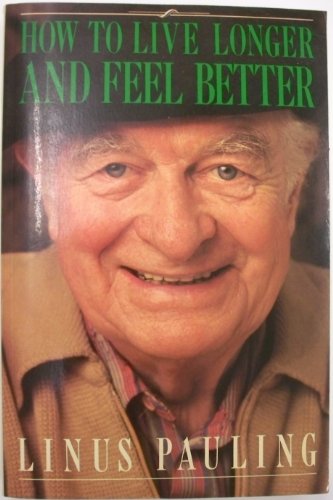
How to Live Longer and Feel Better By Linus Pauling
First Edition Signed
Soft cover. Condition: Very Good. Dust Jacket Condition: No Jacket issued. 1st Edition. Crease to cover from being a read copy. Signed by author on free front end paper. Minor foxing to free front end paper (discoloration due to age). 2nd printing. Signed by Author(s).
-
How to Live Longer and Feel Better By Linus Pauling
Seller: Books From California, Simi Valley, CA, U.S.A.
Seller rating 4 out of 5 stars
Signed
Paperback. Condition: Very Good. Signed. SIGNED by the author. Minimal wear and creases. Pages are clean.
-
INDEX CARD SIGNED BY LINUS PAULING
Published by np nd
Seller: John K King Used & Rare Books, Detroit, MI, U.S.A.
Seller rating 5 out of 5 stars
Signed
Paperback. Condition: Very Good. White index card 3 x 5.25", blank on one side, lined on the other. Great condition with no creasing, soiling or tears. SIGNED BY LINUS PAULING IN BLACK INK ON BLANK SIDE OF INDEX CARD. Pauling has published over 1,200 papers and books, was awarded the Nobel Prize in Chemistry and a Nobel Peace Prize. He is one of only five people who have received more than one Nobel Prize, and was also named one of the 20 greatest scientists of all time by New Science magazine.
-
Linus Pauling: Scientist and Peacemaker [with bookplate signed by Pauling and Cameron]
Language: English
Published by Oregon State University Press, Corvallis, 2001
ISBN 10: 0870714899 ISBN 13: 9780870714894
Seller: Midway Book Store (ABAA), St. Paul, MN, U.S.A.
Association Member: ABAA ILAB MWABA
Seller rating 5 out of 5 stars
First Edition Signed
Hardcover. First edition. 26 x 18.5 cm. Royal octavo. 272pp. Blue cloth in dust jacket. Loosely affixed to the half-title page is a book plate signed by and inscribed to Marie Gowder by Linus Pauling as well as by frequent collaborator Ewan Cameron. This bookplate is usually found in copies of the work they co-authored "Cancer and Vitamin C". In that work they evangelized mega doses of Vitamin C as a cure-all, despite lack of laboratory evidence. "Linus Pauling, the sole individual to win two unshared Nobel Prizes, for chemistry and peace, is widely recognized as one of the most brillant scientists and most controversial individuals of the twentieth century." "He wrote The Nature of the Chemical Bond, one of the most cited sources in scientific history" Near Fine in Near Fine dust jacket.
-
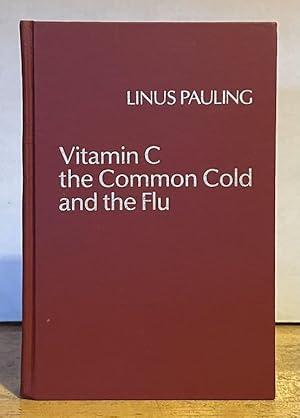
Hard Cover. Condition: Very Good. First Edition Fifth Printing in gilt-stamped maroon cloth SIGNED by Linus Pauling with personalized inscription direct to front endpaper, no markings, pages clean & unfoxed, minor shelf wear with small nick to cloth top rear panel board edge & corner, else clean tight signed hardcover copy, quite scarce as such (no dj, as issued); 8vo; (xiv) 230pp. Signed by Author.
-
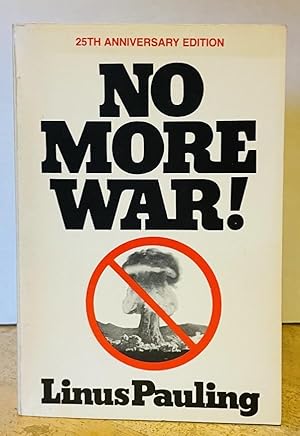
No More War! (25TH ANNIVERSARY EDITION SIGNED BY LINUS PAULING)
Published by Dodd, Mead & Co, New York, 1983
First Edition Signed
Soft Cover. Condition: Very Good. First Edition. First Printing (full # line) in illustrated white wraps SIGNED by Linus Pauling without inscription direct to first page, no markings, no spine creases, light shelf/edge wear & signs of age, slight offsetting to front panel, else clean tight excellent signed copy, scarce as such; 8vo; (xv) 304pp indexed & illus. Signed by Author.
-
Linus Pauling on science and peace: the Nobel Peace Prize lecture, with an Introduction by Gunnar Jahn. Mit eigenhändiger Widmung an Kurt Offenhammer von Linus Pauling auf dem Deckblatt.
Published by Santa Barbara, Kalifornien, Center for the Study of Democratic Institutions, 1964
Seller: Wissenschaftliches Antiquariat Köln Dr. Sebastian Peters UG, Köln, Germany
Seller rating 5 out of 5 stars
Signed
Postkarte. Condition: gut. 15 Seiten, 21,5 cm x 28 cm, Broschur gebunden; mit eigenhändiger Widmung an Kurt Offenhammer von Linus Pauling auf dem Deckblatt. Pauling, Linus Carl (1901 Portland, Oregon-1994 Big Sur, Kalifornien), US-amerikan. Chemiker. Er erhielt 1954 den Nobelpreis für Chemie und 1963 den Friedensnobelpreis. Sprache: eng.
-
The Nature of the Chemical Bond and the Structure of Molecules and Crystals. An Introduction to Modern Structural Chemistry. SIGNED BY LINUS PAULING.
Published by Ithaca: Cornell University Press/ London: Humphrey Milford, Oxford University Press, 1940., 1940
Seller: Scientia Books, ABAA ILAB, Arlington, MA, U.S.A.
Association Member: ABAA ILAB SNEAB
Seller rating 4 out of 5 stars
Signed
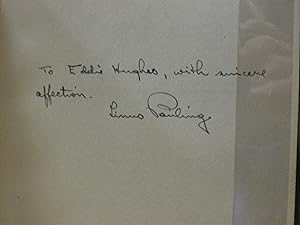
Hardcover. Condition: Good. xvi, 450 pp; ads. Original cloth. Cloth very rubbed (this copy was very used, as it should have been). Second Edition. Linus Pauling, in his later years, signed lots of copies of his books on vitamin C, but signed copies of this, his greatest work, are uncommon. This is an especially fine association. SIGNED BY LINUS PAULING to Edward Hughes: "To Eddie Hughes, with sincere/ affection./ Linus Pauling." In the Preface to this second edition, Pauling writes: "I have again to thank many friends for their advice and assistance; I am especially grateful for their aid to Dr. E. W. Hughes, Research Fellow in Chemistry in the California Institute of Technology, and . . ." (p. vii). In the Preface to the first edition (reprinted in this second edition), Pauling included Hughes as first in the list: "I am grateful for advice and assistance in the preparation of the manuscript to many friends, including Dr. E. W. Hughes. . ." (p. x). "In 1924, [Hughes] received a bachelor s degree in chemistry from Cornell and remained there for the next fourteen years. While at Cornell, he gained his Ph.D. in 1935. During this period, he became interested in crystallography after hearing Professor Carlton C. Murdock lecture and went to work with Murdock as a graduate student in the physics department. In 1934, Murdock recommended him as teaching assistant to a visiting professor, Lawrence Bragg. . . . X-ray crystallography was invented by Bragg, and Hughes felt honored to work with him and act as technical editor on his book for the Cornell Press [Atomic Structure of Minerals (1937)]. In 1937, Hughes was again recommended as a teaching assistant, this time to Linus Pauling, who was impressed enough to ask him to act as a technical editor on a book [The Nature of the Chemical Bond] and to offer him a two-year post at Caltech. In 1938, Hughes arrived at Caltech to do research in the chemistry division. . . . Edward Hughes was a respected chemist and continued the pioneering work in crystallography, begun at Caltech by Burdick and Ellis in 1916, when he introduced the 'Least Squares Method' in 1940. This is the universally accepted method for handling the large amount of data involved in the refinement of crystal structure" (online reference).". Signed by Author(s).
-
TYPED LETTER, SIGNED, FROM LINUS PAULING to Jeremy Bernstein, Physics Department, Stevens Institute of Technology, May 3, 1982, about Pauling's "polyspheron theory of nuclear structure". 3 single-spaced typewritten pages.
Published by 1982., 1982
Seller: Scientia Books, ABAA ILAB, Arlington, MA, U.S.A.
Association Member: ABAA ILAB SNEAB
Seller rating 4 out of 5 stars
Manuscript / Paper Collectible Signed
No Binding. Condition: Very Good. 3 pages. Horizontal crease. Very Good. Quoting from Wikipedia: "On September 16, 1952, Pauling opened a new research notebook with the words 'I have decided to attack the problem of the structure of nuclei.' On October 15, 1965, Pauling published his Close-Packed Spheron Model of the atomic nucleus in two well respected journals, Science and the Proceedings of the National Academy of Sciences. For nearly three decades, until his death in 1994, Pauling published numerous papers on his spheron cluster model. . . . In an interview given in 1990 Pauling commented on his model: 'Now recently, I have been trying to determine detailed structures of atomic nuclei by analyzing the ground state and excited state vibrational bends, as observed experimentally. From reading the physics literature, Physical Review Letters and other journals, I know that many physicists are interested in atomic nuclei, but none of them, so far as I have been able to discover, has been attacking the problem in the same way that I attack it. So I just move along at my own speed, making calculations, and I don't worry about someone else publishing their results a month before I publish mine'." Jeremy Bernstein had written a piece for the New York Times (April 28, 1982) entitled "Accepting Scientific Ideas". Linus Pauling begins this letter to Jeremy Bernstein by saying he read Bernstein's piece "with much interest". Bernstein had written: "there should be some support, I think, for people with solid scientific credentials who, for their own reasons, refuse to swim in the same stream as the rest of us. This raises the very important question of how a scientist can tell an unconventional idea from a crank idea. I say 'scientist' because I do not think a nonscientist can make this judgment at all. In fact, I do not think that most scientists can do it in fields that are far removed from their own. . . . In my own field, the physics of elementary particles, I have occasion to encounter papers by people I have not heard of and that, at first sight, seem a little crazy but that, upon closer examination, turn out to be quite interesting. When I receive such a paper, I ask myself three questions: 1. Does it explain anything? 2. Does it predict anything? 3. Is it connected to anything?" By 1982, Pauling's "polyspheron theory of nuclear structure" had been before the scientific world for 17 years, but it had made no impact at all. In this letter, Pauling answers Bernstein's three questions in the affirmative for the polyspheron theory of nuclear structure. Then Pauling writes in his letter: "during the 17 years after the publication of my first paper there has not, so far as I know, appeared a single reference to any of my papers in papers written by other physicists and published in Physical Review, Physical Review Letters, or other physics journals. . . . I am not very concerned about the failure of nuclear physicists to be interested in what I have written, but I must say that I do feel that nuclear physics would benefit if the physicists were to attempt to understand nuclei in the way that I have done.". Signed by Author(s).
-
Linus Pauling (1901-1994) - Signed card + Photo - 1981
Language: French
Publication Date: 1981
Manuscript / Paper Collectible Signed
Pas de couverture. Condition: Bon. Rare - Authentic card signed in 1981. + Envelope. + Photo 18x18 cm (recent print). Size : 7.5x12.5 cm. Condition : see scans please. Certificate of Authenticity and lifetime guarantee. Signé par l'auteur.
-

Linus Pauling Autograph
Seller: Markus Brandes Autographs GmbH, Kesswil, TG, Switzerland
Association Member: PADA
Seller rating 3 out of 5 stars

Photograph Signed
Signed glossy photograph, shows Linus Pauling in a chest-up portrait, 5 x 7 inch, signed in black felt tip "Linus Pauling", with very mild signs of wear - in nearly very fine condition.
-
LINUS PAULING (1901-94) amerikanischer Chemiker, Nobelpreis Chemie 1954 & Friedensnobelpreis 1962 für seinen Einsatz gegen Kernwaffen
Manuscript / Paper Collectible Signed
Schönes Original-Porträtfoto mit Hut, eigenhändig signiert, Beilage : Original-Briefumschlag San Francisco 19.5.87.
-
Linus Pauling Sketch of his Superconductivity invention
Seller: Schulson Autographs, Ltd., Millburn, NJ, U.S.A.
Seller rating 5 out of 5 stars
Signed
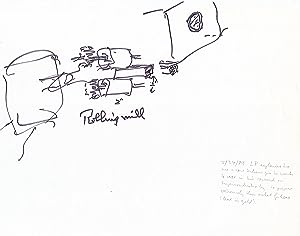
Linus Pauling sketched his superconductivity invention. SIGNED by Emile Zuckerhandl, biologist. Pauling is generally associated with chemistry, Vitamin C, and peace. He also had a keen interest in superconductors. In our sketch, drawn in 1989, Pauling illustrates his new technique on superconductivity for biologist Emile Zuckerhandl. Zuckerhandl (1922-2013), a founder of molecular evolution, worked with Pauling to develop the molecular clock hypothesis. Writing in pencil, Zuckerhandl described the sketch on the lower right corner of the page. "2/4/89 LP [Linus Pauling] explains to me a new technique he wants to use in his research on superconductivity, to prepare extremely thin metal fibers (lead in gold)." Pauling wrote "Rolling Mill" under his sketch. On his professional stationery, Zuckerhandl wrote an explanation of the drawing for David Schulson who purchased it in 1994. "About Linus Pauling's little sketch, I wrote on it the following words." The words are the same as the description already quoted. The 4to size drawing is signed and dated by Zuckerhandl "2/24/89." Pauling worked with several scientists in addition to Emile Zuckerhandl, to develop a superconductivity product starting in 1988. Pauling and his team created a, "composite structure in which superconducting materials assumed the form of fine strands embedded in a wave-guiding matrix. The matrix restricted the superconducting current to a linear motion; however, the strands did not need to be straight, but could also be bent or interconnected into a network. This matrix would be built of a non-conducting material." [ Pauling's Superconductivity Patent, Dec. 12, 2012 on Paulingblog ] Pauling sought patents for his invention and with Zuckerhandl and businessman Richard Hicks set up a company to manage the business side of his superconductivity invention. Ultimately, the product found no buyers, the company suffered financial difficulties, Zuckerhandl established his own Institute of Molecular Medical Sciences, and Pauling died in 1994. Signed.


![Seller image for Linus Pauling: Scientist and Peacemaker [with bookplate signed by Pauling and Cameron] for sale by Midway Book Store (ABAA)](https://pictures.abebooks.com/inventory/md/md31728649193.jpg)