Order Total (1 Item Items):
Shipping Destination:

Peonage, Signed (3 results)
Skip to main search results
Search filters
Product Type
- All Product Types
- Books (3)
- Magazines & Periodicals (No further results match this refinement)
- Comics (No further results match this refinement)
- Sheet Music (No further results match this refinement)
- Art, Prints & Posters (No further results match this refinement)
- Photographs (No further results match this refinement)
- Maps (No further results match this refinement)
- Manuscripts & Paper Collectibles (No further results match this refinement)
Condition Learn more
- New (No further results match this refinement)
- As New, Fine or Near Fine (No further results match this refinement)
- Very Good or Good (1)
- Fair or Poor (No further results match this refinement)
- As Described (2)
Binding
- All Bindings
- Hardcover (No further results match this refinement)
- Softcover (2)
Collectible Attributes
- First Edition (No further results match this refinement)
- Signed (3)
- Dust Jacket (No further results match this refinement)
- Seller-Supplied Images (2)
- Not Print on Demand (3)
Language (2)
Free Shipping
Seller Location
Seller Rating
-
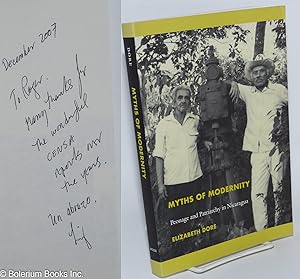
Myths of Modernity: Peonage and Patriarchy in Nicaragua
Language: English
Published by Duke University Press, Durham, NC, 2006
ISBN 10: 082233674X ISBN 13: 9780822336747
Seller: Bolerium Books Inc., San Francisco, CA, U.S.A.
Seller rating 5 out of 5 stars

Signed
Paperback. xii, 252p., wraps, 6x9 inches, illus., very good condition; signed by Dore (as "Liz") on the half-title. On the gendered dynamics of Nicaragua's coffee industry from the 1870s to the 1950s.
-

PRINCIPLE AND PREJUDICE: THE SUPREME COURT AND RACE IN THE PROGRESSIVE ERA PART 2: THE PEONAGE CASES; PART 3: BLACK DISFRANCHISEMENT FROM THE KKK TO THE GRANDFATHER CLAUSE (signed)
Publication Date: 1982
Seller: Xerxes Fine and Rare Books and Documents, Glen Head, NY, U.S.A.
Seller rating 5 out of 5 stars
Signed
NY 1982. Offprints from the Columbia Law Review, May and June, 1982. Parts 2 and 3 only. Octavos, printed blue wraps.** Both issues signed by Schmidt. Two offprints.
-
![Seller image for JOINT RESOLUTION TO AID IN RELIEVING FROM PEONAGE WOMEN AND CHILDREN OF THE NAVAJO INDIANS. (General Orders No. 69. Headquarters of the Army. Adjutant General's Office. Washington, August 14, 1868. [Public Resolution - No. 65.]). for sale by Blue Mountain Books & Manuscripts, Ltd.](https://pictures.abebooks.com/inventory/md/md30661417122.jpg)
JOINT RESOLUTION TO AID IN RELIEVING FROM PEONAGE WOMEN AND CHILDREN OF THE NAVAJO INDIANS. (General Orders No. 69. Headquarters of the Army. Adjutant General's Office. Washington, August 14, 1868. [Public Resolution - No. 65.]).
Published by Washington, D.C., August 14, 1868., 1868
Seller: Blue Mountain Books & Manuscripts, Ltd., Cadyville, NY, U.S.A.
Seller rating 5 out of 5 stars
Signed
Condition: Very good. - A 7-1/4 inches high by 4-5/8 inches wide broadsheet General Order issued as a "resolution of Congress" authorizing Lieutenant General W.T. Sherman "to use the most efficient means his judgment will approve, to reclaim from peonage the women and children of the Navajo Indians, now held in slavery in the territory adjacent to their homes, and the reservation on which the Navajo Indians have been confined." The resolution adapted by Congress on July 27, 1868 was distributed as a general order by "Command of General Grant" and signed in print by E.D. Townsend, as Assistant Adjutant General. Removed from a bound collection in the distant past, the broadsheet is lightly chipped with stab marks along the left edge. Very good. Throughout the American Southwest and, in this case New Mexico, Spanish settlers and their ancestors pursued a flourishing slave trade from the 16th though the 19th centuries. Captive Native Americans, who became known as "Genizaros" were sold as slaves to Hispanic families. This practice went on even after the United States came to govern New Mexico. Having abolished slavery through the 13th Amendment in 1865, Congress then passed the "Peonage Act" in 1867 when it became known that New Mexicans still owned hundreds, maybe thousands, of these "Genizaros", consisting mostly of Navajo women and children.RARE.