
Philosophical Papers: Signed (8 results)
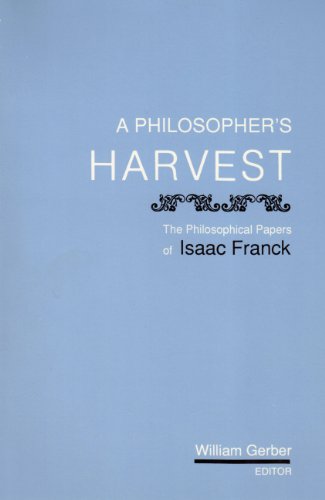
- Softcover
- Signed
Seller: Wonder Book, Frederick, MD, U.S.A.Wonder Book
Contact seller5-star sellerCondition: Used - Good
US$ 7.78
Free ShippingShips within U.S.A.Quantity: 1 available
Condition: Good. Signed Copy . Signed by editor on title page.

Published by Tamkang University Press, Taipei 1993
- Hardcover
- First Edition
- Signed
Seller: Abacus Bookshop, Pittsford, NY, U.S.A.Abacus Bookshop
Contact seller5-star sellerCondition: Used - Fine
US$ 10.00
US$ 4.00 shippingShips within U.S.A.Quantity: 1 available
hardcover. Condition: Fine copy in fine dust jacket. 1st. 8vo, 467 pp., Signed by the author on a "Compliments of" card stapled to the front free endpaper.
Published by Tamkang University Press, Taipei 1993
- Hardcover
- First Edition
- Signed
Seller: CARDINAL BOOKS ~~ ABAC/ILAB, London -- Birr, ON, CanadaCARDINAL BOOKS ~~ ABAC/ILAB
Contact seller5-star sellerCondition: Used - Fine
US$ 14.21
US$ 19.95 shippingShips from Canada to U.S.A.Quantity: 1 available
Cloth. Condition: Fine. Dust Jacket Condition: Fine. First Edition. Signed presentation card clipped to front free endpaper. Clean, tight, bright, sharp and completely unmarked copy in like dust wrapper. Signed cover letter on university letterhead laid in. xii,467pp. Signed by Author(s).

Language: English
Published by D. REIDEL 1978
Series: Philosophical Studies, Book 58 of 134. Book 58 of 134 - Philosophical Studies
- Hardcover
- Signed
Seller: Reader's Corner, Inc., Raleigh, NC, U.S.A.Reader's Corner, Inc.
Contact seller5-star sellerCondition: Used - As new
US$ 95.00
US$ 5.50 shippingShips within U.S.A.Quantity: 1 available
Hardcover. Condition: As New. Dust Jacket Condition: As New. This is a fine, as new, hardcover first edition copy in a fine, as new, mylar protected DJ, blue spine.304 pages with index. Inscribed by the editor on the front flyleaf: "To Chris, Luck, Joe". Inscribed by Author(s).
Published by Melbourne, Wilson & Mackinnon, 1865. 1865
- Hardcover
- Signed
Seller: Grant's Bookshop, Cheltenham, VIC, AustraliaGrant's Bookshop
Contact seller4-star sellerCondition: Used
US$ 238.37
US$ 19.00 shippingShips from Australia to U.S.A.Quantity: 1 available
86pp. 8vo. Original boards, worn on spine and edges. Fold out graph and map. A very good copy. . Fergusm 14738. Inscribed presentation copy. Slight offsetting to endpapers. Very scarce.
 More images
Published by Willaim Clowes and Sons, Limited, London and Beccles 1928
- Hardcover
- First Edition
- Signed
Seller: Montecito Rare Books, Goleta, CA, U.S.A.Montecito Rare Books
Contact seller5-star sellerCondition: Used - Very good
US$ 300.00
US$ 8.00 shippingShips within U.S.A.Quantity: 1 available
Hardcover. Condition: Very Good. 1st Edition. Very Good; spine a little cocked; minor rubbing/bumping to extremities; some scattered soil/stains to cloth; else Fine. Hinges sound, pages clean and bright. No dust jacket. First Edition. M.L. Solon (1835 - 1913) was a French porcelain artist. After beginning his career at the Sèvre…s Pottery, he moved to Stoke-on-Trent in 1870 to work at Mintons Ltd, where he became the leading exponent of the technique of ceramic decoration called pate-sur-pate. His work commanded high prices in the late Victorian period. The letter is folded once, with "The Villas, Stoke-on-Trent" embossed at the head of page one, written on four "pages, then folded again. It reads in part "April 20th, [18?]96. Dear M. Barber, I much regret to say that I have no good photos to send you. I am one of the rare ones who have never applied to a professional photographer to obtain their presentment. At the time when my boys amused themselves by taking a few bad negatives--under the flattering illusion that they were practicing photography--they took my portrait several times. Of these only the worst are now remaining. However, rather than appear unwilling to comply with your request I send you the two unique proofs in my possession." His correspondent was Edwin Atlee Barber (1851 - 1916), an American archaeologist and author, and a scholar of ceramics. One of the two photos is mounted on a card, with cropping marks around the subject, and a note indicating that it would be used in a paper of Barber's that appeared in the Bulletin of the Pennsylvania Museum. Signed by Author(s). Book.
 More images
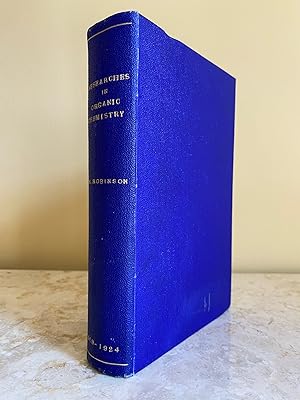
Researches in Organic Chemistry 1909 - 1924 | Collection of 48 Transactions of the Journal Chemical Society Papers (and Memoirs & Proceedings of the Manchester Literary and Philosophical Society and Faraday Society). SIGNED by Sir Robert Robinson to Professor D. R. Kulin.
Robinson, Robert [Sir Robert Robinson (13 September 1886 - 8 February 1975) was a British organic chemist and Nobel laureate recognised in 1947 for his research on plant dyestuffs (anthocyanins) and alkaloids]. Joseph Lister
Published by Published by Proceedings of the Chemical Society of London to 1912. 1910 | 1924. 1909
- Hardcover
- Signed
Seller: Little Stour Books PBFA Member, Canterbury, United KingdomLittle Stour Books PBFA Member
Contact seller5-star sellerCondition: Used - Very good
US$ 3,059.42
US$ 39.60 shippingShips from United Kingdom to U.S.A.Quantity: 1 available
Condition: Very Good. Hard back binding in publisher's original royal blue cloth covered boards, blocked and lettered gilt back. 8vo. 8½'' x 6''. A titan in the world of science, Sir Robert Robinson was Professor of Chemistry at the Universities of Sydney, Liverpool, St Andrews, Manchester and University College London as well a…s having briefly led the British Dyestuffs Corporation laboratories, in 1947 he received the Medal of Freedom with Silver Palm. Robinson Close, in the Science Area at Oxford, is named after him, as is the Robert Robinson Laboratory at the University of Liverpool, the Sir Robert Robinson Laboratory of Organic Chemistry at the University of Manchester and the Robinson and Cornforth Laboratories at the University of Sydney, he was President of the Chemical Society from 1939 to 1941. In Very Good condition. SIGNED by Sir Robert Robinson to the front free end paper 'With kind regards to Professor D. R. Kulin from R. Robinson - March 1932.' Researches in Organic Chemistry 1909 - 1924 | Collection of 48 Transactions of the Chemical Society Papers (and Memoirs & Proceedings of the Manchester Literary and Philosophical Society and Faraday Society). Member of the P.B.F.A. CHEMISTRY.
 More images
Published by Printed for David Henry; and sold by Francis Newbery, at the Corner of St. Paul's Church-Yard, London 1769
- Softcover
- First Edition
- Signed
Seller: Raptis Rare Books, Palm Beach, FL, U.S.A.Raptis Rare Books
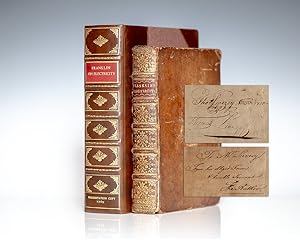
Contact seller5-star sellerFirst complete edition of "the most important scientific book of eighteenth-century America" (PMM), inscribed by Benjamin Franklin to prominent Pennsylvania Quaker and merchant Thomas Livezey, Jr. Quarto, bound in full contemporary calf with elaborate gilt tooling to the spine in six compartments within raised gilt bands, morocc…o spine label lettered in gilt, gilt turn-ins. Illustrated with 7 copper-engraved plates, 2 of which are folding. Presentation copy, inscribed by Benjamin Franklin on the front free endpaper, âTo Mr. Livesy [sic] From his obliged Friend & humble Servant The Author.â With Thomas Livezey's ownership signature to the second free endpaper, "Thomas Livezey Junior 1810." The recipient, Thomas Livezey Jr. (1723-1790), was a member of the fourth generation of the prominent Pennsylvania Quaker Livezey family. His ancestor, Thomas Livezey, the elder (1627-1691), was among the earliest settlers of Pennsylvania; his land was a portion of William Penn's Pennsylvania colony and was granted to him directly by Penn in an early patent. Thomas Livezey Jr. established one of the largest ï our mills in colonial British North America, the Livezey Mill, and rose to prominence as one of the major suppliers of high quality ï our to the world during that era. Situated on Wissahickon Creek in Philadelphia, the Livezey Mill was a major colonial operation, provided flour both domestically and overseas, and fed numerous armies throughout the eighteenth century including those fighting on both sides of the American Revolution. The mill was in continued operation for more than one hundred twenty-ï ve years until roughly 1874. Livezey was elected to the colony of Pennsylvania's legislative body, the Pennsylvania Assembly, in 1765. BenjamÃn Franklin had been elected to the Pennsylvania Assembly 14 years earlier in 1751 and in 1764 (one year prior to Livezey's appointment), Franklin was sent to London by the Pennsylvania Assembly as a colonial agent to protest against the political influence of the Penn family, with whom the assembly was becoming increasingly frustrated. He remained there for five years, striving to end the Penn family's prerogative to overturn legislation from the elected Assembly and their exemption from paying taxes on their land. His lack of influential allies in Whitehall led to the failure of this mission. Franklin and Livezey were warm acquaintances, despite their differences. In late 1767, Livezey sent a case of wine he had made from wild grapes to Franklin in London, writing, âI heartely wish it may arive Safe, and warm the hearts of Every one who tastes it, with a Love for America. And would it Contribute towards bringing about a Change of Government but one month Sooner, I would Gladly Send all I have.â In early 1768, Franklin thanked Livezey in a letter, stating that he âshall apply this parcel as I did the last towards winning the hearts of the Friends of our Country, and wellwishers to the Change of its Government.â PMM 199; Grolier 100 American Books 10; Dibner Heralds of Science 57. Presentation copies of this first collected edition are scarce. This is the only presentation copy to a known recipient to appear on the market over the course of the past century. In very good condition. Housed in custom three quarter morocco clamshell box. âFranklinâs most important scientific publication,â Experiments and Observations contains detailed accounts of the founding fatherâs crucial kite and key experiment, his work with Leiden jars, lightning rods and charged clouds (Norman 830). âThe most dramatic result of Franklinâs researches was the proof that lightning is really an electrical phenomenon. Others had made such a suggestion before himâ" even Newton himselfâ" but it was he who provided the experimental proofâ (PMM). âThe lightning experiments caused Franklinâs name to become known throughout Europe to the public at large and not merely to men of science. Joseph Priestley, in his History of Electricity, characterized the experimental discovery that the lightning discharge is an electrical phenomenon as âthe greatest, perhaps, since the time of Isaac Newton⦠Franklinâs achievement⦠marked the coming of age of electrical science and the full acceptance of the new field of specializationâ (DSB). Franklinâs theory encompassed static electricity, lightning, and stored charge, paving the way for countless theoretical and technological innovations. Immanuel Kant referred to Franklin as the ânew Prometheusâ for he managed to steal the fire of heaven. The work brought Franklin international renown. He became the first American elected to membership in the Royal Society and he was awarded the Copley Medal, the highest scientific honor of the day. Franklin edited the collected edition of his Experiments and Observations himself, revising the text, adding a number of his own philosophical letters and papers, and publishing the complete notes on all of his experiments.


