
Order Total (1 Item Items):
Shipping Destination:

Physiological Interventions Developing Climate by M Prakash R Gomathi (8 results)
Skip to main search results
Search filters
Product Type
- All Product Types
- Books (8)
- Magazines & Periodicals (No further results match this refinement)
- Comics (No further results match this refinement)
- Sheet Music (No further results match this refinement)
- Art, Prints & Posters (No further results match this refinement)
- Photographs (No further results match this refinement)
- Maps (No further results match this refinement)
- Manuscripts & Paper Collectibles (No further results match this refinement)
Condition Learn more
- New (8)
- As New, Fine or Near Fine (No further results match this refinement)
- Very Good or Good (No further results match this refinement)
- Fair or Poor (No further results match this refinement)
- As Described (No further results match this refinement)
Binding
Collectible Attributes
- First Edition (No further results match this refinement)
- Signed (No further results match this refinement)
- Dust Jacket (No further results match this refinement)
- Seller-Supplied Images (1)
- Not Print on Demand (8)
Language (2)
Price
- Any Price
- Under US$ 25 (No further results match this refinement)
- US$ 25 to US$ 50
- Over US$ 50
Free Shipping
Seller Location
Seller Rating
-

Hardcover. Condition: New. ISBN:9789390425549.
-
 International Edition
Physiological Interventions for Developing Climate Resilient Cereals and Fodder Crops
Published by SATISH SERIAL PUBLISHING HOUSE, 2022
ISBN 10: 9390425565 ISBN 13: 9789390425563
Language: English
Condition: New. Brand New. Soft Cover International Edition. Different ISBN and Cover Image. Priced lower than the standard editions which is usually intended to make them more affordable for students abroad. The core content of the book is generally the same as the standard edition. The country selling restrictions may be printed on the book but is no problem for the self-use. This Item maybe shipped from US or any other country as we have multiple locations worldwide.
-
Physiological Interventions for Developing Climate Resilient Pulses and Oil Seed Crops
Published by Satish Serial Publishing House, 2022
ISBN 10: 9390425549 ISBN 13: 9789390425549
Condition: New.
-
Hardcover. Condition: New. ISBN:9789390425563.
-
International Edition
Physiological Interventions for Developing Climate Resilient Pulses and Oil Seed Crops
Published by SATISH SERIAL PUBLISHING HOUSE, 2022
ISBN 10: 9390425549 ISBN 13: 9789390425549
Condition: New. Brand New. Soft Cover International Edition. Different ISBN and Cover Image. Priced lower than the standard editions which is usually intended to make them more affordable for students abroad. The core content of the book is generally the same as the standard edition. The country selling restrictions may be printed on the book but is no problem for the self-use. This Item maybe shipped from US or any other country as we have multiple locations worldwide.
-
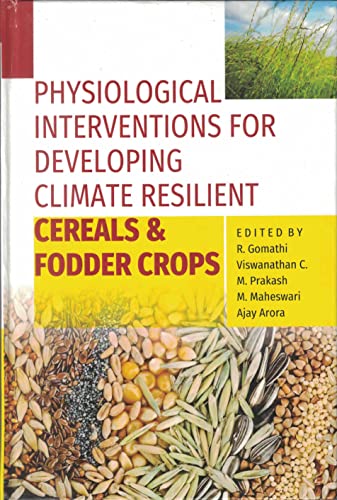
Physiological Interventions for Developing Climate Resilient: Cereals and Fodder Crops
Published by Satish Serial Publishing House, 2022
ISBN 10: 9390425565 ISBN 13: 9789390425563
Language: English
Hardcover. Condition: New. Contents: 1. CRISPR/Cas Systems and Crop Improvement - Methods, Application and Abiotic Stress Tolerance/Nagaaraj Kumar M. , Shivani Nagar, Santosh Kumar V. V., Jyoti Priya, Dipankar Burman, Monica Saifi, Pragya Yadav and Viswanathan Chinnusamy. 2. Elevated Co2 and Water Stress in Combination in Millets and Cereals: Vanguards for Adaptation to Changing Climate/Arun K. Shanker and Divya Bhanu. 3. Heat Tolerance in Cereal Crops An Overview/R. Gomathi and S. Kohila. 4. Genome Editing for the Development of Thermo-Sensitive Genic Male Sterile (Tgms) and Photo-Sensitive Genic Male Sterile (Pgms) Lines in Various Crops: A Review/S. Shweta, S. Varanavasiappan, D. Sudhakar, L. Arul, K. K. Kumar and E. Kokiladevi. 5. Membrane Integrity as an Index to Study High Temperature Stress Tolerance in Rice/D. Vijayalakshmi, A. Vinitha and R. Megala. 6. Physiological and Molecular Strategies to Improve Abiotic Stress Tolerance in Rainfed Cereals/M. Maheswari. 7. Regulatory Role of Strigolactone in Abiotic Stress Tolerance/Shashi Meena and Ajay Arora. 8. Breeding for Bio-Fuel Syndrome by Altering the Physiology of Crops: Pavement for Sustainable Future Energy Needs/A. Yuvaraja, Papineni Venkata Nirosh, C. Kavipriya, K. Thangaraj, C. Menaka and C. Vannirajan. 9. Physiological Interventions for Quality Seed Production in Fodder Crops/Chandan Kumar Gupta, D. Vijay, Edna Antony and D. Seva Nayak. 10. Physiological Traits Associated with Drought Adaptation in Climate-Resilient Finger Millet for Improving Grain Yields under Rainfed Conditions/Y. A. Nanja Reddy, Y. N. Priya Reddy, P. S. Sha Valli Khan and M. V. C. Gowda. 11. Maize and Drought: Morpho-Physiological Changes A Review/V. Rajeswari, K. A. Mumithra Kamatchi, A. Senthil, M. K. Kalarani and R. Gomathi. 12. Melatonin and Abiotic Stress Alleviation in Plants/Anitha, K, A. Senthil, N. Sritharan and M. K. Kalarani. 13. Physiological Characterization of Photosynthesis Related Traits for Improving Yield in Crop Plants/Pavithra K. S., A. Senthil, M. Djanaguiraman, R. Ravikesavan and P. Boominathan. 14. Rice and Drought: Morpho-Physiological Changes A Review/Malini, M. K., A. Senthil, V. Ravichandran and M. K. Kalarani. 15. Flower Opening Time and Heat Tolerance at Flowering in Rice/R. Megala, V. Babu Rajendra Prasad, P. Jeyaprakash, D. Vijayalakshmi and M. K. Kalarani. 16. Role of Plant Hormones in Flooding Stress Tolerance in Rice/D. Vijayalakshmi, A. Vinitha, R. Jeevitha, M. Raveendran and R. Gomathi. Global climate change can have an impact on the yield of crops and is an issue that must be addressed for attaining food security. Further, it can reduce the net carbon gain by increasing plant respiration rates, which in turn would decrease the production yield of crops including cereals and fodder crops and could even result in the invasion of weed, pathogens and pests. Understanding the physiological basis of crop production under sustainable agriculture holds key to the future success of developing abiotic stress tolerant crop plants. Cereal grains are staple foods to most of the population across the globe. In order to feed the predicted world population of 9.8 billion people by 2050, a 70100% increase in cereal food production is required. Enhancing the production rates is generally accepted as the solution to meet the increasing demand, but the current production rates are not adequate to meet the targets. The elevated level of CO2 decreases the quality as well as quantity of various fodder crops and trees. Forage sector acts as both contributor as well as source of adaptation to climate change. The rise in temperature disrupts crop growth and development and this disturbance mainly causes a shift in phenological development of crops and affects their economic yield. To resolve this problem, the scientific community must find alternative crops, improved varieties and techniques to face the ill-effects of global warming. This book provides an overview of impact of climate change on cerea.
-
Physiological Interventions for Developing Climate Resilient Pulses and Oil Seed Crops
Published by Satish Serial Publishing House, 2022
ISBN 10: 9390425549 ISBN 13: 9789390425549
Condition: New.
-

Physiological Interventions for Developing Climate Resilient Pulses and Oil Seed Crops
Published by Satish Serial Publishing House, 2022
ISBN 10: 9390425549 ISBN 13: 9789390425549
Hardcover. Condition: New. Pulses are the main source of protein and minerals in the vegetarian diet. They are cultivated worldwide as major and/or minor crops to provide the nutrition and livelihood for millions of people. Pulses are a rich source of protein (2226%) and micronutrients (especially Fe and Zn), serve as a balanced food for vegetarians when complemented with cereals. Also, their cultivation has helped to sustain cereal-based cropping systems through biological nitrogen fixation and carbon sequestration. Oilseed crops are the basis for biological systems that provides not only edible oils, but also contribute to renewable energy production, help to stabilize greenhouse gases, and mitigate the risk of climate change. Since these are primarily cultivated on marginal lands with few inputs in several resource-poor countries of the world, including several in South Asia, they are exposed to various abiotic stresses, leading to significant yield reduction. Furthermore, climate change due to global warming has increased their vulnerability to emerging new insect pests and abiotic stresses that can become even more serious in the coming years. The changing climate scenario has made it more challenging to breed and develop climate resilient smart pulse & oilseed crops. Although they are climate smart, as they simultaneously adapt to and mitigate the effects of climate change, their narrow genetic diversity has always been a major constraint to their improvement for adaptability. This collection will provide a comprehensive review on crop improvement, crop production and crop protection in pulses and oilseeds, which will serve as a reference book for research scholars and policy-makers.


