Order Total (1 Item Items):
Shipping Destination:

Proceedings Eastern Joint Computer Conference (5 results)
Skip to main search results
Search filters
Product Type
- All Product Types
- Books (5)
- Magazines & Periodicals (No further results match this refinement)
- Comics (No further results match this refinement)
- Sheet Music (No further results match this refinement)
- Art, Prints & Posters (No further results match this refinement)
- Photographs (No further results match this refinement)
- Maps (No further results match this refinement)
- Manuscripts & Paper Collectibles (No further results match this refinement)
Condition Learn more
- New (No further results match this refinement)
- As New, Fine or Near Fine (2)
- Very Good or Good (2)
- Fair or Poor (No further results match this refinement)
- As Described (1)
Binding
Collectible Attributes
- First Edition (1)
- Signed (No further results match this refinement)
- Dust Jacket (2)
- Seller-Supplied Images (3)
- Not Print on Demand (5)
Language (1)
Price
- Any Price
- Under US$ 25 (No further results match this refinement)
- US$ 25 to US$ 50
- Over US$ 50
Free Shipping
Seller Location
Seller Rating
-
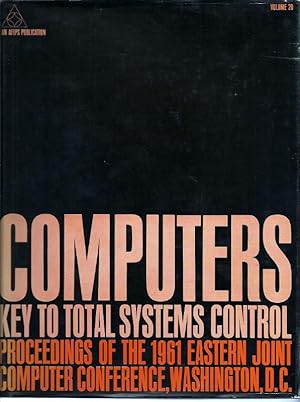
Computers: Key to Total Systems Control: Proceedings of the 1961 Eastern Joint Computer Conference, Washington DC
Published by Macmillan, New York NY, 1962
Seller: The Other Change of Hobbit, Richmond, CA, U.S.A.
Seller rating 5 out of 5 stars

Hard Cover. Condition: Fine. Dust Jacket Condition: Fine. Early Reprint. A nice copy of this volume, with original publisher's packing list showing a price of $12. Spine faded, previous owner's name and date/place of purchase on front free endpaper. Technical volume. Uncommon. This is a 1962 third printing of this proceedings -- we were surprised that it had even gone into a second printing! Shipping cost may be more than ABE's default, particularly outside the US -- please enquire when ordering.
-

Computers--Key to Total Systems Control. Proceedings of the Eastern Joint Computer Conference, Washington, DC, 12/12-14/61
Published by The Macmillan Company
Seller: Wonder Book, Frederick, MD, U.S.A.
Seller rating 5 out of 5 stars
Condition: Good. Good condition. Good dust jacket. Volume 20. Address label on front endpage. (Computers, Data Processing).
-
Computers--Key to Total Systems Control. Proceedings of the Eastern Joint Computer Conference, Washington, DC, 12/12-14/61
Published by The Macmillan Company, New York, 1961
Seller: Ground Zero Books, Ltd., Silver Spring, MD, U.S.A.
Seller rating 4 out of 5 stars

Condition: fair to good, fair to poor. Quarto, 380, illus., figures, tables, charts, references, foxing & discolor ins bds & flylves, foxing to fore-edge, DJ quite worn & foxed. Front DJ spotted and scuffed, several tears and creases to DJ, small piece missing rear DJ, several chips missing along DJ edges. Contains papers on "Project Mercury Real-Time Computational and Data-Flow System, " "Use of a Combined Analog-Digital System for Re-entry Vehicle Flight Simulation, " "Information Handling in the Defense Communications Control Complex, " and "An Automatic Digital Data Assembly System for Space Surveillance, " among other topics.
-
UNIVAC/IBM. J. Presper Eckert, J.C. Chu, A.B. Tonik, and W.F. Schmitt, "Design of the UNIVAC-LARC System, Part I" pp 59-65; and H. Lukoff and L.M. Spandorfer and F.F. Lee, "Design of the UNIVAC-LARC System, Part II" pp 66-74 in Proceedings of the Eastern Joint Computer Conference, Boston, December 1-3 1959. AND OTHER PAPERS.
Published by National Joint Computer Conference, 1959
Seller: JF Ptak Science Books, Hendersonville, NC, U.S.A.
Seller rating 5 out of 5 stars
Soft cover. Condition: Fine. UNIVAC. J. Presper Eckert, J.C. Chu, A.B. Tonik, and W.F. Schmitt, "Design of the UNIVAC-LARC System, Part I" pp 59-65; and H. Lukoff and L.M. Spandorfer and F.F. Lee, "Design of the UNIVAC-LARC System, Part II" pp 66-74; and John Cocke and H. Kolsky, "The Virtual Memory in the STRETCH Computer (pp 82-93). Erich Bloch, "The Engineering Design of the Stretch Computer"; Stanley Chao, "The System Organization of the MOBIDIC B" pp 101-107. AND: Rex Rice, "Computers of the Future", pp 4-14. ALL papers appearing in: Proceedings of the Eastern Joint Computer Conference, Boston, December 1-3 1959, National Joint Computer Conference, 1959, No. 16, 260pp. 11X8.5", flexible cloth wrappers, perfect spine. [++] FINE copy save for small rubber stamp of previous owner on the title page and an almost-invisible repair to the spine. Very nice copy of these problematic reports (the text tended to be too heavy for the binding if you didn't pay attention and give care to the binding). [++] The report by Eckert et al (in two parts) on the UNIVAC-LARC (Livermore Advanced Research Computer Livermore Advanced Research Computer) was the final report on that machine. The IBM STRECH [IBM 7030] computer was the fastest computer on the planet from 1961-1964. [++] "The IBM 7030 (STRETCH), introduced in 1960, represented multiple breakthroughs in computer technology. It was IBM s first supercomputer, ranking as the fastest in the world for three years after its debut. Rather than relying on bulky and often unreliable vacuum tubes, it used transistors. And its advanced random access disk drives provided unrivaled data storage and retrieval speed. The 7030 stretched the limits of computer design to such an extent that it soon became known by the nickname IBM had given it during its development Stretch."--IBM History/Stretch online. [++] "The UNIVAC LARC, short for the Livermore Advanced Research Computer, is a mainframe computer designed to a requirement published by Edward Teller in order to run hydrodynamic simulations for nuclear weapon design. It was one of the earliest supercomputers. LARC supported multiprocessing with two CPUs (called Computers) and an input/output (I/O) Processor (called the Processor). Two LARC machines were built, the first delivered to Livermore in June 1960, and the second to the Navy's David Taylor Model Basin. Both examples had only one Computer, so no multiprocessor LARCs were ever built."--Wikipedia on the LARC [++] Personal note on the MOBIDIC--a friend who worked on this machine said it was the only computer ever built that had gun racks. Since the computer was mobile and built for the Army, there was this requirement.
-
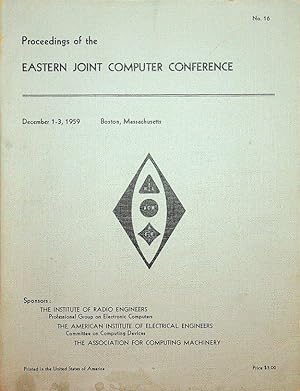
Proceedings of the Eastern Joint Computer Conference : Papers presented at the Joint IRE-AIEE-ACM Computer Conference Boston, Massachusetts, December 1-3, 1959
Published by The 1959 Eastern Joint Computer Conference for The National Joint Computer Committee, Various, 1959
Seller: Kuenzig Books ( ABAA / ILAB ), Topsfield, MA, U.S.A.
Association Member: ABAA ESA ILAB IOBA SNEAB
Seller rating 4 out of 5 stars
First Edition
Wraps. Condition: Very Good. First Edition. First Edition. 260 pages. Tan printed wrappers. Several stains to wrappers, upper corner bumped. Clean internally. Staples rusted, front cover glue cracked but not yet loose. Wraps. Sponsored by the Institute of Radio Engineers (IRE), American Institute of Electrical Engineers (AIEE), and The Association for Computing Machinery (ACM), this is the 16th conference held on the subject of computing. Contains articles by many pioneers including Eckert, and machines including UNIVAC-Larc, The STRETCH computer, MIBIDIC B, and many other ideas including magnetic drum memory for subminiature digital computers. One of the more interesting non-computer papers is "Critical-Path Planning and Scheduling" by J. E. Kelley, Jr., and M. R. Walker. "The critical path method (CPM) is a project modeling technique developed in the late 1950s by Morgan R. Walker of DuPont and James E. Kelley Jr. of Remington Rand.[in their paper found in this conference proceeding on pages 160-173]. Kelley and Walker related their memories of the development of CPM in 1989. Kelley attributed the term "critical path" to the developers of the PERT which was developed at about the same time by Booz Allen Hamilton and the U.S. Navy. The precursors of what came to be known as Critical Path were developed and put into practice by DuPont between 1940 and 1943 and contributed to the success of the Manhattan Project. Critical Path Analysis is commonly used with all forms of projects, including construction, aerospace and defense, software development, research projects, product development, engineering, and plant maintenance, among others. Any project with interdependent activities can apply this method of mathematical analysis. The first time CPM was used for major skyscraper development was in 1966 while constructing the former World Trade Center Twin Towers in New York City. Although the original CPM program and approach is no longer used, the term is generally applied to any approach used to analyze a project network logic diagram." In a nutshell, the Critical Path Method can be used in large scale projects of all types to ascertain (in combination with tools like PERT charts) what deliverables depend on what other parts of the project, and hence allow management to the critical path components without which the project won't get done on time. It also allows changes to be incorporated, and can be used as a predictive tool to ascertain what changes in a project will do to the ultimate deliverables. These tools were used very effectively in large scale projects for years, and became essential even while "improvements" and "new systems" were created. A milestone in project management approaches. See Origins of Cyberspace 740 which discusses the origin of these Joint Computer Conferences and their importance.