

Order Total (1 Item Items):
Shipping Destination:

Receipt Payment, First Edition (7 results)
Skip to main search results
Search filters
Product Type
- All Product Types
- Books (5)
- Magazines & Periodicals (No further results match this refinement)
- Comics (No further results match this refinement)
- Sheet Music (No further results match this refinement)
- Art, Prints & Posters (No further results match this refinement)
- Photographs (No further results match this refinement)
- Maps (No further results match this refinement)
- Manuscripts & Paper Collectibles (2)
Condition Learn more
- New (No further results match this refinement)
- As New, Fine or Near Fine (1)
- Very Good or Good (4)
- Fair or Poor (1)
- As Described (1)
Binding
Collectible Attributes
- First Edition (7)
- Signed (3)
- Dust Jacket (No further results match this refinement)
- Seller-Supplied Images (6)
- Not Print on Demand (7)
Language (1)
Free Shipping
- Free Shipping to U.S.A. (No further results match this refinement)
Seller Location
Seller Rating
-
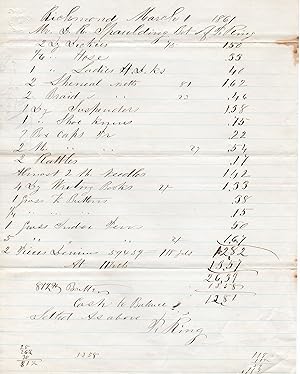
1861 Handwritten Receipt of Payment D. R. Spaulding to F. King Richmond Va
Published by F. King, Va., 1861
First Edition
Unbound. Condition: Very Good. 1st edition. Va.: F. King. Very Good with No dust jacket as issued. 1861. Single sheet. This vintage receipt is in very good collectible condition with a few stains and edge wear as shown. , A 8 by 10 inch receipt. See Photos; This vintage receipt is dated March 1st 1861 , this is just 16 days before Va. Seceded from the Union. The receipt is for various items Caps , Rattles , writing books, etc. From Mr. D. R. Spaulding to F. King . whbx 2.
-
1823 HANDWRITTEN RECEIPT TO ROBERT CROSBY FOR $3 PAYMENT "IN FULL FOR A LEAP TO HIS MARE OUT OF THE HORSE CALLED YOUNG HIGHLANDER IN 1822"
Published by Crawford, NH, 1823
Seller: R & A Petrilla, Booksellers & Appraisers, Roosevelt, NJ, U.S.A.
Seller rating 4 out of 5 stars

First Edition
Condition: Near Fine. Original manuscript. One page, written in sepia ink on old, heavy paper; docketed on verso. 3"x 8".
-

A Parliament Receipt for payment in Relation to the 'Act of Parliament for the Better and More Regular Paying of Annunities'. Signed by Sir Nathaniel Curzon.
Published by UK, 1714
Seller: Lasting Words Ltd, Northampton, UK, United Kingdom
Association Member: PBFA
Seller rating 5 out of 5 stars

Manuscript / Paper Collectible First Edition Signed
US$ 207.14
US$ 26.75 shipping
Ships from United Kingdom to U.S.A.Quantity: 1 available
Add to basketPaper. Condition: Good. First Edition. A Parliament Receipt for payment in Relation to the 'Act of Parliament for the Better and More Regular Paying of Annunities'. Signed by Sir Nathaniel Curzon. C1714. Sir Nathaniel Curzon, 4th Baronet 1676-1758 of Kedleston Hall, Derbyshire was an English Tory politician who represented three constituencies in the 18th century. Size is 260mm x 200mm. Condition is average. Age toned with creasing/slight loss nicks and rough edges. More images can be taken upon request. Ref16870. Signed by Author(s).
-
IN HIS OWN IMAGE. (WITH RECEIPT FOR PAYMENT TO BARON CORVO)
Published by The Bodley Head,, London,, 1901
Seller: Burwood Books, Wickham Market, United Kingdom
Association Member: PBFA
Seller rating 5 out of 5 stars
First Edition
US$ 241.67
US$ 30.17 shipping
Ships from United Kingdom to U.S.A.Quantity: 1 available
Add to basketHardcover. Condition: Fair. First Edition Hardback. 8vo. pp x, 419. Loosely inserted is a signed typed letter from Grant Richards to John Lane ask for royalties for the book + a receipt for £8 19 shillings with postage stamp of Queen Victoria and date March 19 1901. Colonial issue. ÔColonialÕ edition, of which only 500 copies were printed. Original publisher's beige cloth attractively illustrated in white Somewhat used though the boards still look good, some loosening of middle pages to binding but nothing actually detached. Feps have been unattractively covered in blue paper by a previous owner Interesting ownership inscription, bookplate and annotations (quotations from Wilde and Compton Mackenzie) of Philip Sainsbury of the Cayme Press, something of a later Uranian fringe figure who died young in the 1930s. This copy with faults and interesting provenance. Used vg minus.
-
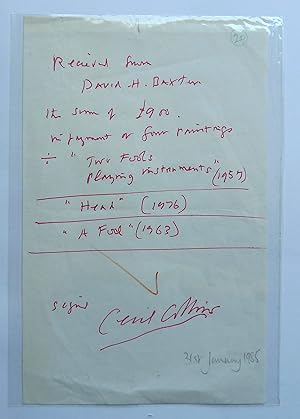
Handwritten receipt for payment for pictures. To David Baxter, date added in pencil 31st January 1985.
Published by Self-published., 1985
Manuscript / Paper Collectible First Edition Signed
US$ 345.24
US$ 15.42 shipping
Ships from United Kingdom to U.S.A.Quantity: 1 available
Add to basketSoft cover. Condition: Very Good. 1st Edition. Handwritten receipt for payment for pictures signed by Cecil Collins. Receipt for £900 for 4 paintings "Two Fools, playing instruments" of 1957; "Head" of 1976 and "A Fool" of 1963. Signed by Author(s).
-

By Order Of The State of Connecticut New London County Court 12 Oct 1790 Sir, Pay Joshua Esquire State Attorney For Said County Three Pounds two Shillings three pence Out of the Taxes Appropriated for the Payment of the Civil HAND WRITTEN AND HARTFORD PRINTED 1790 SUPERIOR COURT RECEIPT WITH BORDER
Published by Hudson and Goodwin, Connectict, 1790
Seller: Three Geese in Flight Celtic Books, Los Angeles, CA, U.S.A.
Seller rating 5 out of 5 stars
First Edition Signed
Condition: Very Good. 1st Edition. Connectict: Hudson and Goodwin, 1790. Book. Very Good. No Binding. 1st Edition. 16mo - over 5¾ - 6¾" tall. ORIGINAL HAND WRITTEN AND PRINTED COLONIAL STATE OF CONNECTICUT October 1790 SIGNED TAX RECEIPT Combination hand writing and printing Colonial border design around 5x7 inch Seven sentences of print and script Hartford Printer Hudson And Goodwin with Signature Treasurer Very Good shape original hole punched by the State of Connecticut in center of document. Two halves One piece of clear tape holding together Flip side signed and inscribed beautiful flowing script"John Dodd" Photo on request. Signed by Author(s).
-
[EARLY SYDNEY PRINTING] Receipt for payment of quit rent made to the Crown by Edward Robinson. Sydney, 29 January 1806.
Seller: Douglas Stewart Fine Books, Armadale, VIC, Australia
Association Member: ANZAAB ILAB
Seller rating 4 out of 5 stars
First Edition
Sydney, NSW : [George Howe, Government Printer], [printed 1802-06]. Printed in black ink on laid paper, 40 x 98 mm; manuscript date of 29 January 1806, with further clerical entries recording the receipt from Edwd. Robinson of 11 shillings, 'being the Amount of one Year's Quit-Rent due to the Crown the 28th of Sept. 1805 on one Grant and one Lease.'; signed D.D. Mann (David Dickenson Mann, government clerk); complete and fine. There can be little doubt that this official receipt from the Crown, made out to Edward Robinson for his (slightly overdue) annual quit rent payments for the year 1805, was printed by George Howe on the same wooden screw-press that had arrived with the First Fleet, and had been used by George Hughes to print the oldest known Australian imprints. It is an extremely early example of an ephemeral Australian printing, which could conceivably have been printed anywhere between 1802, when Howe was made Government Printer, and January 1806, when the receipt was dated and signed by Mann. Its diminutive size reflects the imperative to conserve the limited stocks of paper and ink in the fledgling colony. GEORGE HOWE & EARLY PRINTING IN SYDNEY George Howe (1771-1821) was the son of a government printer onBasseterre, Saint Christopher Island (Saint Kitts). As a young man he went to London and worked as a journeyman printer for The Times newspaper. In 1799 he was convicted of larceny and sentenced to death, but this was commuted totransportationfor life toNew South Wales. Howe arrived in Sydney in November 1800. The first issue of Australia's first newspaper, The Sydney Gazette, and New South Wales Advertiser, was published on Saturday, March 5 1803, by Howe, who had been appointed Government Printer due to his experience working on the London Times. In a despatch to Lord Hobart dated May 9, 1803, Governor King refers to George Howe as an 'ingenious man' (Ferguson 383). Howe not only printed but was also the editor of the Gazette, although the content of the newspaper - published under the initiative of Governor King - was under strict government censorship. The paper was printed on a small wooden screw-press which had been brought to the colony by Arthur Phillip in the First Fleet, along with some metal type, paper and ink. (It would not be long before ink had to be improvised using local resources: a charcoal base mixed with fat, whale and fish oils, and tree resins). David Collins (Account of the English Colony in New South Wales) noted in November 1795 that a young printer, George Hughes, had used the press to print numerous government notices and orders. Copies of some of these ephemeral printed items are held in the Record Office, London (Ferguson, Foster & Green.The Howes and their Press, p 15). This almost certainly makes Hughes responsible for the very earliest Australian imprints (Ferguson, op. cit.), of which the oldest to have survived is a playbill dated 30 July 1796 (now in the National Library of Australia). George Howe used the same press to print the colony's first book, The New South Wales General Standing Orders, in 1802 - probably confirming him as the colony's second printer - and also its second, the first edition of theNew South Walespocket almanack and colonial remembrancer, in 1806. In May 1804 a complete set of new type had been brought from London, although it would not be until 1814 that a replacement for the wooden screw-press - a new iron Stanhope printing press, ordered by Governor Macquarie - would arrive. EDWARD ROBINSON Yorkshireman Edward Robinson (c.1754-1820) arrived in Australia as a convict on the Third Fleet in October 1791. He went on to become a respected citizen of the Hawkesbury River district - alandowner, sheep farmer and, later in life, an innkeeper. He had been granted 30 acres of land on the river at Hawkesbury in the District of Mulgrove Place in December 1794. In September 1802 he was granted a further 100 acres at a lagoon nearby, which was called Robinson?s Lagoon. The 1805 quit rent of 11 shillings which Robinson paid the Crown was for these two holdings. Around this time he had a flock of around 200 sheep, and it is known that he informed Governor King of his wish to experiment with merinos.In 1809 he would receive a further grant to lease 1 3/4 acres 25 rods in Sydney Town, and begranted 80 acres at Upper Nelson. Robinson was the proprietor of a tavern known as theSign of the York Rosesfrom 1809 through to 1815. A short time before his death in June 1820, he was issued a hotel licence for an establishment on the Sydney Road. He died at the Half Way House, an inn on the Parramatta Road today known as the Horse and Jockey, on 6 June 1820, and was buried in the Devonshire Street Cemetery.


![Seller image for [EARLY SYDNEY PRINTING] Receipt for payment of quit rent made to the Crown by Edward Robinson. Sydney, 29 January 1806. for sale by Douglas Stewart Fine Books](https://pictures.abebooks.com/inventory/md/md31241518186.jpg)