
Record 1948: Signed (4 results)

Published by Reinhardt & Evans, London, 1951, London, 1951
- Hardcover
- First Edition
- Signed
Seller: Burwood Books, Wickham Market, , United KingdomBurwood Books
Contact seller5-star sellerCondition: Used - Very good
US$ 55.27
US$ 30.18 shippingShips from United Kingdom to U.S.A.Quantity: 1 available
Hardcover. Condition: Very Good. First Edition. Hardback. Dust Jacket 4to. pp 110. Copiously illustrated in black and white throughout. Signed on front pastedown by Angus McBean, one of the photographers whose photos are in the book: 'Angus McBean/ Endell St London.' Endpapers slightly foxed otherwise VG+ in chipped VG- dust jac…ket. Signedes.
Published by Reinhardt & Evans, London, 1951, London, 1951
- Hardcover
- First Edition
- Signed
Seller: Burwood Books, Wickham Market, , United KingdomBurwood Books
Contact seller5-star sellerCondition: Used - Very good
US$ 66.32
US$ 30.18 shippingShips from United Kingdom to U.S.A.Quantity: 1 available
Hardcover. Condition: Very Good. First Edition. Hardback. Dust Jacket 4to. pp 110. Copiously illustrated in black and white throughout. Signed on front endpaper by the photographer Angus McBean to his partner David Ball: 'For David/ with love from/ Angus.' VG in slightly used near VG dust jacket. Signedes.
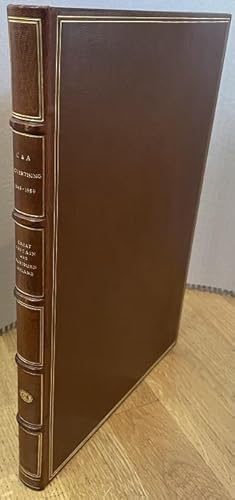
Published by C&A Modes Adveritising Department, London 1970
- Hardcover
- Signed
Seller: Antiquariat am St. Vith, Mönchengladbach, , GermanyAntiquariat am St. Vith
Contact seller5-star sellerCondition: Used
US$ 453.05
US$ 49.19 shippingShips from Germany to U.S.A.Quantity: 1 available
Leinen. Quart. 223 S. Ledereinband mit Rückengoldprägung, goldgeprägten Deckelfileten, Steh - und Innenkantenvergoldung u. Goldschnitt im Leinenschuber (Einband signiert Sangorski & Sutcliffe). Sprache: Englisch, Mit zahlr. schw.-w. Abb. Schuber geringf. fleckig, Einbandrücken minimal aufgehellt, schönes Exemplar im Handeinband…der berühmten Londoner Buchbinderei Sangorski & Sutcliffe. Privatdruck, Nr. 6.
 More images
- Softcover
- Signed
Seller: Max Rambod Inc, Woodland Hills, CA, U.S.A.Max Rambod Inc
Contact seller5-star seller[1] Traill, Sinclair, ed. Jazz Journal issues, 1948, document postwar British jazz culture as readers, collectors, critics, and musicians rebuilt access to American jazz after wartime disruption and expanding record scarcity. Founded by Sinclair Traill in 1948, Jazz Journal became a major English-language jazz periodical; its in…augural year placed African American performers, blues aesthetics, revivalist debate, discography, and record reviews at the center of British jazz criticism. These issues support research into jazz reception in the United Kingdom, transatlantic music journalism, record collecting, racialized cultural admiration, and the postwar circulation of African American musical authority through British print culture. Jazz Journal. Volume 1, Nos. 1-3, 5-6, 8-9. London: J.J. Publications, May-November 1948. Seven issues, each approximately 12 pages, in pictorial wrappers. The run includes the May, June, July, September, October, and November 1948 issues, with one additional issue represented by number rather than month in the supplied description, and contains record reviews, discographies, artist profiles, editorials, criticism, and jazz news. The premier issue opens with Traill's editorial appeal to jazz readers, recalling that "Even in those far-off days between the two wars, when paper was to be had for the asking and printers' costs didn't resemble a millionaire's hotel bill, it was always a dubious endeavour," and closing with the hope that readers would see "a new issue of JAZZ JOURNAL on the first of each month for many years to come." Contents cited in the supplied description include "Make Way for Dixieland or Return to Sanity," a Thomas Waller discography, a September 1948 appreciation of Hoagy Carmichael with signed portrait cover, and Hugues Panassié's November essay "Count Basie and the Blues," which argues that "Count Basie knows how to play the blues as well as it seems possible to do so on the piano." Cover portraits include Louis Armstrong, Nellie Lutcher, Count Basie, and Humphrey Lyttelton, placing African American jazz innovators alongside British revivalist musicians within a magazine aimed at a postwar readership hungry for recordings, biographical knowledge, and critical guidance. Traill, Sinclair, ed. Jazz Journal. Vol. 1, No. 1. London: J.J. Publications, 1948. The opening issue establishes the magazine's postwar purpose through Traill's editorial address to jazz enthusiasts and its promise of sustained monthly criticism. Its contents, including revivalist commentary and discographical attention to Thomas "Fats" Waller, show the early publication's effort to organize jazz knowledge for British readers dependent on print mediation and record collecting. [2] Traill, Sinclair, ed. Jazz Journal. Vol. 1, No. 2. London: J.J. Publications, 1948. This issue continues the magazine's early program of criticism, record commentary, and performer-centered coverage for a readership attentive to American jazz and its British reception. It belongs to the first sequence of issues issued after the May 1948 relaunch from Traill's earlier Pick Up, whose final issue preceded the first Jazz Journal in May 1948. 3] Traill, Sinclair, ed. Jazz Journal. Vol. 1, No. 3. London: J.J. Publications, 1948. The third issue forms part of the magazine's initial attempt to stabilize a postwar jazz readership through recurring reviews, essays, and documentation of recordings and artists. Its position in the first volume is useful for tracing how British jazz criticism developed a regular periodical form in 1948. [4] Traill, Sinclair, ed. Jazz Journal. Vol. 1, No. 5. London: J.J. Publications, 1948. This issue continues the first-year sequence, with the supplied description emphasizing the magazine's mix of artist portraits, discographical writing, and critical essays. The issue contributes to the archive's broader value as evidence of how British jazz readers encountered American performers through images, reviews, and commentary. [5] Traill, Sinclair, ed. Jazz Journal. Vol. 1, No. 6. London: J.J. Publications, 1948. The September 1948 issue features an appreciation of Hoagy Carmichael with a signed portrait cover, connecting jazz readership to popular song, composition, and the American music industry. Its treatment of Carmichael alongside coverage of African American jazz performers demonstrates the publication's wide understanding of jazz-adjacent culture in the late 1940s. [6] Traill, Sinclair, ed. Jazz Journal. Vol. 1, No. 8. London: J.J. Publications, 1948. This issue belongs to the later portion of the inaugural-year run and continues the magazine's regular pattern of record culture, criticism, and performer documentation. In the context of the seven-issue group, it helps show the durability of Traill's monthly editorial project beyond the launch months. [7] Traill, Sinclair, ed. Jazz Journal. Vol. 1, No. 9. London: J.J. Publications, 1948. The November issue includes Hugues Panassié's "Count Basie and the Blues," a critical essay distinguishing blues feeling and phrasing from commercialized improvisation. Its attention to Basie foregrounds African American musical authority within British jazz discourse and gives the archive direct relevance to the study of blues reception, swing-era memory, and postwar criticism. Moderate soiling and creasing to wrappers, occasional spine chipping, intact stapled bindings, delicate covers, and vivid photographic contrasts, good overall. Substantial inaugural-year run of a long-lived British jazz periodical, preserving the early critical vocabulary through which postwar British readers studied African American jazz, swing-era performers, blues expression, and record collecting. Signed.

