Order Total (1 Item Items):
Shipping Destination:

Relativity by Albert Einstein, Signed (9 results)
Skip to main search results
Search filters
Product Type
- All Product Types
- Books (9)
- Magazines & Periodicals (No further results match this refinement)
- Comics (No further results match this refinement)
- Sheet Music (No further results match this refinement)
- Art, Prints & Posters (No further results match this refinement)
- Photographs (No further results match this refinement)
- Maps (No further results match this refinement)
- Manuscripts & Paper Collectibles (No further results match this refinement)
Condition Learn more
- New (No further results match this refinement)
- As New, Fine or Near Fine (No further results match this refinement)
- Very Good or Good (1)
- Fair or Poor (No further results match this refinement)
- As Described (8)
Binding
Collectible Attributes
Language (2)
Price
- Any Price
- Under US$ 25 (No further results match this refinement)
- US$ 25 to US$ 50 (No further results match this refinement)
- Over US$ 50
Free Shipping
Seller Location
Seller Rating
-

RELATIVITY. The Special And The General Theory. Custom Clamshell Case Only. (NO BOOK INCLUDED)
Published by Henry Holt and Company, New York, 1920
Seller: TBCL The Book Collector's Library, Montreal, QC, Canada
Association Member: IOBA
Seller rating 5 out of 5 stars

First Edition Signed
First Edition. RELATIVITY: Custom Clamshell Case Only. Henry Holt and Company New York: [1920, Book Date] Excellent Custom Clamshell Case [Not A Book] For The First Edition. Elegant BLUE LEATHER & fine black cloth, Custom SILVER-Stamped Titles to spine. Embossed multi-layered, multi-image [sculpted] design on the side inspired from the atom. Finished in rich Black velour on the interior. A superb & unique protective clamshell case for this first edition. This Handsome Collector's Custom Case fit for an important Collector. "Books definitely NOT included" When you place your order: Please confirm the actual size of your first edition as sizes may vary with age or if the edition is covered in Mylar. The text can be altered to add "signed" or other special requests. Generally over 100 in-stock titles. Custom Craft available upon request. Book definitely NOT included Size can be adapted to soft or hardcover first editions.
-

The Evolution of Physics: The Growth of Ideas from Early Concepts to Relativity and Quanta.
Published by Cambridge University Press, Cambridge, 1938
First Edition Signed
First edition of this classic work, which traces the development of ideas in physics. Octavo, original blue cloth. Presentation copy, inscribed by Albert Einstein on the half-title page, "To Dr. Montrell Albert Einstein Princeton 1943." Near fine in a near fine price-clipped dust jacket. On publication The Saturday Review of Literature praised Evolution of Physics as "masterly Einstein and Infeld's book should do much to spread an understanding and appreciation one of the great dramas in the evolution of human thought.".
-

Sixth edition of Einstein's clear and systematic exposition of the theory of relativity, with the ownership stamp on the front and rear pastedowns, "Stephen Hawking Newton Institute University of Cambridge Cambridge, England." Octavo, original cloth. Translated By Edwin Plimpton Adams and Ernest G. Straus. Fine in a very good dust jacket. An exceptional association. In the book, Einstein outlines both the special and general theories of relativity, explaining their mathematical foundations and physical implications, particularly regarding the nature of space, time, and gravitation. Designed for readers with a background in physics and mathematics, the text serves as both a summary of Einsteinâs groundbreaking contributions and an accessible guide to the conceptual shifts his theories introduced to modern science. The work remains a significant historical and intellectual document, illustrating Einsteinâs effort to communicate complex scientific ideas with clarity and precision.
-

The Evolution of Physics: The Growth of Ideas from Early Concepts to Relativity and Quanta.
Published by Cambridge University Press, Cambridge, 1938
First Edition Signed
First edition of this classic work, which traces the development of ideas in physics. Octavo, original blue cloth. Presentation copy, inscribed by the author in the year of publication on the second free endpaper, "For David Stern Albert Einstein 1938." Fine in a near dust jacket with a few small closed tears. Trade editions signed by Einstein are scarce. Upon publication The Saturday Review of Literature praised Evolution of Physics as "masterly Einstein and Infeld's book should do much to spread an understanding and appreciation one of the great dramas in the evolution of human thought.".
-
The Evolution of Physics: The Growth of Ideas from Early Concepts to Relativity and Quanta.
Published by Simon and Schuster, New York, 1951
First Edition Signed
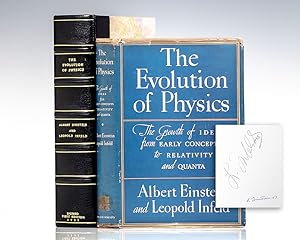
Later printingÂof this classic work, which traces the development of ideas in physics. Octavo, original blue cloth. Boldly signed by both authors on the front free endpaper, "A. Einstein. 53" and "L. Infeld 1958." Near fine in a very good dust jacket. We have never seen another example signed by both authors. Rare and desirable. Upon publication The Saturday Review of Literature praised Evolution of Physics as "masterly Einstein and Infeld's book should do much to spread an understanding and appreciation one of the great dramas in the evolution of human thought.".
-
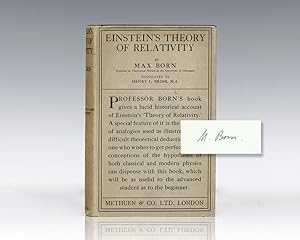
First edition of this classic account of Born's analysis and interpretation of Einstein's theory of relativity. Octavo, original cloth, frontispiece of Einstein. Signed by Max Born on the verso of the frontispiece. Translated by Henry L. Brose. Very good in a very good dust jacket. Housed in a custom half morocco clamshell box. First editions are uncommon, signed examples rare. Einstein's Theory of Relativity is a book in which one great mind explains the work of another great mind in terms comprehensible to the layman is a significant achievement. This is such a book. Max Born was awarded the Nobel Prize in 1954 and was one of the world's great physicists: in this work he analyzes and interprets the theory of Einsteinian relativity. The result is undoubtedly the most lucid and insightful of all the books that have been written to explain the revolutionary theory that marked the end of the classical and the beginning of the modern era of physics. Born follows a quasi-historical method of presentation. The book begins with a review of the classical physics, covering such topics as origins of space and time measurements, geometric axioms, Ptolemaic and Copernican astronomy, concepts of equilibrium and force, laws of motion, inertia, mass, momentum and energy, Newtonian world system (absolute space and absolute time, gravitation, celestial mechanics, centrifugal forces and absolute space), laws of optics (the corpuscular and undulatory theories, speed of light, wave theory, Doppler effect, convection of light by matter), electrodynamics (including magnetic induction, electromagnetic theory of light, electromagnetic ether, electromagnetic laws of moving bodies, electromagnetic mass, and the contraction hypothesis). Born then takes up his exposition of Einstein's special and general theories of relativity, discussing the concept of simultaneity, kinematics, Einstein's mechanics and dynamics, relativity of arbitrary motions, the principle of equivalence, the geometry of curved surfaces, and the space-time continuum, among other topics. Born then points out some predictions of the theory of relativity and its implications for cosmology, and indicates what is being sought in the unified field theory. This work steers a middle course between vague popularizations and complex scientific presentations. This is a careful discussion of principles stated in thoroughly acceptable scientific form, yet in a manner that makes it possible for the reader who has no scientific training to understand it. Only high school algebra has been used in explaining the nature of classical physics and relativity, and simple experiments and diagrams are used to illustrate each step. The layman and the beginning student in physics will find this an immensely valuable and usable introduction to relativity.
-

ALBERT EINSTEIN Signed Book 1920 Theory of Relativity Science Berlin US Jews
Language: German
Published by Berlin, 1920
Seller: Miramar Antiques Art and Books Co. SL, MADRID, M, Spain
Seller rating 4 out of 5 stars

Signed
Encuadernación de tapa blanda. Condition: Bien. Dust Jacket Condition: Bien. A historical important science booklet by the famous Albert Einstein signed. Title: ÄTHER UND RELATIVITÄTS THEORIE. Theory of Relativity. Printed 1920, Berlin. Ex-libris of 1943 and german stamps. The booklet is complete and on good condition, it only has a very small broken part on the first page at the top that you can see in the photo. All items are guaranteed to be 100% authentic. Returns: 14 day money back guarantee if item is Unsatisfactory to Buyers standards. Firmado por el autor.
-

THE MEANING OF RELATIVITY: FOUR LECTURES DELIVERED AT PRINCETON UNIVERSITY, MAY, 1921. Signed by Einstein
Published by Methuen & Co. Ltd, London, 1924
Seller: TBCL The Book Collector's Library, Montreal, QC, Canada
Association Member: IOBA
Seller rating 5 out of 5 stars
Signed
Second Edition. Second Edition. Signed by Author. SIGNED Copy. The uncommon second UK edition. 8vo., 123pp. A near fine copy in a very good or better dustwrapper showing a few small chips at the extremities. Nicely signed by Einstein on the front free endpaper in blue fountain pen in full: "Albert Einstein. 1949". Neat prize inscription dated 1942, Liverpool University just above the signature. Very rarely seen signed. Weil 124a for the 1st edition - no mention of the 1924 2nd. Custom slipcase in fine condition. Signed by Author.
-
![Seller image for Einstein: My Work in Relativity Supplanted Newtonian Mechanics and Changed Our Notion of Space and Time Forever ("In classical mechanics, space and time were completed existences, which had to be presupposed as real [a priori] in order to give meaning to the laws of motion. It was a reality in the same sense as the reality of matter; even governing the latter. In this sense Kant was entirely wrong.") for sale by The Raab Collection](https://pictures.abebooks.com/inventory/md/md30771263176.jpg)
Einstein: My Work in Relativity Supplanted Newtonian Mechanics and Changed Our Notion of Space and Time Forever ("In classical mechanics, space and time were completed existences, which had to be presupposed as real [a priori] in order to give meaning to the laws of motion. It was a reality in the same sense as the reality of matter; even governing the latter. In this sense Kant was entirely wrong.")
Seller: The Raab Collection, Ardmore, PA, U.S.A.
Association Member: ABAA ILAB PADA
Seller rating 4 out of 5 stars
Signed
The fullest summation we have seen by Einstein comparing relativity to Newtonian concepts of space and timeImmanuel Kant took both Euclidean geometry and the Newtonian laws of motion to be synthetic a priori principles, which, from Kant?s point of view, function as necessary presuppositions for applying our fundamental concepts of space, time, matter, and motion to our sensible experience of the natural world, meaning they are fixed necessary conditions. This idea rested on the absolute nature of space and time, the work of Newton, and the relationship between geometry and physics.In 1905, while a young patent clerk and physicist in Bern, Switzerland, Albert Einstein obtained his doctorate and published a paper that explained his newly developed Special Theory of Relativity. This unlocked many mysteries of the universe, and introduced the world to "e=mc2," equating mass and the speed of light with energy. It established that time and space are not fixed, and in fact change to maintain a constant speed of light regardless of the relative motions of sources and observers. Just 10 years later, in 1915, Einstein published his General Theory of Relativity, which described the universe as a four-dimensional continuum (with time added as the fourth dimension), where gravitational effects are explained by the warping of space-time. In this theory, Einstein incorporated gravity as a geometric property of space-time.The impact of Einstein's work between 1905 and 1915 challenged many principles of physics that had been accepted for centuries. In 1921, he won the Nobel Prize for his work. Time Magazine named him the Person of the Century for the 20th century for his discoveries in relativity and space-time. Einstein is the most important scientist since Isaac Newton, and probably the most famous in history.Space and time were considered relativistic, more subjective, and not the fixed a priori notions that had long permeated the mathematical and scientific worlds.Max Fischler was a California scientist who was interested in the implications of this distinction: were space and time now to be studied together in this context only or were the nature of space and the nature of time different?In special relativity, what appears simultaneous to one person, might not to another - they are relative. You cannot separate space and time; they occur subjectively and semi-dependently, but are not tied to the content of that space.With General Relativity, space-time remains but matter warps it. It's a field, like the sheet of a trampoline but reacts to matter. One needs all four dimensions of space-time and without them, the others don't exist. You need matter for space.On September 5, 1954, he wrote to Einstein: ".Can anything in your theory of Relativity be said to throw new light on the nature of space and time themselves? Or must we rest satisfied with the purely new logical treatment of these conceptions? In other words, does the new view of space and time as space-time carry any new meaning ontologically beyond the purely mathematical and logical relationship between the two. Or to put it differently: When Minkowski, in his famous words said, 'Space by itself and time by itself must not sink into the mere shadows, and only a kind of union of the two can preserve an independent existence,' did he not attach some new, real meaning to the 'spacetime' which the old independent notions of space and time could not convey? If so in what does this new meaning consist?."Four days later, Einstein replied in this letter:Typed letter signed, in German, on his personal blind embossed letterhead, Princeton, September 9, 1954, to Max Fishler. "The expression cited in the second paragraph only signifies the wish for logical clarity in the formal expressions. De facto the justification for concepts lies in their ability to comprehend the empirically given."In classical mechanics, space and time were completed existences, which had to be presupposed as real [a pri.