Order Total (1 Item Items):
Shipping Destination:

Relocation Center, Signed (4 results)
Skip to main search results
Search filters
Product Type
- All Product Types
- Books (4)
- Magazines & Periodicals (No further results match this refinement)
- Comics (No further results match this refinement)
- Sheet Music (No further results match this refinement)
- Art, Prints & Posters (No further results match this refinement)
- Photographs (No further results match this refinement)
- Maps (No further results match this refinement)
- Manuscripts & Paper Collectibles (No further results match this refinement)
Condition Learn more
- New (1)
- As New, Fine or Near Fine (2)
- Very Good or Good (No further results match this refinement)
- Fair or Poor (No further results match this refinement)
- As Described (1)
Binding
Collectible Attributes
Language (2)
Price
- Any Price
- Under US$ 25 (No further results match this refinement)
- US$ 25 to US$ 50 (No further results match this refinement)
- Over US$ 50
Free Shipping
- Free Shipping to U.S.A. (No further results match this refinement)
Seller Location
Seller Rating
-
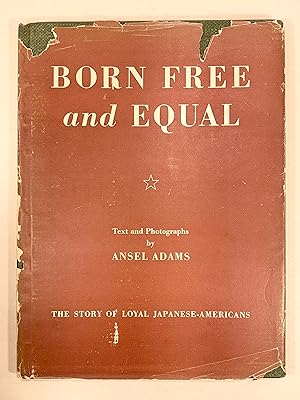
BORN FREE AND EQUAL: The Story of Loyal Japanese Americans, Manzanar Relocation Center, Inyo County, California
Language: English
Published by Spotted Dog Press, Inc, Bishop, California, 2002
ISBN 10: 1893343057 ISBN 13: 9781893343054
Seller: johnson rare books & archives, ABAA, Covina, CA, U.S.A.
Association Member: ABAA ESA ILAB
Seller rating 5 out of 5 stars

Signed
Hardcover. Condition: Near fine. Dust Jacket Condition: Very good. Inscribed on the title page by Sue Kunitomi Embrey, who contributed an introduction to this work. An influential Japanese-American activist from her youth in the Little Tokyo section of Los Angeles to her grim experiences at Manzanar and her postwar struggle to raise awareness of the internment camps, Embrey (1923-2006) played a major role in bringing this dark chapter of American history into the light of congressional acknowledgement and a presidential apology. A new and expanded edition of the book first published by U.S. Camera in 1944 with photographs and text by Ansel Adams. Includes an introduction by Archie Miyatake, the son of photographer and Manzanar internee Toyo Miyatake, who collaborated with Adams on the collaborative exhibit Two Views of Manzanar after the war. Also features contributions by Sue Kunitomi Embrey and William H. Michael. Edited by Wynne Benti. Quarto: 128 p. with numerous photographic illustrations. Original blue cloth binding, with gilt titles. A near fine copy in a pictorial dust jacket with some minor rubbing.
-
Born Free and Equal Photographs of the Loyal Japanese-Americans at Manzanar Relocation Center Inyo County, California
Published by U S Camera, New York, 1944
Seller: Old New York Book Shop, ABAA, Atlanta, GA, U.S.A.
Seller rating 5 out of 5 stars
First Edition Signed
Hardcover. Condition: Near fine. Dust Jacket Condition: good. First Edition. 112p quarto, illustrated Texts and photographs by Ansel Adams. Extremities a little bumped and rubbed else near fine in good dust jacket with some moderate overall chipping, mostly visible on the front panel. Inscribed on the verso of the front fly: "For M.H. Pollock with good wishes of Ansel Adams Feb 1946" A photo essay on the interned Japanese Americans at Manzanar. Adams made little attempt to hide his contempt for the policy. Rare either in jacket or signed, this is both.
-
Japanese Internment Heart Mountain War Relocation Center Materials Documenting WRA Governance, Camp Administration, and Community Activities Inside the Camp, 1944
Publication Date: 1944
Seller: Max Rambod Inc, Woodland Hills, CA, U.S.A.
Association Member: ABAA ILAB PADA
Seller rating 5 out of 5 stars
Signed
[Japanese Internment] Heart Mountain War Relocation Center materials documenting administrative theory alongside camp level cultural practice. The War Relocation Authority's political administration and daily life inside Japanese American incarceration during World War II, including a copy of Community Government in War Relocation Centers signed "Rachel Sady," likely the anthropologist Rachel Reese Sady of the War Relocation Authority's Community Analysis Section, paired with a 1944 recital program naming Heart Mountain residents and a camp letterhead sheet. The booklet analyzes block organization, temporary councils, organizing commissions, the crises at Poston and Manzanar, registration, and the extension of representation to Issei, while the recital program shows community activities operating within Heart Mountain's own block and barracks geography. Heart Mountain opened in Wyoming in August 1942 under the War Relocation Authority, held more than 10,000 Japanese Americans behind barbed wire and guard towers, and differed from most WRA camps in relying on a Temporary Council of Block Chairmen rather than a standard elected community council, making this grouping a sharp document of how federal control and inmate social life intersected within one confinement site. 1944-1946, Heart Mountain, Wyoming, with one Washington, D.C., War Relocation Authority publication. Archive of 3 items: 1 typed recital program, 1 Heart Mountain War Relocation Project letterhead sheet, and 1 printed WRA booklet. [1] United States. War Relocation Authority. Community Government in War Relocation Centers. Washington, D.C.: U.S. Government Printing Office, [1946]. Printed wrappers, upper cover signed "Rachel Sady." Prepared by Solon T. Kimball, head of the Section of Community Government, the 103-page volume examines the War Relocation Authority's effort to construct political administration within the camps through legal policy, block organization, temporary community councils, organizing commissions, and debates over representation, with sections on the Poston strike, the Manzanar riot, registration, and the extension of representation to the Issei. Its closing pages turn from camp governance to the consequences of removal itself, recommending "special governmental agencies or units" to provide "resettlement aid (grants)" and "loans" to former inmates, and stating in a "statement of facts" that "mental suffering has been caused by the forced mass evictions" and that there had been "almost a complete destruction of financial foundations built during over half a century." The signature matches the name of anthropologist Rachel Reese Sady, a University of Chicago trained researcher who worked for the WRA's Community Analysis Section during the war and later wrote on labor relations, race relations, and rumors in the camps; without further provenance, the inscription is best treated as a probable but unconfirmed identification. [2] The Community Activities of Heart Mountain invites you to a Pupils Piano Recital of Julia Kuwahara. Heart Mountain, Wyoming: Community Activities of Heart Mountain, May 29, 1944. Typed program for a recital held Monday evening at 8:00 p.m. in "Y Lounge, 23-25-N." The program names Heart Mountain residents and performers including Nobuko Kato, Lillian Kumagai, Helen Kato, Fumiko Fukuda, Kiyoko Nomura, Linda Ito, Matsuko Iizuka, Taneko Okauchi, Frances Okazaki, and Kiku Hori, with repertoire by Mozart, Mendelssohn, Chopin, Tchaikovsky, Rachmaninoff, and others. In documentary terms, this is the strongest item in the group: it anchors camp cultural life to a precise date and place while preserving a roster of named individuals living inside Heart Mountain's internal address system. [3] Heart Mountain War Relocation Project letterhead. Heart Mountain, Wyoming: War Relocation Authority, circa 1944-1945. Single sheet with printed Heart Mountain vignette and the designation "Heart Mountain War Relocation Project / Heart Mountain, Signed.
-

Heart Mountain Relocation Center
Language: English
Published by Omniscriptum Mär 2026, 2026
ISBN 10: 613185792X ISBN 13: 9786131857928
Seller: buchversandmimpf2000, Emtmannsberg, BAYE, Germany
Seller rating 5 out of 5 stars
Signed Print on Demand
Taschenbuch. Condition: Neu. This item is printed on demand - Print on Demand Titel. Neuware -Please note that the content of this book primarily consists of articlesavailable from Wikipedia or other free sources online. The HeartMountain Relocation Center, named after nearby Heart Mountain Butte, wasone of ten internment camps used to incarcerate Japanese Americansexcluded from the West Coast during World War II under the provisions ofExecutive Order 9066 signed by President Franklin D. Roosevelt. TheHeart Mountain Relocation Center is located in Park County between thetowns of Cody and Powell in the northwestern corner of Wyoming, 60 mileseast of Yellowstone National Park and 45 miles south of the Montanastate line. The location for the center was selected because it wasremote and yet convenient. The land was managed by the federal Bureau ofReclamation, which before the war had initiated a major irrigationproject in the area and had already constructed canals, buildings, andsome infrastructure. The site was adjacent to a railroad spur and depotwhere internees could be off-loaded and processed.VDM Verlag, Dudweiler Landstraße 99, 66123 Saarbrücken 88 pp. Englisch.