
Rocket Development by Robert Goddard: First Edition (10 results)

Published by Prentice-Hall, Englewood Cliffs, NJ 1948
- Hardcover
- First Edition
Seller: Bibliodisia Books, Caxton Club, Chicago, IL, U.S.A.Bibliodisia Books, Caxton Club
Contact seller5-star sellerCondition: Used - Very good
US$ 60.00
US$ 6.00 shippingShips within U.S.A.Quantity: 1 available
Hardcover. Condition: Very Good. First Edition. Original blue gilt cloth with date on title page. The father of modern rocketry's own account of his work in developing the rocket.
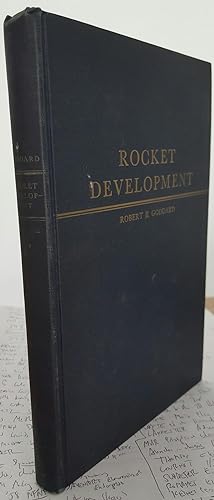
Published by New York: Prentice-Hall, 1948. 1948
- Hardcover
- First Edition
Seller: Ted Kottler, Bookseller, Redondo Beach, CA, U.S.A.Ted Kottler, Bookseller
Contact seller4-star sellerCondition: Used - Very good
US$ 150.00
US$ 12.70 shippingShips within U.S.A.Quantity: 1 available
Hardcover. Condition: Very Good. No Jacket. 1st Edition. First Edition. Frontispiece, xx, 291 pp; illus. Original cloth. Spine lettering rubbed, else Very Good, without dust jacket.
Published by Published by The Smithsonian Institution, City of Washington 1936
- Softcover
- First Edition
Seller: Currey, L.W. Inc. ABAA/ILAB, Elizabethtown, NY, U.S.A.Currey, L.W. Inc. ABAA/ILAB
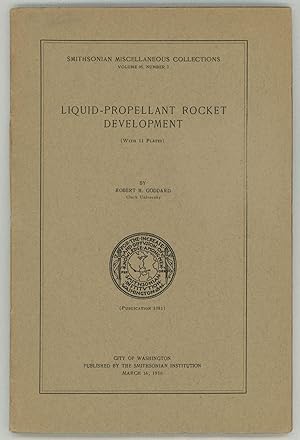
Contact seller4-star sellerOctavo, pp. [1-2] 1-10, eleven pages of illustrations on six inserted plates, original tan wrappers printed in black, sewn, untrimmed. First edition. Smithsonian Miscellaneous Collections, Volume 95, Number 3 (Publication 3381). "Includes the first public mention of Goddard's historic 1926 liquid-fueled rocket launch" (Ciancone)…. Ciancone 85. Ley, Rockets, Missiles, and Space Travel, revised edition, 1957, p. 491. Interlibrum 270 #151. Tiny spot on rear cover, a fine copy. A superb copy. Enclosed in a custom quarter green leather clamshell box with leather spine label. (#160970).
- Hardcover
- First Edition
Seller: John K King Used & Rare Books, Detroit, MI, U.S.A.John K King Used & Rare Books
Contact seller5-star sellerNY 1948. Illus, 9x6", cloth, 291 w/index, EX-LIBRARY, usual markings, corners badly bumped, covers well worn. FIRST EDITION.
Language: Esperanto
Published by Prentice Hall Inc., New York 1948
- Hardcover
- First Edition
Seller: NWJbooks, Lancaster, PA, U.S.A.NWJbooks
Contact seller4-star sellerCondition: Used - Near fine
US$ 200.00
US$ 10.00 shippingShips within U.S.A.Quantity: 1 available
Hardcover. Condition: Near Fine. No Jacket. 1st Edition. Gilt lettering on blue covers. 8vo, 291pp. A Robert H. Goddard U.S. Air Mail stamp is on the title page. Spine lettering somewhat dulled.
Published by Washington, D.C.: Smithsonian Institution, March 16, 1936. 1936
- First Edition
Seller: William Reese Company, New York, NY, U.S.A.William Reese Company
Contact seller5-star sellerFirst edition. Published as Smithsonian Miscellaneous Collections, Volume 95, number 3 (Publication 3381). "Includes the first public mention of Goddard's historic 1926 liquid-fueled rocket launch" -Ciancone. "Goddard worked out the theory of rocket propulsion independently.Having explored the mathematical practicality of rocket…ry since 1906 and the experimental workability of reaction engines in laboratory vacuum tests since 1912, Goddard began to accumulate ideas for probing beyond the Earth's stratosphere. His first two patents in 1914, for a liquid-fuel gun rocket and a multistage step rocket, let to some modest recognition and financial support from the Smithsonian Institution.With an eye toward patentability of demonstrated systems and with the aid of no more than a handful of technicians, Goddard achieved a series of workable liquid-fuel flights starting in 1926. Through the patronage of Charles A. Lindbergh, the Daniel and Florence Guggenheim Foundation, and the Carnegie and Smithsonian institutions, the Goddards and their small staff were able to move near Roswell, New Mexico. There, during most of the 1930s, Goddard demonstrated, despite many failures in his systematic static and flight tests, progressively more sophisticated experimental boosters and payloads, reaching speeds of 700 miles per hour and altitudes above 8000 feet in several test flights" - Dictionary of Scientific Biography. Ciancone, Literary Legacy of The Space Age: An Annotated Bibliography of Pre-1958 Books On Rocketry & Space Travel 85. Original medium brown sewn printed wrapper, lettered in black. Small private collection bookplate on inside of front wrapper (stamped "Withdrawn"), thumb tip-size spot of darkening at extreme lower edge of upper wrapper, upper fore-tip faintly bumped, otherwise fine, with the section of plates largely unopened.
 More images
Published by Smithsonian Instiution, Washington, D.C. 1936
- First Edition
Seller: James Cummins Bookseller, ABAA, New York, NY, U.S.A.James Cummins Bookseller, ABAA
Contact seller5-star sellerFirst edition. First edition. Smithsonian Miscellaneous Collections. Volume 95, Number 3. 11 plates on 6 leaves. [2], 10 pp. 8vo. An important marker in the development of rocketry and space flight, the pamphlet sums up Goddard's pioneering work in rocketry over the previous two decades. On March 16, 1926 Goddard launched the wo…rld's first liquid propellant rocket, from a site near Auburn, Massachusetts, and he would continue to develop the technology for the rest of his life. He held over 200 patents relating to rocketry and space flight, and in honor of his contributions NASA named its first space-flight center after him. The pamphlet was produced in part as a report back to the Smithsonian, who had begun contributing financially to his research beginning in 1915. Original side-stitched printed wrappers; partially unopened. Minor shelfwear, but fine Smithsonian Miscellaneous Collections. Volume 95, Number 3. 11 plates on 6 leaves. [2], 10 pp. 8vo.
 More images
Published by Smithsonian Institution, Washington, D.C. 1936
- First Edition
Seller: Burnside Rare Books, ABAA, Portland, OR, U.S.A.Burnside Rare Books, ABAA
Contact seller5-star sellerCondition: Used - Very good
US$ 2,500.00
Free ShippingShips within U.S.A.Quantity: 1 available
Condition: Very Good. First Edition. First edition, first printing. Bound in publisher's tan string-bound wraps printed in black. Very Good with toning and general wear. Eagle stamp on circular paper adhered to title page. In March of 1926, Goddard launched the world's first liquid-propelled rocket in Auburn, MA, with a small gr…oup of witnessed including his wife and several research assistants from nearby Clark University. It reached nearly 41 feet high and crashed nearly 184 feet from it's launch, smashing on impact. Goddard mostly worked independently and was highly secretively-- this is the second of only two papers he published on rocketry, though his impact was immense. Goddard theories and work anticipated many of the developments that made space-flight possible, and he is considered one of the founding fathers of modern rocketry.
 More images
- Hardcover
- First Edition
Seller: Herman H. J. Lynge & Søn ILAB-ABF, Copenhagen, , DenmarkHerman H. J. Lynge & Søn ILAB-ABF
Contact seller4-star sellerCondition: Used
US$ 2,846.19
Free ShippingShips from Denmark to U.S.A.Quantity: 1 available
Washington, The Smithsonian Institution, 1936. 8vo. In recent red full cloth with gilt lettering to front board. Published as part of "Smithsonian Miscellaneous Collections, Volume 95, Number 3, Publication 3381". A fine and clean copy. (2), 10 pp. + 11 photographic plates. First edition of Goddard's paper on liquid-fueled rocke…t development. Goddard is credited with creating and building the world's first liquid-fueled rocket and is often referred to as the man who ushered in the Space Age (Pendray, Rocket Development). By temperament and training Goddard was not a team worker, yet he laid the foundation from which team workers could launch men to the moon" (DSB). Goddard was secretive about his research and only published two papers" "A Method of Reaching Extreme Altitudes" (1919) and the present. Goddard launched the first liquid-fuel rocket on 16 March 1926 near Auburn, Mass. The ten-foot rocket, nicknamed "Nell" reached an altitude of 41 feet, traveled a distance of 184 feet and landed 2.5 seconds after lift-off in a cabbage patch. "Although his list of firsts in rocketry was distuguished, Goddard was eventually surpassed by teams of rocket research and development experts elsewhere, particularly in Germany." (DSB)."Like the Russian hero Konstantin Tsiolkovsky and the German pioneer Hermann Oberth, Goddard worked out the theory of rocket propulsion independently [.] Having explored the mathematical practicality of rocketry since 1906 and the experimental workability of reaction engines in laboratory vacuum tests since 1912, Goddard began to accumulate ideas for probing beyond the Earth's stratosphere. His first two patents in 1914, for a liquid-fuel gun rocket and a multistage step rocket, let to some modest recognition and financial support from the Smithsonian Institution [.] With an eye toward patentability of demonstrated systems and with the aid of no more than a handful of technicians, Goddard achieved a series of workable liquid-fuel flights starting in 1926. Through the patronage of Charles A. Lindbergh, the Daniel and Florence Guggenheim Foundation, and the Carnegie and Smithsonian institutions, the Goddards and their small staff were able to move near Roswell, New Mexico. There, during most of the 1930s, Goddard demonstrated, despite many failures in his systematic static and flight tests, progressively more sophisticated experimental boosters and payloads, reaching speeds of 700 miles per hour and altitudes above 8000 feet in several test flights" (DSB).
 More images
- Hardcover
- First Edition
Seller: Herman H. J. Lynge & Søn ILAB-ABF, Copenhagen, , DenmarkHerman H. J. Lynge & Søn ILAB-ABF
Contact seller4-star sellerCondition: Used
US$ 2,846.19
Free ShippingShips from Denmark to U.S.A.Quantity: 1 available
Washington, The Smithsonian Institution, 1936. 8vo. In recent red full cloth with gilt lettering to front board. Published as part of "Smithsonian Miscellaneous Collections, Volume 95, Number 3, Publication 3381". A fine and clean copy. (2), 10 pp. + 11 photographic plates. First edition of Goddard's paper on liquid-fueled rocke…t development. Goddard is credited with creating and building the world's first liquid-fueled rocket and is often referred to as the man who ushered in the Space Age (Pendray, Rocket Development). By temperament and training Goddard was not a team worker, yet he laid the foundation from which team workers could launch men to the moon" (DSB). Goddard was secretive about his research and only published two papers" "A Method of Reaching Extreme Altitudes" (1919) and the present. Goddard launched the first liquid-fuel rocket on 16 March 1926 near Auburn, Mass. The ten-foot rocket, nicknamed "Nell" reached an altitude of 41 feet, traveled a distance of 184 feet and landed 2.5 seconds after lift-off in a cabbage patch. "Although his list of firsts in rocketry was distuguished, Goddard was eventually surpassed by teams of rocket research and development experts elsewhere, particularly in Germany." (DSB)."Like the Russian hero Konstantin Tsiolkovsky and the German pioneer Hermann Oberth, Goddard worked out the theory of rocket propulsion independently [.] Having explored the mathematical practicality of rocketry since 1906 and the experimental workability of reaction engines in laboratory vacuum tests since 1912, Goddard began to accumulate ideas for probing beyond the Earth's stratosphere. His first two patents in 1914, for a liquid-fuel gun rocket and a multistage step rocket, let to some modest recognition and financial support from the Smithsonian Institution [.] With an eye toward patentability of demonstrated systems and with the aid of no more than a handful of technicians, Goddard achieved a series of workable liquid-fuel flights starting in 1926. Through the patronage of Charles A. Lindbergh, the Daniel and Florence Guggenheim Foundation, and the Carnegie and Smithsonian institutions, the Goddards and their small staff were able to move near Roswell, New Mexico. There, during most of the 1930s, Goddard demonstrated, despite many failures in his systematic static and flight tests, progressively more sophisticated experimental boosters and payloads, reaching speeds of 700 miles per hour and altitudes above 8000 feet in several test flights" (DSB).


