

Order Total (1 Item Items):
Shipping Destination:

Schwinger, Signed (5 results)
Skip to main search results
Search filters
Product Type
- All Product Types
- Books (3)
- Magazines & Periodicals (No further results match this refinement)
- Comics (No further results match this refinement)
- Sheet Music (No further results match this refinement)
- Art, Prints & Posters (2)
- Photographs (No further results match this refinement)
- Maps (No further results match this refinement)
- Manuscripts & Paper Collectibles (No further results match this refinement)
Condition Learn more
- New (No further results match this refinement)
- As New, Fine or Near Fine (No further results match this refinement)
- Very Good or Good (1)
- Fair or Poor (No further results match this refinement)
- As Described (4)
Binding
- All Bindings
- Hardcover (No further results match this refinement)
- Softcover (1)
Collectible Attributes
- First Edition (3)
- Signed (5)
- Dust Jacket (No further results match this refinement)
- Seller-Supplied Images (4)
- Not Print on Demand (5)
Language (3)
Free Shipping
Seller Location
Seller Rating
-

Penderecki : Begegnungen, Lebensdaten, Werkkommentare. Wolfram Schwinger
Language: German
Published by Stuttgart : Deutsche Verlags-Anstalt, 1979
ISBN 10: 3421018324 ISBN 13: 9783421018328
Signed
Pp. m. Sch. Condition: Gut. 271 S. : Ill., Noten ; 23 x 25 cm vom Autor signiert 9783421018328 Sprache: Deutsch Gewicht in Gramm: 550.
-
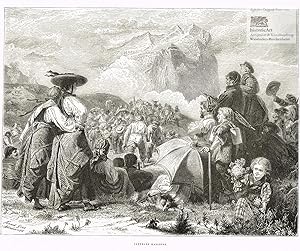
Lutteurs Hasliens. Wettkampf der Schwinger im Hasli-Tal vor großem Publikum. Xylographie nach Konrad Grob 1876
Language: German
Published by ohne Orts- und Verlagsangabe München, 1876
Seller: historicArt Antiquariat & Kunsthandlung, Wiesbaden-Breckenheim, Germany
Seller rating 5 out of 5 stars

Art / Print / Poster First Edition Signed
1. Xylographie (Holzstich) nach Grob (im Druckstock signiert) auf rückseitig unbedrucktem Blatt, bildliche Darstellung ca. 19 x 25 cm, Blattgröße ca. 24,5 x 31,5 cm, sauber und sehr gut erhalten 1100 gr.
-

Lutteurs, ou amusement pastoral sur le grand Scheidek, Canton de Berne. Kämpfende Schwinger auf der Großen Scheidegg vor Alpenpanorama. Altgouachierte Original-Lithographie von Hess bei Lamy um 1830
Language: French
Published by Basel Bern u Genf: JP Lamy um, 1830
Seller: historicArt Antiquariat & Kunsthandlung, Wiesbaden-Breckenheim, Germany
Seller rating 5 out of 5 stars
Art / Print / Poster First Edition Signed
1. prächtige Original-Lithographie nach Hess (im Stein signiert) von kämpfenden Burschen in Lederhosen (Schwingern) auf rückseitig unbedrucktem Karton, von alter Hand in deckenden Farben meisterhaft gouachiert, wirkt wie ein Ölgemälde, bildliche Darstellung ca. 11,5 x 15,5 cm, Kartongröße ca. 19,5 x 22,5 cm, im breiten Rand außerhalb der bildlichen Darstellung etwas berieben, ansonsten bemerkenswert gut erhalten, selten 2100 gr.
-

Rare original autograph letter signed by Nobel Prize-winning theoretical physicist Julian Schwinger to Turkish physicist Behram Kursonoglu. One page, on Institut des Hautes Etudes Scientifiques stationery, dated January 6, and addressed to Kursonoglu. The letter is regarding Schwinger offering an affirmative response to an invitation to attend the conference on Symmetry Principles at High Energy. The recipient, Behram KurÅunoÄlu (1922â"2003), was a Turkish theoretical physicist whose career made him one of the most internationally connected and institutionally consequential scientists produced by the Republic of Turkey in the twentieth century. Born in the small town of Ãaykara on Turkeyâs border with Georgia, he was sent on scholarship to the University of Istanbul, where he graduated in 1945, before proceeding on a Turkish government scholarship to the University of Edinburgh â" his arrival in London in August 1945 coinciding with the news of the bombing of Hiroshima, an event he later recalled as defining his sense of the moral stakes of theoretical physics. He pursued postdoctoral work under Paul Dirac at Cambridge â" a mentorship that shaped his lifelong preoccupation with unified field theory â" before joining the University of Miami as a professor of physics in 1958 and founding its Center for Theoretical Studies in 1965, which he directed until 1992 and which he built into a genuine mecca for theoretical physics, hosting Nobel laureates including Dirac, Lars Onsager, and Robert Hofstadter. He organized the celebrated annual Coral Gables Conferences beginning in 1964, which brought together leading scientists from across the world and established South Florida as an unlikely but genuine node in the international network of theoretical physics. He also participated in the discovery of two different types of neutrinos in the late 1950s, served as a founding member of the Turkish Atomic Energy Commission, and received the Turkish Presidential Science Prize in 1972. His most significant scholarly contribution â" his generalization of Einsteinâs unified field theory incorporating a fundamental length parameter â" occupied him throughout his career and reflected a characteristically ambitious attempt to reconcile gravitation with the quantum world that few of his contemporaries were willing to pursue with equal persistence. In near fine condition with mail folds. The piece measures 8.25 inches by 10.5 inches. Julian Seymour Schwinger (1918â"1994) was an American theoretical physicist whose contributions to quantum electrodynamics â" the quantum field theory describing the interactions between light and matter â" rank among the most mathematically sophisticated and intellectually formidable achievements in the history of modern physics. Born in New York City to a Jewish family of Romanian and Polish descent, Schwinger displayed such precocious mathematical ability that he was publishing original research in physics by the age of sixteen and completed his doctorate at Columbia University under Isidor Isaac Rabi at the age of twenty-one. During the Second World War he made fundamental contributions to radar theory and the development of microwave technology at the MIT Radiation Laboratory, work whose practical significance was matched only by the theoretical advances it inspired. His postwar reformulation of quantum electrodynamics developed independently and simultaneously with Richard Feynman and Sin-Itiro Tomonaga earned the three men the Nobel Prize in Physics in 1965. Where Feynman's approach relied on the intuitive visual language of Feynman diagrams, Schwinger worked in a dense operator formalism that reflected his belief that physics should be expressed through rigorous mathematical structures rather than pictorial shortcuts â" a stylistic divergence that has led some historians of science to argue that Feynman's more accessible methods ultimately displaced Schwinger's in the pedagogical tradition despite their formal equivalence. A legendary teacher at Harvard, where he trained more doctoral students who themselves became members of the National Academy of Sciences than any other physicist in American history, Schwinger spent the final years of his career at UCLA pursuing his controversial theory of sonoluminescence and cold fusion â" work that the mainstream physics community regarded with considerable skepticism but that Schwinger defended with characteristic intellectual independence until his death.
-

Notes on lectures by Julian Schwinger: Discontinuities in waveguides. Dittoed typescript
Publication Date: 1945
Seller: Jeremy Norman's historyofscience, Novato, CA, U.S.A.
Seller rating 4 out of 5 stars

Signed
Schwinger, Julian (1918-94). Notes on lectures by Julian Schwinger: Discontinuities in waveguides. Prepared by David S. Saxon. Dittoed typescript, numbered "24", each leaf stamped "Confidential"; first leaf with Harvard. Radiation Research Laboratory Document Room stamp dated 10 March 1945. [3], xxviii, 109ff. 281 x 217 mm. In stiff binder with metal fasteners, handwritten paper label on the front cover, light wear. Very good. Laid in is a printed "Receipt form" dated 19 December 1945, completed in carbon typescript, showing that this copy had been signed out to Schwinger's sometime collaborator Morton Hamermesh (1915-2003). Schwinger was one of the architects of modern quantum electrodynamics, receiving a share of the 1965 Nobel Prize in physics (together with Richard Feynman and Shin'ichiro Tomonaga) for his contribution to QED theory. QED, a synthesis of quantum field theory and special relativity, originated in the 1920s with the work of Heisenberg, Dirac, Pauli and other physicists as a means of describing the behavior of subatomic particles; by the 1940s, however, experimental anomalies and inherent mathematical errors were eroding faith in its validity. Schwinger helped to restore confidence in the theory by developing a method called "mathematical renormalization" to calculate the proper masses and charges of subatomic particles. "[Schwinger's] efforts culminated in the acceptance of quantum field theory as the proper representation of microscopic phenomena, and he was awarded the Nobel Prize for this achievement" (Schweber, QED and the Men Who Made It, p. 274). During World War II Schwinger worked on radar and microwave technology at MIT's Radiation Laboratory, second only to the Manhattan Project in its size and importance to the U. S. war effort. Schwinger was put in charge of the waveguide theory team, responsible for designing the special metallic pipelines needed to conduct microwave energy with minimum loss. "Schwinger felt very comfortable with his assignment, which, because of sheer complexity, was intellectually challenging and matched well his background in electromagnetic interactions in quantum physics. Methodologically, the diffraction of electromagnetic waves resembled the scattering problems in quantum mechanics, so he would not stray too far from conceptually familiar territory . . . The experiences of the Radiation Laboratory turned out to be very stimulating for [Schwinger's] scientific career and there is no way of knowing what his life as a physicist would look like without them" (Mehra, Climbing the Mountain: The Scientific Biography of Julian Schwinger, p. 106). The present notes on Schwinger's Rad Lab waveguide lectures, compiled by his colleague David A. Saxon (1920-2005), were initially marked "Restricted" when they were distributed; this classification was later lowered to "Confidential." This copy-copy no. 24-was at one time issued to Morton Hamermesh, who would later collaborate with Schwinger on the scattering of slow neutrons by ortho- and para-hydrogen and deuterium. .


