
Secd Microprocessor Verification Case by Graham Brian (8 results)

- Hardcover
Seller: GreatBookPrices, Columbia, MD, U.S.A.GreatBookPrices
Contact seller5-star sellerCondition: Used - As new
US$ 138.11
US$ 2.64 shippingShips within U.S.A.Quantity: 15 available
Condition: As New. Unread book in perfect condition.

- Softcover
Seller: GreatBookPrices, Columbia, MD, U.S.A.GreatBookPrices
Contact seller5-star sellerCondition: New
US$ 145.98
US$ 2.64 shippingShips within U.S.A.Quantity: 15 available
Condition: New.

- Hardcover
Seller: GreatBookPrices, Columbia, MD, U.S.A.GreatBookPrices
Contact seller5-star sellerCondition: New
US$ 174.32
US$ 2.64 shippingShips within U.S.A.Quantity: 15 available
Condition: New.

- Hardcover
Seller: moluna, Greven, Germanymoluna
Contact seller5-star sellerCondition: New
US$ 147.35
US$ 54.67 shippingShips from Germany to U.S.A.Quantity: Over 20 available
Gebunden. Condition: New.

- Hardcover
Seller: AHA-BUCH GmbH, Einbeck, GermanyAHA-BUCH GmbH
Contact seller5-star sellerCondition: New
US$ 197.77
US$ 39.05 shippingShips from Germany to U.S.A.Quantity: 2 available
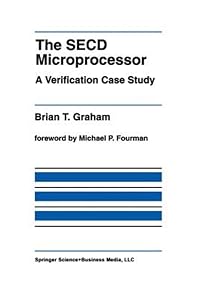
Buch. Condition: Neu. Neuware - This is a milestone in machine-assisted microprocessor verification. Gordon [20] and Hunt [32] led the way with their verifications of sim ple designs, Cohn [12, 13] followed this with the verification of parts of the VIPER microprocessor. This work illustrates how much these, and other, pioneers achieved in developing tractable models, scalable tools, and a robust methodology. A condensed review of previous re search, emphasising the behavioural model underlying this style of verification is followed by a careful, and remarkably readable, ac count of the SECD architecture, its formalisation, and a report on the organisation and execution of the automated correctness proof in HOL. This monograph reports on Graham's MSc project, demonstrat ing that - in the right hands - the tools and methodology for formal verification can (and therefore should ) now be applied by someone with little previous expertise in formal methods, to verify a non-trivial microprocessor in a limited timescale. This is not to belittle Graham's achievement; the production of this proof, work ing as Graham did from the previous literature, goes well beyond a typical MSc project. The achievement is that, with this exposition to hand, an engineer tackling the verification of similar microprocessor designs will have a clear view of the milestones that must be passed on the way, and of the methods to be applied to achieve them.…

- Softcover
Seller: Mispah books, Redhill, SURRE, United KingdomMispah books
Contact seller4-star sellerCondition: Used - As new
US$ 246.87
US$ 33.47 shippingShips from United Kingdom to U.S.A.Quantity: 1 available
Paperback. Condition: Like New. LIKE NEW. SHIPS FROM MULTIPLE LOCATIONS. book.
- Softcover
Seller: GreatBookPrices, Columbia, MD, U.S.A.GreatBookPrices
Contact seller5-star sellerCondition: Used - As new
US$ 277.69
US$ 2.64 shippingShips within U.S.A.Quantity: 15 available
Condition: As New. Unread book in perfect condition.

- Softcover
- Print on Demand
Seller: AHA-BUCH GmbH, Einbeck, GermanyAHA-BUCH GmbH
Contact seller5-star sellerCondition: New
US$ 143.50
US$ 39.05 shippingShips from Germany to U.S.A.Quantity: 1 available
Taschenbuch. Condition: Neu. nach der Bestellung gedruckt Neuware - Printed after ordering - This is a milestone in machine-assisted microprocessor verification. Gordon [20] and Hunt [32] led the way with their verifications of sim ple designs, Cohn [12, 13] followed this with the verification of parts of the VIPER microprocessor. This work illustrates how much these, and other, pioneers achieved in developing tractable models, scalable tools, and a robust methodology. A condensed review of previous re search, emphasising the behavioural model underlying this style of verification is followed by a careful, and remarkably readable, ac count of the SECD architecture, its formalisation, and a report on the organisation and execution of the automated correctness proof in HOL. This monograph reports on Graham's MSc project, demonstrat ing that - in the right hands - the tools and methodology for formal verification can (and therefore should ) now be applied by someone with little previous expertise in formal methods, to verify a non-trivial microprocessor in a limited timescale. This is not to belittle Graham's achievement; the production of this proof, work ing as Graham did from the previous literature, goes well beyond a typical MSc project. The achievement is that, with this exposition to hand, an engineer tackling the verification of similar microprocessor designs will have a clear view of the milestones that must be passed on the way, and of the methods to be applied to achieve them.…


