
Shape Content: First Edition (14 results)

Published by Harvard University Press 1957
- Hardcover
- First Edition
Seller: Dorothy Meyer - Bookseller, Batavia, IL, U.S.A.Dorothy Meyer - Bookseller
Contact seller4-star sellerCondition: Used - Very good
US$ 9.00
US$ 6.95 shippingShips within U.S.A.Quantity: 1 available
Hardcover. Condition: very good. Dust Jacket Condition: good. First Edition date same on title. NOT an ex library book. 131 pages. Dust jacket has 1/2" chips, 1" tear. Price is not clipped.
Published by Vintage Books 1960
- Softcover
- First Edition
Seller: Voyageur Book Shop, Milwaukee, WI, U.S.A.Voyageur Book Shop
Contact seller5-star sellerCondition: Used - Good
US$ 14.00
US$ 4.75 shippingShips within U.S.A.Quantity: 1 available
Soft cover. Condition: Good. First Paperback Printing. Light corner wear and soiling to the wraps, previous owner's name on the first and last pages. A9.
Published by Vintage Books v-108 (random House) 1957 verso, Cambridge 1957
- Softcover
- First Edition
Seller: WONDERFUL BOOKS BY MAIL, CHICO-CA, CA, U.S.A.WONDERFUL BOOKS BY MAIL
Contact seller5-star sellerCondition: Used - Very good
US$ 16.00
US$ 3.75 shippingShips within U.S.A.Quantity: 1 available
paperback. Condition: Very Good. First Edition Thus. VERY GOOD CONDITION PAPERBACK, clean, solid, bright.color red & blue art frontis. bit toning to edges of otherwise white paper cover. ; Red titles with black tiger cover art, all on white aper covers.; 152pg pages; . . .Questing Mind, Humaine Spirit. based on a series of Norto…n Lectures at Harvard l957-l958 by Ben Shahn. art, philosophy and history. "Most forceful stattemnt on art by an artist of out time". Illustrated by Shahn Line Drawings (34) (illustrator).
Published by Harvard Univ Press 1957
- Hardcover
- First Edition
Seller: Mark Henderson, Overland Park, KS, U.S.A.Mark Henderson
Contact seller4-star sellerCondition: Used - Good
US$ 14.97
US$ 5.95 shippingShips within U.S.A.Quantity: 1 available
Hardcover. Condition: Good. No Dust Jacket. 1st Edition. The book has underlining. Book.
Language: English
Published by Harvard University Press, Cambs, Mass 1957
- Hardcover
- First Edition
Seller: valley books, Holton, SUFFO, United Kingdomvalley books
Contact seller5-star sellerCondition: Used - Near fine
US$ 34.52
US$ 12.47 shippingShips from United Kingdom to U.S.A.Quantity: 1 available
Hardcover. Condition: Near Fine. Dust Jacket Condition: Good. 1st Edition. Dj has repaired closed tears in loose clear plastic protective werapper.Colour frontispiece with many line drawings.
Published by Harvard Univ Press, Cambridge, MA 1957
- Hardcover
- First Edition
Seller: Larry W Price Books, Portland, OR, U.S.A.Larry W Price Books
Contact seller5-star sellerCondition: Used - Very good
US$ 29.50
US$ 4.95 shippingShips within U.S.A.Quantity: 1 available
Hardcover. Condition: Very Good. 1st Edition. 131 pp.+ Color Illus Plt at Frontis, Red-Brn Hardback, spine sunned else VG, no DJ, 1st ed.
 More images
Published by Harvard University Press 1957
- Hardcover
- First Edition
Seller: curtis paul books, inc., Crestline, CA, U.S.A.curtis paul books, inc.
Contact seller5-star sellerCondition: Used - Very good
US$ 29.99
US$ 4.49 shippingShips within U.S.A.Quantity: 1 available
Hardcover. Condition: Very Good+. Dust Jacket Condition: Very Good-. First Edition. Original cloth. First edition. Color frontis. Occasional pencil underlining, some wear to spine ends. The DJ has some chips and short tears, slight damping to rear panel. ; 8vo 8" - 9" tall; 131 pages.
Published by Vintage/Random House, New York 1957
- Softcover
- First Edition
Seller: 32.1 Rare Books + Ephemera, IOBA, ESA, Princeton, NJ, U.S.A.32.1 Rare Books + Ephemera, IOBA, ESA
Contact seller4-star sellerCondition: Used - Near fine
US$ 35.00
US$ 5.50 shippingShips within U.S.A.Quantity: 1 available
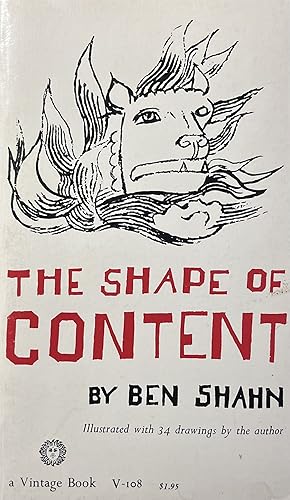
Softcover. Condition: Near Fine. First Edition. 12mo., 151 pp. Illustrated with 34 drawings by the author. Eleanor Hazard [illustrator]. First Vintage edition, based on a series of lectures delivered by Ben Shahn. Considered a classic in the field of art, philosophy and history. Illustrations by the author. Near Fine in illustra…ted wraps.

Published by Harvard University Press, Cambridge 1957
- Hardcover
- First Edition
Seller: Kenneth Mallory Bookseller ABAA, Decatur, GA, U.S.A.Kenneth Mallory Bookseller ABAA
Contact seller5-star sellerCondition: Used - Very good
US$ 50.00
US$ 5.99 shippingShips within U.S.A.Quantity: 1 available
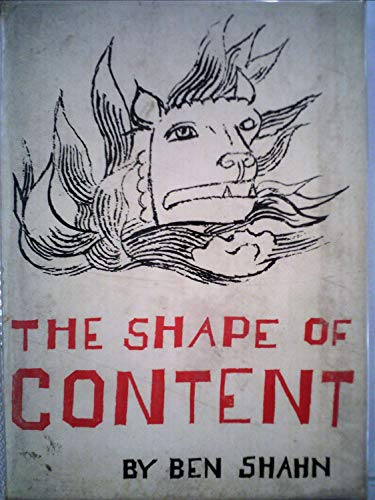
Hardcover. Condition: Very good. Hardcover. First Edition. 131pp. Pages tanned, else a very good hardback in a darkened and rubbed jacket that has a half inch wide and deep chip to the top of the rear panel.
Language: English
Published by Harvard University Press, Cambridge, MA 1957
Series: The Charles Eliot Norton Lectures, Book 3 of 10. Book 3 of 10 - The Charles Eliot Norton Lectures
- Hardcover
- First Edition
Seller: Ground Zero Books, Ltd., Silver Spring, MD, U.S.A.Ground Zero Books, Ltd.
Contact seller5-star sellerCondition: Used - Good
US$ 100.00
US$ 5.00 shippingShips within U.S.A.Quantity: 1 available
Hardcover. Condition: Good. Dust Jacket Condition: fair. Presumed first edition/first printing. Sewn binding. Cloth over boards. [8], 131, [1] pages. Color frontis (Allegory). Illustrations. This work is made up of the author's Charles Eliot Norton Lectures. DJ worn, torn, soiled, and chipped. Minor page soiling noted. From Wiki…pedia: "Ben Shahn (September 12, 1898 March 14, 1969) was a Lithuanian-born American artist. He is best known for his works of social realism, his left-wing political views, and his series of lectures published as The Shape of Content. Shahn mixed different genres of art. Shahn used both expressive and precise visual languages, which he coalesced through the consistency of his authoritative line. His background in lithography contributed to his detail-oriented look, Shahn is also noted for his use of unique symbolism. While Shahn's "love for exactitude" is apparent in his graphics, so too is his creativity. Evocative juxtapositions characterize his aesthetic. He intentionally paired contrasting scales, colors, and images together to create tension. His art is striking but also introspective. He often captured figures engrossed in their own worlds. Although he used many mediums, his pieces are consistently thoughtful and playful." "Mr. Shahn sets forth his views on both the practice and the purposes of art with a clarity, cogency, and incisiveness that any professional writer might envy, and he manages to interweave with this a good deal of interesting material about his own development as an artist, as well as a running summary of his opinions on contemporary painting in general? The book is highly controversial?also highly stimulating."-The New Yorker"The book is the clearest, most forceful statement on art by an artist of our time that I have read."-Frank Getletin, The New Republic"A remarkably interesting book, which puts the reader in rewarding contact with a questing mind and a humane spirit."-The Atlantic"To find a lucid painter speaking lucidly of art is a thrilling discovery? [He traces] the formation of painting from idea to completion, both generally and specifically with a clarity of thought and a precise use of language which should be a very archetypal model for all critics and painters alike."-Virginia Quarterly Review"In this brilliant book, which brings the many talents of Ben Shahn?into one crisp, clear, unified, astounding career, the primary focus is the exploration and explanation of the relationship between Shahn's paintings and photographs? The first half of the book consists of four exquisitely written essays by Kao, Katzman, and Webster, beautifully illustrated with superb reproductions of Shahn's photographs and related materials, including detailed notes. The second half is an exhibition catalog with a wealth of quality reproductions of his paintings and photographs."-J. Natal, Choice.

Published by Vintage Books, New York 1957
- Softcover
- First Edition
Seller: Rare Book Cellar, Pomona, NY, U.S.A.Rare Book Cellar
Contact seller5-star sellerSoftcover. First Edition; First Printing. Very Good in wraps. Toning on text block edges. Crease on front panel. Toning on rear panel. ; 8vo 8" - 9" tall.
 More images
Published by Harvard University Press 1957
- Hardcover
- First Edition
Seller: Braintree Book Rack, Cohasset, MA, U.S.A.Braintree Book Rack
Contact seller4-star sellerCondition: Used - Very good
US$ 59.99
US$ 5.99 shippingShips within U.S.A.Quantity: 1 available
Hardcover. Condition: Very Good. Dust Jacket Condition: Very Good. First Edition. Color frontis. A clean solid copy in very good condition; the jacket has some rubbing and a bit of edgewear, but looks nice in it's clear, protective wrapper.
Published by Harvard University Press 1957
- Hardcover
- First Edition
Seller: Moe's Books, Berkeley, CA, U.S.A.Moe's Books
Contact seller4-star sellerCondition: Used - Very good
US$ 60.00
US$ 6.50 shippingShips within U.S.A.Quantity: 1 available
Hard cover. Condition: Very good. Dust Jacket Condition: Poor. Jacket rubbed and heavily worn with notable chipping and tearing along edges. Cloth covers clean, clean and crisp throughout inside.
 More images
Published by London 1738
- First Edition
- Signed
Seller: SOPHIA RARE BOOKS, Koebenhavn V, , DenmarkSOPHIA RARE BOOKS
Contact seller4-star sellerCondition: Used
US$ 12,500.00
Free ShippingShips from Denmark to U.S.A.Quantity: 1 available
First edition. On the Figure of the Earth: The Lapland and Peru Expeditions. An autograph letter signed by John Machin (c. 1686-1751), Secretary of the Royal Society and Professor of Astronomy at Gresham College, four pages on a bifolium, written from Gresham College on 22 June 1738 to the Scottish mathematician James Stirling a…t Leadhills - descended in the Stirling family at Garden House, Stirlingshire, until the dispersal at Lyon & Turnbull, Edinburgh, on 23 October 2025 in the sale entitled The Library of James Stirling, Mathematician. The letter belongs to the closing weeks of one of the most consequential empirical episodes in eighteenth-century natural philosophy: the testing, by direct geodetic measurement at high and low latitudes, of Newton's prediction in the Principia that the rotation of the Earth must give it the figure of an oblate ellipsoid of revolution. Machin had served Newton on the 1712 Royal Society commission that adjudicated the calculus priority dispute against Leibniz; he had been appointed to the Gresham chair on Newton's recommendation in 1713; and he occupied the office of Secretary of the Royal Society from 1718 until 1747, the seat from which Newton had directed the Society in the priority decade. Stirling, sixteen years younger, had been elected on Newton's personal nomination on 3 November 1726, four months before Newton's death, and was at the time of the present letter the leading British exponent of Newton's theory of the figure of the Earth. The letter is the documentary inside of the moment at which the Lapland expedition's data first reached London and at which Stirling, alone among British mathematicians, possessed an unpublished demonstration that the figure could only be the rotational ellipsoid Newton had supposed. The full text was first printed by Charles Tweedie in his James Stirling: A Sketch of His Life and Works along with His Scientific Correspondence (Oxford: Clarendon Press, 1922), where it occupies chapter IX and pp. 161-164. John Machin took his Gresham chair in May 1713 with a testimonial from Newton describing him as "studious, sober, and learned in the Latin tongue, and in Mathematics a great Master" (Correspondence of Isaac Newton, ed. Turnbull, vol. V, p. 408). His most famous published result - Machin's formula for ?, ?/4 = 4 arctan(1/5) ? arctan(1/239), with which he had calculated ? to one hundred decimal places in 1706 - appeared in William Jones's Synopsis Palmariorum Matheseos in the same year and gave him a quiet but durable reputation among Continental mathematicians. He served on the 1712 Royal Society commission together with Halley, Arbuthnot, Jones, and others, in the proceedings that issued the Commercium Epistolicum for Newton against Leibniz. As Secretary of the Royal Society from 1718, he was the channel through which Newton's mathematical correspondence with British and Continental colleagues passed in the last decade of his life; in 1722 he saw Newton's own revised edition of Arithmetica Universalis through the press, an undertaking for which Conduitt later reported Newton had intended a hundred-guinea fee but never paid it. After Newton's death Machin's mathematical work concentrated on lunar theory; his short tract The Laws of the Moon's Motion according to Gravity was attached to Andrew Motte's 1729 English Principia, and a longer manuscript of the same subject he was at the time of the present letter still hastening to complete. He died at Gresham College on 9 June 1751. James Stirling, by 1738, had been a decade away from the London mathematical scene. After his election to the Royal Society in 1726 and his joint authorship with de Moivre of the asymptotic formula for the factorial that bears his name - published in his Methodus Differentialis of 1730 - Stirling had quitted his teaching post at Watts's Academy and accepted, in 1735, the management of the Scots Mining Company's lead mines at Leadhills in Lanarkshire. The decision answered a Jacobite's difficulty - Stirling had lost his Balliol scholarships in 1715 for refusing the oath of allegiance, and his subsequent Italian exile had lasted until 1722 - with practical advancement, but it cost him much of the leisure he had previously devoted to mathematics. From Leadhills he kept up a Continental correspondence with Cramer at Geneva and with Euler at St Petersburg, and a domestic one with Maclaurin at Edinburgh and Machin at Gresham; by 1738 the letters from London were the principal current of mathematical news he had access to. The remoteness of the Stirling correspondent of the present letter is the unstated background of Machin's opening apology for his own slowness to write back: "Sure I am in the case of Endymion!" the senior man writes, glossing his year-long silence as a fairytale sleep. The technical centre of the letter is the figure-of-the-Earth controversy. Newton had argued in Principia Book III, Proposition XIX, that a homogeneous fluid Earth rotating once daily on its axis must take the form of an oblate spheroid - flattened at the poles, bulged at the equator - with a polar diameter shorter than the equatorial by about one part in 230. The pendulum data Richer had reported from Cayenne in 1672 and Halley from St Helena in 1677 had been broadly consistent with the prediction, in that gravity was found to be lower at the equator and a pendulum of fixed length to swing more slowly. But the geodetic measurement Jacques Cassini had reported in his De la grandeur et de la figure de la terre (Paris, 1720) gave the contrary result: that successive degrees of the meridian shortened toward the pole, implying a prolate Earth elongated along the axis of rotation. Cassini's measurement reached only from Dunkerque to Collioure; the Académie des Sciences accordingly determined to send two expeditions to extreme latitudes, one to Lapland under Maupertuis and the other to Peru under Bouguer and La Condamine, and to compare the lengths of a degree of meridian near the Arc. Signed.


