

Order Total (1 Item Items):
Shipping Destination:

Situation Normal, Signed (8 results)
Skip to main search results
Search filters
Product Type
- All Product Types
- Books (8)
- Magazines & Periodicals (No further results match this refinement)
- Comics (No further results match this refinement)
- Sheet Music (No further results match this refinement)
- Art, Prints & Posters (No further results match this refinement)
- Photographs (No further results match this refinement)
- Maps (No further results match this refinement)
- Manuscripts & Paper Collectibles (No further results match this refinement)
Condition Learn more
- New (No further results match this refinement)
- As New, Fine or Near Fine (1)
- Very Good or Good (3)
- Fair or Poor (No further results match this refinement)
- As Described (4)
Binding
- All Bindings
- Hardcover (5)
- Softcover (No further results match this refinement)
Collectible Attributes
Language (1)
Price
- Any Price
- Under US$ 25 (No further results match this refinement)
- US$ 25 to US$ 50 (No further results match this refinement)
- Over US$ 50
Free Shipping
- Free Shipping to U.S.A. (No further results match this refinement)
Seller Location
Seller Rating
-
Situation Normal
Published by New York: Reynal & Hitchcock, 1944
Seller: North Star Rare Books & Manuscripts, Sheffield, MA, U.S.A.
Seller rating 5 out of 5 stars

First Edition Signed
Hardcover. Condition: Near Fine. 1st Edition. Octavo, yellow cloth lettered in red and black; bookplate; unclipped pictorial dust jacket, with slight edge-wear to extremities, reinforced on verso. First edition of Miller's first book, with material gathered for the film production of "GI Joe." A handsome copy signed by Miller on the title page. Signed by Author(s).
-
Situation Normal.
Published by Reynal and Hitchcock, New York, 1944
Seller: Between the Covers-Rare Books, Inc. ABAA, Gloucester City, NJ, U.S.A.
Association Member: ABAA ESA ILAB IOBA
Seller rating 5 out of 5 stars
First Edition Signed
Hardcover. Condition: Very Good. First edition. Octavo. 179pp. Modest soil, wear at the spine ends and corners, very good, lacking the dust jacket. Signed by Miller on the front fly. His first book.
-
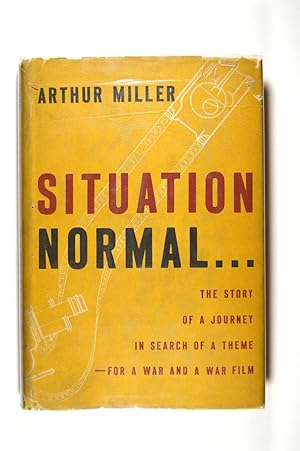
SITUATION NORMAL . [Signed]
Published by Reynal & Hitchcock, New York, NY, 1944
Seller: Second Story Books, ABAA, Rockville, MD, U.S.A.
Seller rating 4 out of 5 stars

First Edition Signed
Hardcover. First Edition, First Printing. Octavo, 179 pages. In Good plus condition. Yellow spine with black and red lettering. boards have mild shelving wear, stains throughout, bending wear along the spine head and tail edges, and light fraying along the fore corners and spine head and tail edges. Textblock has splitting to gutter from the title page to page 179, stains on the front end-page, pencil marks on the front pastedown, mild wear along the edges, and moderate age-toning along the edges. Signed flat by Arthur Miller on the title page. Shelved Room C. 1392111. Special Collections.
-

Situation Normal.
Published by Reynal & Hitchcock, New York, 1944
Seller: Jeffrey H. Marks, Rare Books, ABAA, Rochester, NY, U.S.A.
Seller rating 5 out of 5 stars
First Edition Signed
179 pp. 8vo, publisher's lettered cloth in dust jacket. First edition. A bright copy with a little use to the extremities of the spine and the rear panel; in a dust-soiled jacket with a few small chips. Signed by Arthur Miller on the title page. Author's first book.
-
SITUATION NORMAL
Published by Reynal & Hitchcock, NY, 1944
Seller: REVERE BOOKS, abaa/ilab & ioba, Fernandina Beach, FL, U.S.A.
Association Member: ABAA ILAB IOBA
Seller rating 5 out of 5 stars
First Edition Signed
Hardcovers. Condition: Very Good. Dust Jacket Condition: Good. First Edition. First edition, first prnt. Signed by Miller on the title page. Chipped dustjacket. Very Good condition in a Good dustjacket with an archival cover. Miller's first book describing his experiences researching the war correspondence of Ernie Pyle in preparation for a film script. Signed by Author(s).
-
![Seller image for Situation Normal. [Signed] for sale by Capitol Hill Books, ABAA](https://pictures.abebooks.com/inventory/md/md31372551961.jpg)
Situation Normal. [Signed]
Published by Reynal & Hitchcock, New York, 1944
Seller: Capitol Hill Books, ABAA, Washington, DC, U.S.A.
Seller rating 5 out of 5 stars
First Edition Signed
Condition: Very Good. Dust Jacket Condition: Very Good. New York: Reynal & Hitchcock, 1944. First Edition. Signed by Arthur Miller at title page without inscription. Octavo. 179 pp. Illustrated dust jacket with $2.00 price present. Yellow boards stamped in black and red. Dust jacket chipped along edges with general soiling and smudging and tape mending to verso. Boards lightly worn along edges, corners bumped, mild soiling to edges and patch of red discoloration to top of spine. Binding is sound and pages unmarked. Miller's first book, the story of his research into Ernie Pyle's war-time correspondence to help with the production of William Wellman's 1945 film, The Story of G.I. Joe.
-
Situation Normal. (Signed First Edition)
Published by Reynal and Hitchcock, New York, 1944
Seller: Royal Books, Inc., ABAA, Baltimore, MD, U.S.A.
Seller rating 5 out of 5 stars
First Edition Signed
Dust Jacket Condition: dj. First Edition. First Edition. SIGNED by the author on the title page. Arthur Miller was tasked with compiling information about the writing of Pulitzer Prize-winning World War II correspondent Ernie Pyle and the wartime experiences of American infantrymen for director William A. Wellman's 1945 adaptation "The Story of G.I. Joe," although Miller's work would ultimately go unused for the film. Near Fine in an about Near Fine dust jacket. A couple of tiny splashes on the top right corner of the front board. Jacket lightly toned on the spine panel, with a few faint scuffs on the front and rear panels. Signed.
-
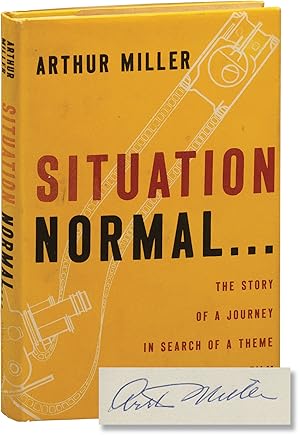
Situation Normal. [Signed, With 7-Page Typescript]
Published by Reynal and Hitchcock, New York, 1944
Seller: Lorne Bair Rare Books, ABAA, Winchester, VA, U.S.A.
Association Member: ABAA ILAB IOBA
Seller rating 5 out of 5 stars
First Edition Signed
Dust Jacket Condition: dj. First Edition. First Printing. Octavo (21.25cm); yellow cloth, with titles stamped in black and red on spine and front cover; dustjacket; [x],179,[3]pp. Signed by Miller in blue ball-point pen on the title page. Spine ends gently nudged, some trivial wear to lower board edges, with a hint of sunning to upper board edges, and a faint, shallow stain to lower edge of rear cover; Near Fine. Dustjacket is unclipped (priced $2.00), with two tiny tears at crown, and a faint vertical crease along left joint; a bright, very Near Fine example. Laid into this copy is an untitled seven-page carbon typescript on onionskin (8" x 10.5"), written by Miller in 1943, relating details about the book's conception; horizontal fold at center, staple holes at upper left corner, with two neat punctures along left margin; Very Good+. Attractive copy of the Pulitzer Prize-winning playwright's first book, based on his experiences researching the war correspondence of journalist Ernie Pyle. The title derives from the widely-used military acronym slang "SNAFU" (Situation Normal: All Fucked Up), which translates to a bad situation that is a normal state of affairs. Miller was tasked by Hollywood to gather material for "an honest movie" about American GI's during the war, about their training, daily life, their hopes, dreams, and why they are fighting. Miller visited several Army camps, training, living, and interviewing soldiers and taking down the unvarnished truth of his discoveries. "I was the person fate picked out of Brooklyn to go among the soldiers and pick up enough facts, honest-to-God true facts, to make a soldier picture which soldiers could sit through until the end without once laughing in derision. A picture that would properly end all soldier pictures" (p.1). The film in question was William A. Wellman's The Story of G.I. Joe, to be adapted by Miller for Lester Cowan from Pyle's 1943 book This Is Your War. Miller's version was ultimatley not produced, likely due to ideological differences and his leftist political leanings. The typescript, written the year before Situation Normal was published, summarizes the conception of the book, detailing his early meetings with Ernie Pyle over how his work would be translated into film, and what they wanted to accomplish. "I bring up the idea that it would be a shame to show this massive canvas without reducing what is chaos to at least an inkling of purpose and order, and of course he agrees. But we both feel that to lard on ideology where there is no ideology would be to wrap the truth. You can't have soldiers talking about four freedoms when all they want is to go home. Myself I curse the press and the million textbooks that turn out the billions of words and never add up to an excuse for dying" (typescript, p.5). A superlative copy of an important debut. Signed.


![Seller image for SITUATION NORMAL . [Signed] for sale by Second Story Books, ABAA](https://pictures.abebooks.com/inventory/md/md32120362946.jpg)


![Seller image for Situation Normal. [Signed, With 7-Page Typescript] for sale by Lorne Bair Rare Books, ABAA](https://pictures.abebooks.com/inventory/md/md31503454220.jpg)