
Order Total (1 Item Items):
Shipping Destination:

Statistical Inductive Inference Minimum Message by Wallace C S (34 results)
Skip to main search results
Search filters
Product Type
- All Product Types
- Books (34)
- Magazines & Periodicals (No further results match this refinement)
- Comics (No further results match this refinement)
- Sheet Music (No further results match this refinement)
- Art, Prints & Posters (No further results match this refinement)
- Photographs (No further results match this refinement)
- Maps (No further results match this refinement)
- Manuscripts & Paper Collectibles (No further results match this refinement)
Condition Learn more
- New (29)
- As New, Fine or Near Fine (3)
- Very Good or Good (1)
- Fair or Poor (No further results match this refinement)
- As Described (1)
Binding
Collectible Attributes
- First Edition (No further results match this refinement)
- Signed (No further results match this refinement)
- Dust Jacket (No further results match this refinement)
- Seller-Supplied Images (13)
- Not Print on Demand (30)
Language (2)
Free Shipping
Seller Location
Seller Rating
-

Condition: Brand New. New. US edition. Expediting shipping for all USA and Europe orders excluding PO Box. Excellent Customer Service.
-
Condition: New. This is a Brand-new US Edition. This Item may be shipped from US or any other country as we have multiple locations worldwide.
-
Condition: New. Brand New Original US Edition. Customer service! Satisfaction Guaranteed.
-
Brand new book. Fast ship. Please provide full street address as we are not able to ship to P O box address.
-
Brand new book. Fast ship. Please provide full street address as we are not able to ship to P O box address.
-

Hardcover. Slight sunning to top edge of front cover and spine, otherwise very good condition. No dustjacket. Part of the Springer Information Science & Statistics series. 429pp. ISBN-10 038723795X ISBN-13: ISBN-13: 9780387237954.
-
 International Edition
Condition: New. Brand New! Fast Delivery This is an International Edition and ship within 24-48 hours. Deliver by FedEx and Dhl, & Aramex, UPS, & USPS and we do accept APO and PO BOX Addresses. Order can be delivered worldwide within 7-12 days and we do have flat rate for up to 2LB. Extra shipping charges will be requested if the Book weight is more than 5 LB. This Item May be shipped from India, United states & United Kingdom. Depending on your location and availability.
-
Condition: Brand New. New. US edition. Expediting shipping for all USA and Europe orders excluding PO Box. Excellent Customer Service.
-
Condition: New. This is a Brand-new US Edition. This Item may be shipped from US or any other country as we have multiple locations worldwide.
-
Condition: New. Brand New Original US Edition. Customer service! Satisfaction Guaranteed.
-
Condition: New. This is a Brand-new US Edition. This Item may be shipped from US or any other country as we have multiple locations worldwide.
-
Brand new book. Fast ship. Please provide full street address as we are not able to ship to P O box address.
-
Brand new book. Fast ship. Please provide full street address as we are not able to ship to P O box address.
-

-
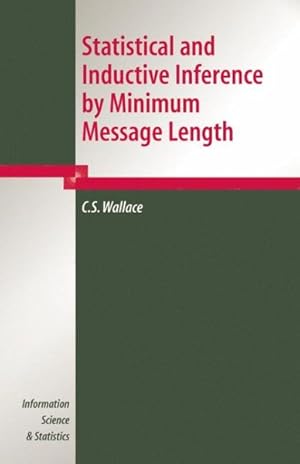
Statistical and Inductive Inference by Minimum Message Length (Information Science and Statistics)
Book 3 of 20: Information Science and StatisticsSeller: Ria Christie Collections, Uxbridge, United Kingdom
Seller rating 5 out of 5 stars

US$ 147.03
US$ 16.35 shipping
Ships from United Kingdom to U.S.A.Quantity: Over 20 available
Add to basketCondition: New. In.
-
-
-
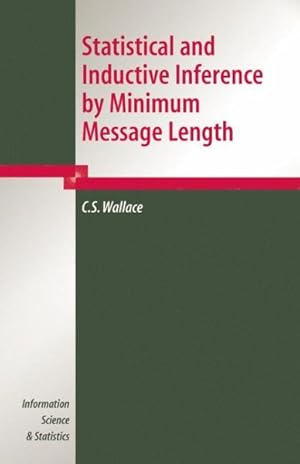
Statistical and Inductive Inference by Minimum Message Length (Information Science and Statistics)
Book 3 of 20: Information Science and StatisticsSeller: Ria Christie Collections, Uxbridge, United Kingdom
Seller rating 5 out of 5 stars
US$ 189.19
US$ 16.35 shipping
Ships from United Kingdom to U.S.A.Quantity: Over 20 available
Add to basketCondition: New. In.
-
-
Condition: As New. Unread book in perfect condition.
-
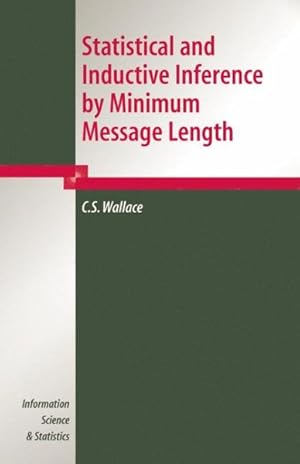
Statistical And Inductive Inference By Minimum Message Length
Book 3 of 20: Information Science and StatisticsSeller: GreatBookPricesUK, Woodford Green, United Kingdom
Seller rating 5 out of 5 stars
US$ 190.56
US$ 20.47 shipping
Ships from United Kingdom to U.S.A.Quantity: Over 20 available
Add to basketCondition: New.
-
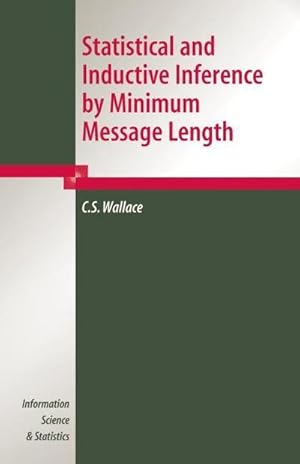
Taschenbuch. Condition: Neu. Druck auf Anfrage Neuware - Printed after ordering - Mythanksareduetothemanypeoplewhohaveassistedintheworkreported here and in the preparation of this book. The work is incomplete and this account of it rougher than it might be. Such virtues as it has owe much to others; the faults are all mine. MyworkleadingtothisbookbeganwhenDavidBoultonandIattempted to develop a method for intrinsic classi cation. Given data on a sample from some population, we aimed to discover whether the population should be considered to be a mixture of di erent types, classes or species of thing, and, if so, how many classes were present, what each class looked like, and which things in the sample belonged to which class. I saw the problem as one of Bayesian inference, but with prior probability densities replaced by discrete probabilities re ecting the precision to which the data would allow parameters to be estimated. Boulton, however, proposed that a classi cation of the sample was a way of brie y encoding the data: once each class was described and each thing assigned to a class, the data for a thing would be partially implied by the characteristics of its class, and hence require little further description. After some weeks' arguing our cases, we decided on the maths for each approach, and soon discovered they gave essentially the same results. Without Boulton's insight, we may never have made the connection between inference and brief encoding, which is the heart of this work.
-
Statistical and Inductive Inference by Minimum Message Length (Information Science and Statistics)
Book 3 of 20: Information Science and StatisticsUS$ 207.99
US$ 34.11 shipping
Ships from United Kingdom to U.S.A.Quantity: 1 available
Add to basketPaperback. Condition: Like New. Like New. book.
-
Statistical And Inductive Inference By Minimum Message Length
Book 3 of 20: Information Science and StatisticsSeller: GreatBookPricesUK, Woodford Green, United Kingdom
Seller rating 5 out of 5 stars
US$ 213.94
US$ 20.47 shipping
Ships from United Kingdom to U.S.A.Quantity: Over 20 available
Add to basketCondition: As New. Unread book in perfect condition.
-
International Edition
Hardcover. Condition: New. Brand New! Fast Delivery This is an International Edition and ship within 24-48 hours. Deliver by FedEx and Dhl, & Aramex, UPS, & USPS and we do accept APO and PO BOX Addresses. Order can be delivered worldwide within 7-12 days and we do have flat rate for up to 2LB. Extra shipping charges will be requested if the Book weight is more than 5 LB. This Item May be shipped from India, United states & United Kingdom. Depending on your location and availability.
-

Statistical and Inductive Inference by Minimum Message Length
Book 3 of 20: Information Science and StatisticsLanguage: English
Published by Springer-Verlag New York Inc., US, 2005
ISBN 10: 038723795X ISBN 13: 9780387237954
Seller: Rarewaves.com USA, London, LONDO, United Kingdom
Seller rating 5 out of 5 stars
US$ 242.01
Free Shipping
Ships from United Kingdom to U.S.A.Quantity: Over 20 available
Add to basketHardback. Condition: New. 2005 ed. The Minimum Message Length (MML) Principle is an information-theoretic approach to induction, hypothesis testing, model selection, and statistical inference. MML, which provides a formal specification for the implementation of Occam's Razor, asserts that the ?best? explanation of observed data is the shortest. Further, an explanation is acceptable (i.e. the induction is justified) only if the explanation is shorter than the original data.This book gives a sound introduction to the Minimum Message Length Principle and its applications, provides the theoretical arguments for the adoption of the principle, and shows the development of certain approximations that assist its practical application. MML appears also to provide both a normative and a descriptive basis for inductive reasoning generally, and scientific induction in particular. The book describes this basis and aims to show its relevance to the Philosophy of Science.Statistical and Inductive Inference by Minimum Message Length will be of special interest to graduate students and researchers in Machine Learning and Data Mining, scientists and analysts in various disciplines wishing to make use of computer techniques for hypothesis discovery, statisticians and econometricians interested in the underlying theory of their discipline, and persons interested in the Philosophy of Science.The book could also be used in a graduate-level course in Machine Learning and Estimation and Model-selection, Econometrics and Data Mining.C.S. Wallace was appointed Foundation Chair of Computer Science at Monash University in 1968, at the age of 35, where he worked until his death in 2004. He received an ACM Fellowship in 1995, and was appointed Professor Emeritus in 1996. Professor Wallace made numerous significant contributions to diverse areas of Computer Science, such as Computer Architecture, Simulation and Machine Learning. His final research focused primarily on the Minimum Message Length Principle.
-
Statistical and Inductive Inference by Minimum Message Length
Book 3 of 20: Information Science and StatisticsUS$ 212.77
US$ 57.81 shipping
Ships from Germany to U.S.A.Quantity: Over 20 available
Add to basketCondition: New. Since 1965, Professor Wallace and others have been developing an approach tostatistical estimation, hypothesis testing, model selection and their applications in the Artificial Intelligence field of Machine LearningMythanksareduetothemanypeoplewh.
-

Statistical and Inductive Inference by Minimum Message Length
Book 3 of 20: Information Science and StatisticsLanguage: English
Published by Springer-Verlag New York Inc., US, 2005
ISBN 10: 038723795X ISBN 13: 9780387237954
US$ 233.00
US$ 88.69 shipping
Ships from United Kingdom to U.S.A.Quantity: Over 20 available
Add to basketHardback. Condition: New. 2005 ed. The Minimum Message Length (MML) Principle is an information-theoretic approach to induction, hypothesis testing, model selection, and statistical inference. MML, which provides a formal specification for the implementation of Occam's Razor, asserts that the ?best? explanation of observed data is the shortest. Further, an explanation is acceptable (i.e. the induction is justified) only if the explanation is shorter than the original data.This book gives a sound introduction to the Minimum Message Length Principle and its applications, provides the theoretical arguments for the adoption of the principle, and shows the development of certain approximations that assist its practical application. MML appears also to provide both a normative and a descriptive basis for inductive reasoning generally, and scientific induction in particular. The book describes this basis and aims to show its relevance to the Philosophy of Science.Statistical and Inductive Inference by Minimum Message Length will be of special interest to graduate students and researchers in Machine Learning and Data Mining, scientists and analysts in various disciplines wishing to make use of computer techniques for hypothesis discovery, statisticians and econometricians interested in the underlying theory of their discipline, and persons interested in the Philosophy of Science.The book could also be used in a graduate-level course in Machine Learning and Estimation and Model-selection, Econometrics and Data Mining.C.S. Wallace was appointed Foundation Chair of Computer Science at Monash University in 1968, at the age of 35, where he worked until his death in 2004. He received an ACM Fellowship in 1995, and was appointed Professor Emeritus in 1996. Professor Wallace made numerous significant contributions to diverse areas of Computer Science, such as Computer Architecture, Simulation and Machine Learning. His final research focused primarily on the Minimum Message Length Principle.
-

Statistical and Inductive Inference by Minimum Message Length
Book 3 of 20: Information Science and StatisticsLanguage: English
Published by Springer New York Mai 2005, 2005
ISBN 10: 038723795X ISBN 13: 9780387237954
Buch. Condition: Neu. Neuware - Mythanksareduetothemanypeoplewhohaveassistedintheworkreported here and in the preparation of this book. The work is incomplete and this account of it rougher than it might be. Such virtues as it has owe much to others; the faults are all mine. MyworkleadingtothisbookbeganwhenDavidBoultonandIattempted to develop a method for intrinsic classi cation. Given data on a sample from some population, we aimed to discover whether the population should be considered to be a mixture of di erent types, classes or species of thing, and, if so, how many classes were present, what each class looked like, and which things in the sample belonged to which class. I saw the problem as one of Bayesian inference, but with prior probability densities replaced by discrete probabilities re ecting the precision to which the data would allow parameters to be estimated. Boulton, however, proposed that a classi cation of the sample was a way of brie y encoding the data: once each class was described and each thing assigned to a class, the data for a thing would be partially implied by the characteristics of its class, and hence require little further description. After some weeks' arguing our cases, we decided on the maths for each approach, and soon discovered they gave essentially the same results. Without Boulton's insight, we may never have made the connection between inference and brief encoding, which is the heart of this work.
-

Statistical and Inductive Inference by Minimum Message Length (Information Science and Statistics)
Published by Springer, 2005
ISBN 10: 0071457453 ISBN 13: 9780071457453
Hardcover. Condition: Good. Connecting readers with great books since 1972! Used textbooks may not include companion materials such as access codes, etc. May have some wear or writing/highlighting. We ship orders daily and Customer Service is our top priority!


