Order Total (1 Item Items):
Shipping Destination:

Steamship Leviathan (4 results)
Skip to main search results
Search filters
Product Type
- All Product Types
- Books (2)
- Magazines & Periodicals (No further results match this refinement)
- Comics (No further results match this refinement)
- Sheet Music (No further results match this refinement)
- Art, Prints & Posters (1)
- Photographs (No further results match this refinement)
- Maps (No further results match this refinement)
- Manuscripts & Paper Collectibles (1)
Condition Learn more
- New (No further results match this refinement)
- As New, Fine or Near Fine (1)
- Very Good or Good (3)
- Fair or Poor (No further results match this refinement)
- As Described (No further results match this refinement)
Binding
- All Bindings
- Hardcover (No further results match this refinement)
- Softcover (2)
Collectible Attributes
- First Edition (1)
- Signed (No further results match this refinement)
- Dust Jacket (No further results match this refinement)
- Seller-Supplied Images (4)
- Not Print on Demand (4)
Language (1)
Free Shipping
Seller Location
Seller Rating
-
Ansichtskarte / Postkarte Dampfschiff SS Leviathan, United States Lines, USL, Steamship
Manuscript / Paper Collectible
Condition: guter Zustand. Zustand siehe Scan, ungelaufen - ca 14 cm X 9 cm.
-
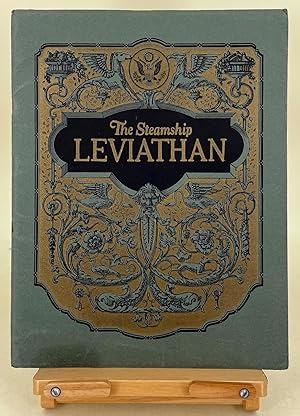
The Steamship Leviathan
Published by United States Lines managing operators for U.S, Shipping Board
Seller: Leakey's Bookshop Ltd., Inverness, United Kingdom
Seller rating 5 out of 5 stars

First Edition
US$ 61.33
US$ 25.61 shipping
Ships from United Kingdom to U.S.A.Quantity: 1 available
Add to basketSoft cover. Condition: Near Fine. 1st Edition. No date. Large 8vo. Pp32. Photographic illustrations. Original card wraps, wire stapled. Staples rusty and partially perished. A fragile item, seldom seen.
-
THE STEAMSHIP LEVIATHAN
Published by United States Lines, managing operators for U.S. Shipping Board, New York, 1923
Seller: Aardvark Rare Books, EUGENE, OR, U.S.A.
Seller rating 5 out of 5 stars
Staplebound Pamphlet. Condition: Very Good. Stapled advertising pamphlet, 10.4 in. x 8 in, pp. 32. Illustrated with full-page black and white photographic illustrations of the luxuries awaiting the passengers on the ocean liner, and a two-page painting of the ship. Olive green cardpaper wraps with elaborate gilt and black design with gilt title to front, and gilt and black emblem of the "United States Lines" to rear. Edgewear with light creasing and thumbwear to corners. A couple light stains to rear cover. Small rust stains from staples on pp 16/17. This is the promotional brochure offering the history, elegance, and passenger details for the massive ocean liner Leviathan as it returns to private service as a prestigious ocean liner after World War I. Photo-illustrations show the on-board Ritz-Carlton Restaurant, the gardens, social hall, library, tea-room, smoking-room, the first two classes of staterooms, and more. The caption on the painting of the Leviathan (pp. 16/17) indicate the brochure was published before its return to passenger service in 1923. A list of United States Lines Offices and Agents is on page 32. "The ocean liner Leviathan was one of the largest and most popularly recognizable passenger ships on the Atlantic in the 1920s. Like all ocean liners, the ship was at once a complex and powerful machine as well as a socially stratified hotel catering to different travel budgets and expectations. As such, she required a large crew in order to operate successfully. On her first peacetime crossing after World War I, that crew numbered 1,100 men and women, and they worked to ensure a comfortable, safe, and rapid five-days voyage for the ship's 1,800 passengers. "The Leviathan was built as the Vaterland for Germany's Hamburg-American Line. The ship had crossed the Atlantic only seven times when war broke out in Europe in 1914. She was laid up for safekeeping at her pier in Hoboken, New Jersey, but when the United States entered World War I in 1917, the American government seized the Vaterland and converted her into a troopship. Renamed Leviathan on the suggestion of President Woodrow Wilson and operated by the navy, she carried 94,000 troops to France, one-sixth the total American deployment in Europe. From 1919 to 1922, she was again laid up in New York Harbor. After a complete reconditioning at Newport News, Virginia, she reentered commercial service as the flagship of the new United States Lines (in 1923), which operated her for the U.S. Shipping Board until 1929. Subsequently sold into private hands, the ship ran until 1934. High operating costs and low passenger numbers during the Depression led to the Leviathan being laid up in New York Harbor (again) until 1938, when she sailed to Scotland and was scrapped." (from The Smithsonian).
-

Group of large format wood-engravings of the Leviathan Steamship. First editions.
Published by London: The Illustrated London News, 1858
Seller: Wittenborn Art Books, San Francisco, CA, U.S.A.
Seller rating 4 out of 5 stars

Art / Print / Poster
Condition: Good. 3 Wood-engravings: 15.75 x 23 inches.