
Theory Decrease Velocity Moving Electrified by Bohr: First Edition (4 results)

Language: English
Published by London Taylor & Francis 1915
- First Edition
Seller: Antiquariat Gerhard Gruber, Heilbronn, , GermanyAntiquariat Gerhard Gruber
Contact seller4-star sellerCondition: Used
US$ 718.81
US$ 46.14 shippingShips from Germany to U.S.A.Quantity: 1 available
(22 x 14,5 cm). VIII, 824 S. Mit Abbildungen und 18 teils gefalteten Tafeln. Halbleinwandband der Zeit. Erste Ausgabe. - Bohr beschreibt hier die Kathodenstrahlexperimente von Franck und Hertz mit Hilfe seiner Theorie, besonders den Übergang vom Normalzustand des Atoms in einen anderen stationären Zustand. "Die berühmten Stoßexp…erimente von Franck und Hertz wurden von Bohr sofort als Bestätigung der Existenz diskreter Energieniveaus aufgefaßt" (Röseberg, Bohr). - Stempel auf Titel. Einband gering berieben, sonst sauber und gut erhalten. - DSB 2, 239; Röseberg, Bohr Nr. 16 und 17. - Der Band enthält weiter Arbeiten von J. J. Thomson, Rayleigh, Bragg, Rutherford, Soddy etc.
Language: English
Published by London Taylor & Francis 1913
- First Edition
Seller: Antiquariat Gerhard Gruber, Heilbronn, , GermanyAntiquariat Gerhard Gruber
Contact seller4-star sellerCondition: Used
US$ 1,006.34
US$ 46.14 shippingShips from Germany to U.S.A.Quantity: 1 available
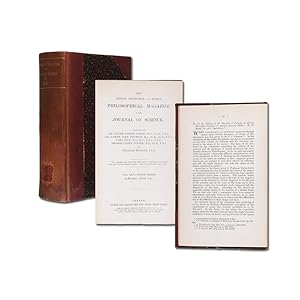
(22 x 14 cm). VIII, 876 S. Mit Abbildungen und 10 teils gefalteten Tafeln. Halbleinwandband der Zeit. Erste Ausgabe dieser Vorarbeit zu seiner berühmten Veröffentlichung "On the Constitution of Atoms and Molecules". Bohr analysiert hier die Wechselwirkung zwischen alpha-Teilchen und Elektronen und verbessert die von C. G. Darwin… aufgestellte Bremstheorie der alpha-Teilchen, die nun ausgezeichnet mit den empirischen Daten übereinstimmt. Der daraus ableitbare Zusammenhang zwischen optischen Größen, Bindungskräften und Anzahl der Elektronen ist dabei von besonderer Bedeutung. "In this paper the theory of the decrease of velocity of moving electrified particles in passing through matter is given in a form, such that the rate of the decrease in the velocity depends on the frequency of vibration of the electrons in the atoms of the absorbing material. Adopting Prof. Rutherford's theory of the constitution of atoms, it seems that it can be concluded with great certainty, from the absorption of alpha-rays, that a hydrogen atom contains only 1 electron outside the positively charged nucleus, and that a helium atom only contains 2 electrons outside the nucleus" (Conclusions). - Stempel auf Vorsatz. Rücken mit entferntem Label, sonst gut erhalten. - DSB 2, 239; Röseberg, Bohr Nr. 6. - Der Band enthält weiter Arbeiten von Rayleigh, Chadwick, Rutherford, Geiger, Bragg, Lodge etc.
 More images
- Softcover
- First Edition
Seller: Herman H. J. Lynge & Søn ILAB-ABF, Copenhagen, , DenmarkHerman H. J. Lynge & Søn ILAB-ABF
Contact seller4-star sellerCondition: Used
US$ 9,219.50
Free ShippingShips from Denmark to U.S.A.Quantity: 1 available
[London, Taylor & Francis], 1913. 8vo. Original printed wrappers. The fragile wrappers are detached, but fully intact. Merely tiny parts of the thin backstrip lacking. Three small tears to front wrapper, no loss, as well as a couple of creses. Back wrapper with a slight bend to the corner and minor fading to extremities. Pp. (9)…-31. Scarce first edition, off-print issue with presentation-inscription, of Bohr's seminal first work on nuclear physics, being the work that lays the foundation for his atomic theory (published before his "On the Constitution of Atoms and Molecules"), in which he is able to conclude "that a hydrogen atom contains only 1 electron outside the positively charged nucleus, and that a helium atom only contains 2 electrons outside the nucleus ." "Bohr's 1913 paper on alpha-particles [i.e. the present], which he had begun in Manchester, and which had led him to the question of atomic structure, marks the transition to his great work, also of 1913, on that same problem. While still in Manchester, he had already begun an early sketch of those entirely new ideas." (Pais, p. 128). The present work must be considered one of the most important to the birth of modern atomic theory.The work is inscribed to renowned Danish physicist and meteorologist Dan la Cour (1876-1942), son of the great Poul la Cour (1846-1908), who is considered the "Danish Edison". The inscription reads as thus: "Hr. Docent Afdelingschef D. la Cour/ med venlig Hilsen/ fra/ Forfatteren." [In Danish, i.e.: "Mr. Assistant Professor Head of Department D. la Cour/ with kind regards/ from/ the author."].Dan la Cour was the assistant of Niels Bohr's father, Christian Bohr, and a well known scientist. From 1903, he was head of the department of the Meteorological Institute, and from 1923 leader thereof. From 1908 he was Associate Professor at the Polytechnic College. His original scientific works are highly respected, as are his original apparati for measuring earth magnetism which are considered highly valuable. "His original intelligence, which in many ways resemble that of his father, also bore fruit in his patenting of various inventions: the "Pyknoprobe", developed to quickly determine the different layers of the sea" a use of termite in quickly heating food and drinks out in the open under unfavourable weather conditions." (From the Danish Encyclopaedia - own translation). He wrote a number of important and esteemed works and was member of the Danish Scientific Academy as well as many prominent international scientific commissions of meteorology and geophysics (i.e. president of the International Geodetical and Geophysical Union). He was also honorary Doctor at the George Washington University. After finishing his studies in Copenhagen, Bohr went to Cambridge in order to pursue his studies on electron theory under the guidance of J.J. Thompson. Thompson, who was beginning to lose interest in the subject by now, did, however, not recognize the genious of the young Bohr, and as soon as he could, Bohr went to Manchester, where Ernest Rutherford had established a laboratory. "There, from March to July 1912, working with utmost concentration, he [i.e. Bohr] laid the foundation for his greatest achievements in physics, the theory of the atomic constitution." (DSB). Bohr's survey of the implications of Rutherford's atomic model had led him to attack the much harder problem which lay at the core of it, namely determining the exact nature of the relation between the atomic number and the number of electrons in the atom. "Bohr obtained a much deeper insight into the problem by a brilliant piece of work, which he - working, as he said, "day and night" - completed with astonishing speed" (DSB), that paper being the present "On the Theory of the Decrease of Velocity of Moving electrified Particles on passing through Matter", which thus constitutes his very first publication on the subject, published immediately after this dense period of 1912, in the Philosop.
 More images
- Softcover
- First Edition
Seller: Herman H. J. Lynge & Søn ILAB-ABF, Copenhagen, , DenmarkHerman H. J. Lynge & Søn ILAB-ABF
Contact seller4-star sellerCondition: Used
US$ 1,589.57
Free ShippingShips from Denmark to U.S.A.Quantity: 1 available
London, Taylor & Francis, 1913. 8vo. Original printed wrappers" chipped, backstrip lacks. The whole issue. 200 pp., 2 plates. First edition of Bohr's first work on nuclear physics, published just before his 'On the Constitution of Atoms and Molecules'. During his visit to Manchester Bohr had the chance to get a first hand accoun…t of Rutherford's investigations on the penetration of alpha-particles through matter. In order to explain the large-angle scattering of alpha rays, which Rutherford had observed, he proposed his "nuclear" model of the atom in contrast to J.J. Thomson's "plum pudding" model in 1910. Bohr eagerly took up the new model and soon recognized its far-reaching implications. In particular, he pointed out that the nuclear model of the atom implied a sharp separation between the chemical properties, ascribed to the peripherical electrons, and the radioactive properties, which affected the nucleas itself. In this paper the theory of the decrease of velocity of moving electrified particles in passing through matter is given in a form, such that the rate of the decrease in the velocity depends on the frequency of vibration of the electrons in the atoms of the absorbing material. In the conclusion Bohr could state 'that a hydrogen atom contains only 1 electron outside the positively charged nucleas, and that a helium atom only contains 2 electrons outside the nucleas'.Rosenfeld, Bohr Bibliography No. 5. Rosenfeld, Dictionary of Scientific Biography II, pp. 240-41.


