
Time Cross: Signed (10 results)

Published by Ace 1956
- Softcover
- Signed
Seller: THE FINE BOOKS COMPANY / A.B.A.A / 1979, ROCHESTER, MI, U.S.A.THE FINE BOOKS COMPANY / A.B.A.A / 1979
Contact seller4-star sellerTHE CROSS ROADS OF TIME, Ace, (1956), just about fine full color pictorial wraps. Signed by the author. F-391.
 More images
- Hardcover
- First Edition
- Signed
Seller: Solvang Book Company, Lompoc, CA, U.S.A.Solvang Book Company
Contact seller5-star sellerCondition: Used - Very good
US$ 250.00
US$ 6.25 shippingShips within U.S.A.Quantity: 1 available
Hardcover. Condition: Very Good. 1st Edition. Inch and a half abrasion to fore-edge of rear board at the foot. Light soil to head and fore-edge of text block, spine lightly faded. Binding slightly cocked but firm. Bookplate to front paste-down. Inscribed, signed and dated on title page. Prospectus laid in. Inscribed by Author(s)….
 More images
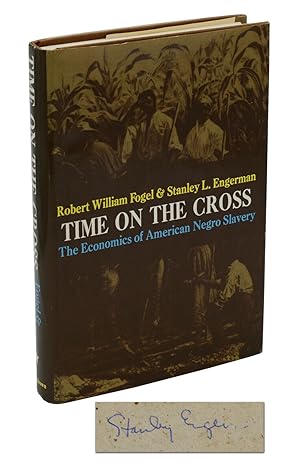
TIME ON THE CROSS: THE ECONOMICS OF AMERICAN NEGRO SLAVERY [Inscribed]
Fogel, Robert William [Author]; Engerman, Stanley L. [Author]
Language: English
Published by Little, Brown, Boston, Massachusetts; Toronto, Canada 1974
- Hardcover
- First Edition
- Signed
Seller: Second Story Books, ABAA, Rockville, MD, U.S.A.Second Story Books, ABAA
Contact seller4-star sellerCondition: Used
US$ 400.00
US$ 7.00 shippingShips within U.S.A.Quantity: 1 available
Hardcover. First Edition, First Printing. Octavo, 286 pages. In Very Good condition with Very Good condition dust jacket. Spine is black with white lettering. Dust jacket protected by mylar covering, price uncut: "$8.95" on front flap, has mild chipping to fore corners, mild shelving wear and creasing along spine head and tail,…and a 1.5in. closed tear along front head edge. Boards have mild shelving wear along spine head and tail, mild bumping to fore corners. Textblock head edge has moderate foxing, fore and tail edges have light foxing and soiling; front pastedown has light surface tearing and adhesive staining, likely from previous owner's bookplate (now removed). Inscribed "To Dick, Best Wishes" by Bob Fogel [Author] on title page. DL Consignment. Shelved Room C. 1400340. Special Collections.
 More images
Published by Little, Brown and Company, Boston 1974
- Softcover
- First Edition
- Signed
Seller: The Accidental Bookseller, IOBA, FABA, Boca Raton, FL, U.S.A.The Accidental Bookseller, IOBA, FABA
Contact seller5-star sellerCondition: Used - Near fine
US$ 300.00
US$ 6.00 shippingShips within U.S.A.Quantity: 1 available
Condition: Near Fine. Dust Jacket Condition: Very Good. First edition. Little, Brown and Company: Boston, 1974. First edition. Signed and dated by Fogel with a warm inscription to Henry Rosovsky, economist and academic administrator who served as dean of the Faculty of Arts and Sciences of Harvard University. Rosovsky is among a… large group of scholars cited in the book's Acknowledgments who contributed to the development of the book. The date of the inscription precedes by several weeks the New York Times' review of the book. Fogel went on to win the 1993 Nobel Prize for Economics for "having renewed research in economic history by applying economic theory and quantitative methods in order to explain economic and institutional change," according to the Nobel citation. In the biography Fogel wrote for the Nobel, he acknowledges Rosovsky for providing research assistants, a computer programmer, and the computer time needed to conduct his research while at Harvard in the late 1970s. This groundbreaking book reexamined the economic foundations of American slavery, marking "the start of a new period of slavery scholarship and some searching revisions of a national tradition" (C. Vann Woodward, New York Review of Books). The book generated somewhat of a firestorm of media coverage when it was first published due to its controversial hypothesis: that slavery was a highly efficient, profitable enterprise, that the South was generally flourishing economically on the eve of the Civil War, that the slaves were treated reasonably well, and that they had a standard of living compared favorably with many northern white industrial workers. "It is a rare monograph in economic history that gets reviewed in magazines and newspapers such as Newsweek , Time , The Atlantic Monthly , The New York Times , The Wall Street Journal and The Washington Post among others; or whose authors appear on television talk shows. Robert Fogel and Stanley Engerman's Time on the Cross was one such book â" perhaps the only one." A near fine copy in a very good dust wrapper owing to a tear on the rear panel.
 More images
Published by Little, Brown and Company, Boston 1974
- Hardcover
- First Edition
- Signed
Seller: Raptis Rare Books, Palm Beach, FL, U.S.A.Raptis Rare Books
Contact seller5-star sellerFirst edition of this work which attracted widespread attention in the media and generated heated controversy and criticism for its methodology and conclusions. Octavo, original brown cloth, 2 volumes. Both volumes are signed by Nobel Prize-winning economist, "RW Fogel 3/18/10." Each are near fine in very good to near fine dust…jackets. Jacket design by Sarah L. Bindari. Fogel and Engerman's groundbreaking books reexamined the economic foundations of American slavery, marking "the start of a new period of slavery scholarship and some searching revisions of a national tradition" (C. Vann Woodward, New York Review of Books).

Published by Little, Brown and Company, Boston 1974
- Hardcover
- First Edition
- Signed
Seller: Raptis Rare Books, Palm Beach, FL, U.S.A.Raptis Rare Books
Contact seller5-star sellerFirst edition of this work which attracted widespread attention in the media and generated heated controversy and criticism for its methodology and conclusions. Octavo, original brown cloth, 2 volumes. Both volumes are inscribed by both authors to the same recipient. Volume one is near fine in a near fine dust jacket with light…wear to the spine tips. Volume two is near fine in a fine dust jacket. Jacket design by Sarah L. Bindari. Fogel and Engerman's groundbreaking books reexamined the economic foundations of American slavery, marking "the start of a new period of slavery scholarship and some searching revisions of a national tradition" (C. Vann Woodward, New York Review of Books).
- Hardcover
- First Edition
- Signed
Seller: T. Cadman WW2 Books, Carmichael, CA, U.S.A.T. Cadman WW2 Books
Contact seller3-star sellerCondition: Used - Very good
US$ 200.00
US$ 6.50 shippingShips within U.S.A.Quantity: 1 available
Hardcover. Condition: Very Good. 1st Edition. Winidore (Richmond) 1999, first edition, #145 of 250 signed by the author, also inscribed by the author, 457 pp, photos, very good in pictorial hardcovers with no jacket as issued. Signed by Author(s).
 More images
Published by Little, Brown and Company, Boston 1974
- First Edition
- Signed
Seller: Burnside Rare Books, ABAA, Portland, OR, U.S.A.Burnside Rare Books, ABAA
Contact seller5-star sellerFirst Edition. First edition. Signed by co-author Stanley Engerman on front free endpaper. xviii, 286 pp. Brown cloth, spine lettered in gilt. Edges lightly foxed, else Fine in Near Fine unclipped dust jacket, light shelf wear, tiny nick to fore edge of back panel. Two economists' examination of the economics of American slavery…, which garnered lots of controversy and media attention-- much more than the average economic monograph. It won the Bancroft Prize in American history. Fogel would later win the Nobel Prize in Economic Sciences in 1993. Engerman is currently a Professor Emeritus at the University of Rochester.
 More images
Published by Boston, Toronto: Little, Brown and Company, 1974 1974
- First Edition
- Signed
Seller: Peter Harrington. ABA/ ILAB., London, United KingdomPeter Harrington. ABA/ ILAB.
Contact seller5-star sellerCondition: Used
US$ 3,082.27
US$ 29.26 shippingShips from United Kingdom to U.S.A.Quantity: 1 available
First edition, first printing, signed by the author on the half-title of each volume. The authors controversially argued, using sophisticated economic models, that American slavery was more economically profitable than previously believed, indeed more productive than free labour. In 1993 Fogel was awarded the Nobel Prize in Econ…omics (along with Douglass North) for developing "'new economic history', or cliometrics, i.e. research that combines economic theory, quantitative methods, hypothesis testing, counterfactual alternatives and traditional techniques of economic history, to explain economic growth and decline" (Nobel press release). 2 vols, octavo. Original brown cloth, spines lettered in gilt. With dust jackets. Jackets a little worn and scratched with two longer tears at head of spine panel of vol. II, unclipped: fine copies in good jackets.
- Signed
Seller: The Raab Collection, Ardmore, PA, U.S.A.The Raab Collection
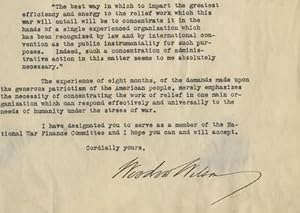
Contact seller4-star seller?The experience of eight months, of the demands made upon the generous patriotism of the American people, merely emphasizes the necessity of concentrating the work of relief in one main organization which can respond effectively and universally to the needs of humanity under the stress of war. I have designated you to serve as a… member of the National War Finance Committee and I hope you can and will accept.?On March 19, 1913, President Woodrow Wilson was named the first honorary president of the American Red Cross, establishing a precedent for all chief executives who have followed. His quotation ?I summon you to comradeship in the Red Cross? became a rallying cry, and decorated one of the most famous Red Cross posters - a young woman clutching an American flag with the Red Cross symbol and U.S. Capitol in the background.When the United States officially entered World War I on April 6, 1917, it had been raging in Europe since the summer of 1914. Bound by its government charter to support the U.S. military, the American Red Cross was championed by Wilson as he called upon the American people to back the organization in its support of millions of young men heading to the battlefields of Europe. On May 10, 1917, Wilson appointed a 13-man War Council to guide operations of the Red Cross during the conflict. The Red Cross held its first War Fund drive that year. As part of the war effort, the Red Cross began service to blinded war veterans, started its Canteen Service to provide refreshments to the military, introduced medical social work in servicemen?s hospitals, and began the Nurses? Aide program to make up for nurse shortages during wartime.Since 1914 the Red Cross had been providing relief to worn-torn European countries, first with doctors, nurses, and medical supplies on the SS Red Cross or Mercy Ship, and later with hospital garments, surgical bandages, and refugee clothing, sent to sister Red Cross societies, and produced by Americans recruited through the Women?s Bureau of the Red Cross. After the U.S. declaration of war, the Army and Navy regularly requested thousands of surgical dressings and what were referred to as ?comfort? items for their men. Comfort items included hand-knitted socks, sweaters, soap, razors and the like. Between 1917 and 1919, over 8 million American women, along with many Junior Red Cross members, produced over 370 million relief articles for the Allied armed forces and civilians in Europe.Cornelius N. Bliss, Jr., whose father was a member of President McKinley?s Cabinet, was a philanthropist who was also active politically. He participated in the successful presidential campaign of Theodore Roosevelt in 1904. In July 1916, he was named treasurer of the Republican National Committee, and also served as president of the Association for Improving the Condition of the Poor. When the United States entered World War I in 1917, President Wilson named Bliss as one of the 13 members of his Red Cross War Council. The next year he became its acting chairman. When it came time to raise funds for the Red Cross in 1918, Wilson formed the National War Finance Committee. With his experience in finance and as treasurer, it was natural that Wilson would want Bliss to serve on it.Typed letter signed, on American Red Cross letterhead, Washington, March 6, 1918, to Bliss, asking him to accept appointment to the National War Finance Committee. ?The Chairman of the War Council informs me that the American Red Cross will shortly appeal to the American people for additional funds to carry on its work. The close co-operation of the American National Red Cross with the military branch of the Government has suggested many new avenues of helpfulness in the immediate business of our organization for war, but in the present situation there are unlimited opportunities of broad humanitarian service, and the effective performance of the service is necessary in itself and in its relation to our master purpose of winning the war..


