

Order Total (1 Item Items):
Shipping Destination:

Tokyo Journal, Signed (6 results)
Skip to main search results
Search filters
Product Type
- All Product Types
- Books (6)
- Magazines & Periodicals (No further results match this refinement)
- Comics (No further results match this refinement)
- Sheet Music (No further results match this refinement)
- Art, Prints & Posters (No further results match this refinement)
- Photographs (No further results match this refinement)
- Maps (No further results match this refinement)
- Manuscripts & Paper Collectibles (No further results match this refinement)
Condition Learn more
- New (No further results match this refinement)
- As New, Fine or Near Fine (No further results match this refinement)
- Very Good or Good (6)
- Fair or Poor (No further results match this refinement)
- As Described (No further results match this refinement)
Binding
Collectible Attributes
Language (2)
Free Shipping
- Free Shipping to U.S.A. (No further results match this refinement)
Seller Location
Seller Rating
-

An amended note on ichthyology of the survey of the Myojin-sho, 1952, with special reference to a myctophid fish, Lampanyctus Lampanyctus punctatissimus Gilbert. Sonderdruck aus: Journal of the Tokyo University of Fisheries 41, 79-84.
Published by 1954, 1954
Seller: Wissenschaftliches Antiquariat Köln Dr. Sebastian Peters UG, Köln, Germany
Seller rating 5 out of 5 stars

Signed
Condition: gut. Abb., 28 cm, handschr. Widmung des Verfassers, Ecke leicht geknickt. Sprache: Englisch.
-
The Cambro-Ordovician formations and faunas of South Korea, Part X. Stratigraphy of the Chosen Group in Korea and southern Manchuria and its relation to the Cambro-Ordovician formations of other areas. Section D. The Ordovician of eastern Asia and other parts of the continent. Sonderdruck aus: Journal of the Faculty of Science, University of Tokyo 17: 163-316.
Published by 1969, 1969
Seller: Wissenschaftliches Antiquariat Köln Dr. Sebastian Peters UG, Köln, Germany
Seller rating 5 out of 5 stars
Signed
geheftet, ohne Einband. Condition: gut. 26 cm, handschr. Widmung des Verfassers, Heftung leicht rostig, geknickt, aus der Sammlung Alexander Tollmann. Sprache: eng.
-
A new aberrant form of the Cybiidae from Japan. Sonderdruck aus: Journal of the College of Africulture, Imperial University of Tokyo 7, 377-382.
Published by 1926, 1926
Seller: Wissenschaftliches Antiquariat Köln Dr. Sebastian Peters UG, Köln, Germany
Seller rating 5 out of 5 stars
Signed
Condition: gut. Abb., 27 cm, handschr. Widmung des Verfassers, mehrfach geknickt, gebräunt Sprache: Englisch.
-
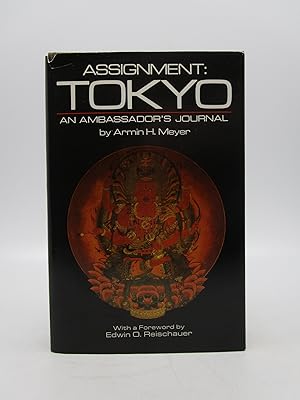
Assignment Tokyo: An Ambassador's Journal (Signed)
Seller: Shelley and Son Books (IOBA), Hendersonville, NC, U.S.A.
Association Member: IOBA
Seller rating 5 out of 5 stars
Signed
Hardcover. Condition: Very Good. Dust Jacket Condition: Very Good. First Printing. Inscribed by the author on half title page. First Printing. Two toned cloth. Dust jacket is not price clipped. Top fore-edge of textblock is age toned. xii, 396pp., index. Front inner hinge a bit worn. Signed by the author.
-
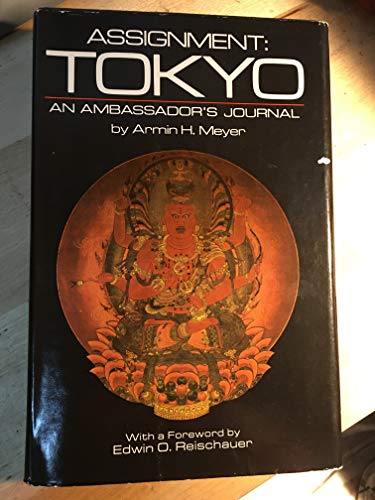
Assignment: Tokyo; An Ambassadors Journal
Language: English
Published by The Bobbs-Merrill Company, Inc, Indianapolis, 1974
ISBN 10: 0672519615 ISBN 13: 9780672519611
Seller: Ground Zero Books, Ltd., Silver Spring, MD, U.S.A.
Seller rating 5 out of 5 stars
First Edition Signed
Hardcover. Condition: Very Good. Dust Jacket Condition: Good. First Printing [Stated]. xii, 396 pages. DJ has some wear, tears and soiling. Some edge soiling. Inscription on half-title page reads: June 7, 1973. To Jean and Charles, With appreciation for so many kindnesses and with all good wishes for ever greater successes in service to our country. Armin H. Meyer. Includes Foreword by Edwin O. Reischauer., Acknowledgments, Appendix A, and Index. Chapters include Mission: Adjustment to the Realities of the 1970's; As Okinawa Goes, So Goes Japan; Mutuality and Mutability in Security Partnership; Detente with Mainland China: Nixon's Billiard Shot; Nixon Shock Number Two: Economic Reciprocity; Textiles: Taxing Tokyo's Tensile Strength; The Changing Art of the Possible; and Two Great Powers in Search of Their Roles. In Ambassador Meyer's words, the purpose of this book is to awaken greater public interest in the gravity of America's relationship with Asia's foremost power, and in the delicacy which must be exercised by those to whom responsibility for the relationship is entrusted. The partnership, so critical to peace in Asia, cannot be taken for granted. The postwar development of Japan has been nothing less than phenomenal. Within a quarter of a century, a nation which was physically devastated and morally crushed rose to become one of the world's three leading industrial powers. But with successes come new problems. By 1969, major adjustments to new realities were necessry--in Japan, and in the all-important relationship between Japan and the United States. This book is his account of the critical issues which were faced, and how they were handled. Armin Henry Meyer (19 January 1914, in Fort Wayne, Indiana - 13 August 2006) was an American diplomat who served as United States Ambassador to Lebanon (1961 to 1965), United States Ambassador to Iran (1965-1969), and United States Ambassador to Japan (1969-1972). Meyer graduated from Capital University in 1939. In 1941, he earned a master's degree in mathematics at Ohio State University. In 1943, Meyer joined the staff of the United States Office of War Information in Cairo. Meyer found his tenure in Japan to be "particularly challenging . because he faced the task of ?easing the shock of President Nixon's historic breakthrough to China.'". While in Japan, he led negotiations which ultimately let to the return of Japanese sovereignty in Japan. Richard Nixon creates a task force on international terrorism after Israeli athletes were killed at the 1972 Olympic Games in Munich. Meyer returned to the State Department to head the task force. Derived from a Kirkus review: As Ambassador to Japan, Meyer rode out some world-historic storms. Above all there came the crisis of August 15, 1971, when the U.S. announced the New Economic Policy. Japanese export levels and Japanese hopes of postponing a yen revaluation fell overboard at once. Meyer says that neither he nor Tokyo was informed ahead of time. He reviews American-Japanese discussions before and after this economic contretemps with a censure of popular protest -- which seem to have endeared him to his authoritarian-minded Japanese counterparts like Kiichi Aishi. Meyer describes his "lifelong creed" thus: "Accentuate the positive; don't accept the negative." This disposition came in handy for soothing Japanese worries about Nixon's China policy. Bilateral "discretion" explains both the difficulties and the successes of these 1969-1972. rounds, whose merely tenuous connection with real decision-making is what Meyer's tizzy in August 1971 signifies. He's obviously told us only a fraction of what he knows.
-
Journal of the Faculty of Science, Imperial University of Tokyo - Section II: Geology, Mineralogy, Geography, Seismology Vol. III, Part 7
Published by Imperial University of Tokyo, Tokyo, 1933
Seller: UHR Books, Hollis Center, ME, U.S.A.
Association Member: MABA
Seller rating 5 out of 5 stars
First Edition Signed
Soft cover. Condition: Good. No Jacket. First Edition. Inscribed and SIGNED by the AUTHOR on the top of the front cover. RARE copy of this illustrated, early 20th century work from Japan. This Volume III, Part 7 of the work encompasses a "Faunal Study of the Wanwanian (Basal Ordovician) Series with Special Notes on the Ribeiridae and the Ellesmereoceroids". Illustrated with 10 black-and-white plates. Light exterior wear/fading/marks, inked name on front cover and title page; else interior is in very good condition. SIGNED BY AUTHOR. Book.

